MercoPress. South Atlantic News Agency
Tag: Falklands sovereignty
-
Friday, October 23rd 2026 - 10:25 UTC
US confirms concern over the impact of Argentina’s Falklands bill on its companies
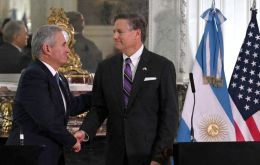
US Deputy Secretary of State Christopher Landau acknowledged in Buenos Aires on Thursday that Washington is closely watching the impact that Argentina’s National Sovereignty Defence bill, which toughens sanctions against those involved in hydrocarbon exploitation in the Falklands, could have on its companies. Argentine Foreign Minister Pablo Quirno defended the initiative.
Add your comment! -
Tuesday, October 13th 2026 - 18:45 UTC
London says it will abide by any law of the sea provisional measures as it moves to shield its companies
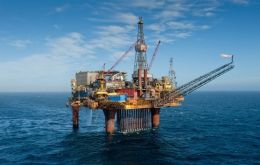
The British government said on Tuesday that any provisional measures ordered by the International Tribunal for the Law of the Sea are binding and that the United Kingdom complies with its international obligations, on the same day Argentina asked that tribunal to halt the Sea Lion oil project in Falklands waters. In parallel, London announced it will use its protection of trading interests legislation to shield British companies from Argentine sanctions.
-
Tuesday, October 13th 2026 - 09:13 UTC
“Falkland Islanders will is to remain British, and we will uphold it”, PM Burnham told Trump
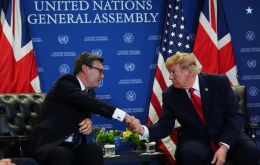
“In my meeting with President Trump I raised the Falkland Islands and the clear and declared will of the Islanders to remain British”, revealed United Kingdom Prime Minister Andy Burnham in an oral statement to the House of Commons this Monday.
-
Monday, October 12th 2026 - 07:10 UTC
Brexit campaigner Daniel Hannan warns a US shift on the Falklands would wreck the Atlantic alliance
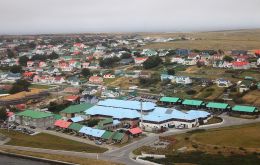
Daniel Hannan, one of the leading strategists of the Brexit campaign and director general of the Institute of Economic Affairs (IEA), has warned in the Washington Examiner that a change in the US position on the Falklands would put the Atlantic alliance at risk. His column responds to one by economists Walter E. Block and Ege Fakkusoglu defending Argentina’s claim to the archipelago.
-
Monday, October 5th 2026 - 10:20 UTC
Falklands weighs curbs on Argentine visitors after flag-waving incidents
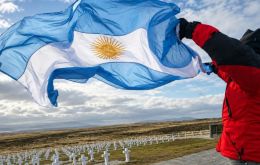
Amid a sharp rise in international attention on the South Atlantic and its energy resources, Falkland Islands residents have been angered by Argentine visitors seen waving Argentine flags and banners denying British sovereignty, prompting calls from members of the community to restrict such visits.
-
Thursday, October 1st 2026 - 09:32 UTC
Uruguay's foreign minister separates the “invaded island” from the money extracted from the Falklands
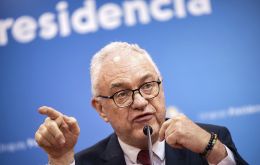
Uruguay's Foreign Minister Mario Lubetkin argued that the Falklands dispute has changed in nature with oil exploration: one thing, he said, is “the invaded island” and “the fight against colonialism”, and another is “when a lot of money is taken from there”. His remarks come as Yamandú Orsi's government considers buying two patrol vessels from the Royal Navy, a deal that has already prompted a resolution from twenty deputies of Argentine President Javier Milei's party.
-
Monday, September 28th 2026 - 09:33 UTC
London says Argentina “lacks the ability” to take the Falklands
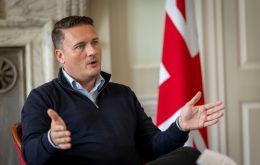
British Defence Secretary Wes Streeting said Argentina “lacks the ability” to take the Falkland Islands and that the United Kingdom “has the ability to defend” them, in an interview with the Sunday paper The Sun on Sunday published on Saturday. Asked whether London could protect the archipelago militarily if Buenos Aires sent warships, he answered yes.
-
Wednesday, September 23rd 2026 - 17:54 UTC
Milei at the UN: “The Malvinas are a national cause for us”
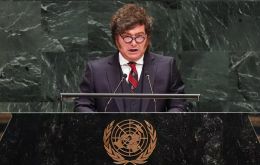
Argentine President Javier Milei called on the United Nations General Assembly on Wednesday to act over what he described as unilateral British actions in the Falklands, and accused the organisation of having “decided to look the other way” on the dispute. “The Malvinas are a national cause for us,” he said, repeating the phrase twice at the start of his address.
-
Wednesday, September 23rd 2026 - 09:49 UTC
Burnham at the UN: “the rights of British territories to remain British”
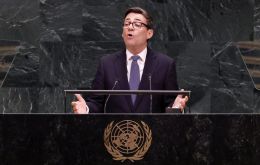
British Prime Minister Andy Burnham placed the Falklands among the challenges to the rule of law in his first address to the United Nations General Assembly, delivered on Tuesday evening in New York, setting them in the same sentence as Russia.
-
Saturday, September 19th 2026 - 09:32 UTC
UK calls Argentine action against Falklands companies “unacceptable”
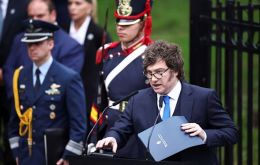
Britain's Minister for the Overseas Territories, Uma Kumaran, on Friday described as “unacceptable” and carrying “no legal justification” the proceedings Argentina has opened against companies and individuals linked to economic activity in the Falklands, and said the United Kingdom's diplomatic network fully backs those targeted.