MercoPress. South Atlantic News Agency


Falklands’ stamps and the story of the only reindeer world population unaffected by the Chernobyl radioactive fallout
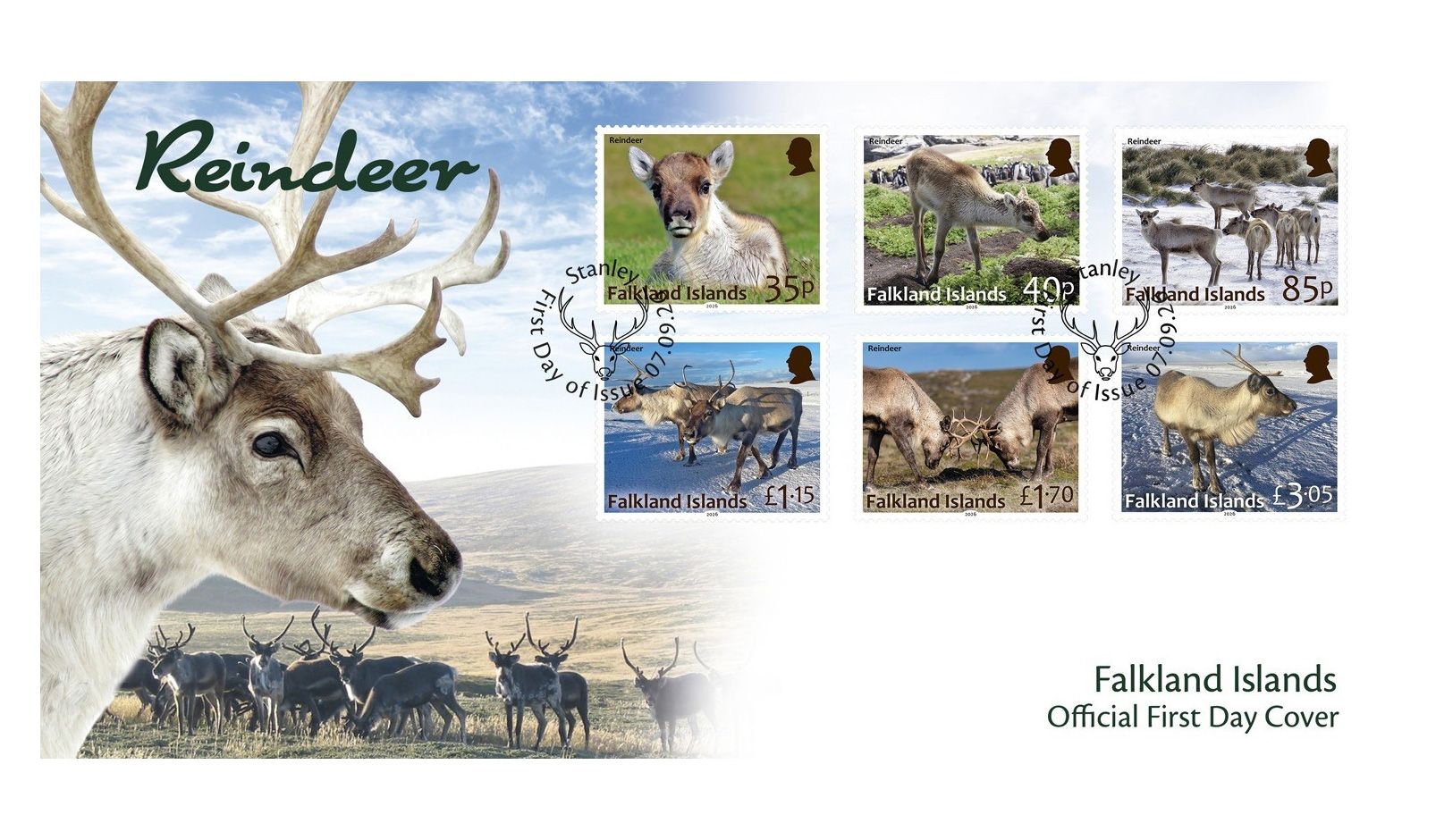 Official first day cover
 One of the latest Falkland Islands Post Philatelic office is dedicated to the South Georgia reindeer, introduced by the Norwegian whalers and how they adapated to Southern Atlantic climate, living conditions and were later transferred to the Falklands.
Reindeer are native to the northern hemisphere but came to the Falklands from South Georgia. They are renowned for their incredible survival skills in freezing environments, for which they are ideally suited.
They have a brilliant winter coat comprising two layers of fur. A soft and dense undercoat that’s covered by a long, coarse outer layer of hollow hairs. These trap air and provide such excellent insulation that even snow falling on them doesn’t melt. Their eyes are a scientific marvel and change colour with the seasons. In the summer, they are a beautiful gold, changing to a deep blue as summer fades to winter, helping them to see better in the low winter light. Their long slim legs contain a high concentration of oleic acid which helps to prevent freezing. This combined with a system of intertwined arteries and veins allows reindeers to have a unique way to regulate their body temperature, even in deep cold. Also, their uniquely structured noses really do glow red. They are full of blood vessels which warm up the cold air as they inhale, enabling them to survive in their native habitats, even when the air temperature can drop to -40 °C.
Reindeer are unique amongst more than 40 members of the deer family as both males and females grow antlers, which are shed annually. Both sexes finish growing their antlers at the same time, but expectant females tend to shed theirs later into springtime, better equipping them to dig through the snow and to defend feeding spots without having to compete with antlerless males. Norwegian whalers introduced reindeer to South Georgia in the early 1900s. They provided a familiar food source to the whalers who would otherwise have had a very limited diet, were a reminder of home and hunting them provided a recreational activity. Reindeer were introduced to two discreet areas of South Georgia on three occasions between 1909-1925.
The reindeer thrived well, substituting their usual lichen diet with tussac grass and burnet. By the turn of the century the original 33 introduced reindeer had increased in number to several thousand. As the whaling industry came to an end in the 1960s and regular culls ceased in the 1980s, the reindeer population increased to over 6,000. With their range limited by natural glacial borders herds became increasingly dense and were having a significant impact on flora and fauna, to the point where their presence was destroying the island’s habitats and threatening some bird species with extinction. This prompted the decision to eradicate the reindeer to protect local biodiversity. The programme was carried out between 2013 and 2015 with the involvement of animal welfare professionals.
These South Atlantic reindeer possessed a unique genetic heritage, as they were the only reindeer population in the world entirely unaffected by the radioactive fallout from the Chernobyl nuclear disaster. In order to preserve this unique genetic pool of the South Georgia herds, and in order to help diversify agriculture in the Falkland Islands, 59 South Georgian reindeer calves were translocated to the Falklands in 2001 by the Falkland Island Government where they became the basis of well managed commercial herds, their first offspring being produced in 2003. Initially the calves were held in the FIG quarantine paddock whilst they underwent treatments. They were then moved to the Falkland Islands Department of Agriculture managed farm Saladero.
Some years later the herd was dispersed; some to Weddell Island and most to West Lagoons farm in the northwest of West Falklands. They didn’t thrive there and were eventually rounded up and moved to Albemarle where they remain to this day. In 2002 and 2003 a further two privately funded translocation expeditions were undertaken by Jérôme Poncet, importing a further 31 reindeer to Beaver Island in the Falkland Islands, where they still flourish. While not a massive commercial industry, the Falklands maintain small, localized populations of these wonderful animals.
Design Bee Design
Photography 35p, £1.15 & £3.05 - Donna Evans 40p, 85p - Juliette Hennequin £1.70 - Jérôme Poncet FDC - Jérôme Poncet & Dept. of Agriculture
Design Bee Design. Photography 35p, £1.15 & £3.05 - Donna Evans 40p, 85p - Juliette Hennequin £1.70 - Jérôme Poncet FDC - Jérôme Poncet & Dept. of Agriculture
Printer Cartor Security Printing; Process Stochastic Lithography; Perforation 13¼ x 13 per 2cms; Stamp Size 38 x 30.6mm; Sheet Layout 10
Production Co-ordination Creative Direction (Worldwide) Ltd


Top Comments
Disclaimer & comment rulesCommenting for this story is now closed.
If you have a Facebook account, become a fan and comment on our Facebook Page!