MercoPress. South Atlantic News Agency



EU proposes Canada as its first 'associate member', a status that does not yet exist
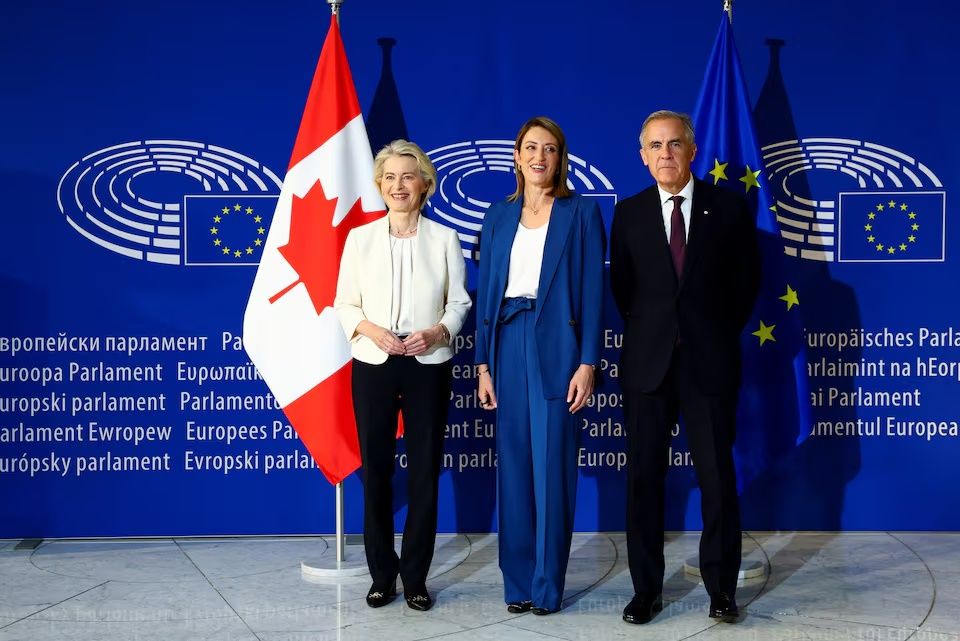 Full membership is not on the table: Article 49 of the Treaty on European Union reserves membership for European states
 European Commission President Ursula von der Leyen proposed on Wednesday that Canada become the European Union's first “associate member,” a status not provided for in the bloc's treaties and whose details have not been defined.
“I would like to work with you on opening the door for Canada being the first associate member of the EU,” von der Leyen said during her annual State of the Union address in Strasbourg, addressing Canadian Prime Minister Mark Carney, a special guest of the European Parliament seated in the front row. The proposal drew a standing ovation. Carney is due to address the chamber on Thursday.
Full membership is not on the table: Article 49 of the Treaty on European Union reserves membership for European states. The bloc has also been reluctant in the past to entertain flexible categories of membership.
Von der Leyen further proposed moving from the Comprehensive Economic and Trade Agreement, known as CETA, to what she called an “alliance for the future,” aimed at creating a common prosperity and economic security space, with cooperation on technology, critical raw materials, energy and defense. She said the Union must urgently reimagine its partnerships and stressed the initiative “is not an alliance against anyone else.”
Carney's office welcomed the proposal, saying Canada is deepening ties with the European Union to strengthen its sovereignty. Canada's ambassador-designate to the bloc, Jonathan Wilkinson, told reporters, however, that the two sides remain far from landing an agreement.
The rapprochement responds to the trade war with the United States, destination of around 70% of Canadian exports. US President Donald Trump has imposed tariffs on Canada and has repeatedly suggested the country become the 51st state, an idea Carney rejects. Canada and the European Union had already launched a strategic partnership in 2025, whose implementation they reviewed in November.
Bilateral trade in goods and services reached €130.8 billion last year, some US$151 billion, according to the European Commission, an increase of more than 80% over the past decade. The Union is Canada's second largest trading partner. CETA eliminated 99% of tariff lines when it provisionally entered into force in 2017, though ten member states have yet to ratify it.
Finland's President Alexander Stubb had set out on June 3 a vision of a Union of up to forty states including Canada, the United Kingdom, Türkiye, Norway and Iceland, asking whether it would not be preferable for Canada to be the Union's 28th state rather than the United States' 51st. In March, French Foreign Minister Jean-Noël Barrot suggested Ottawa might accede at some point.
Support in Canada is not unanimous. A survey by pollster Abacus Data put backing for deeper cooperation with the bloc at around 80% and support for eventual accession at 49%; the poll does not specify sample size or margin of error. Conservative opposition leader Pierre Poilievre called Carney's effort misplaced and said Canada will be neither the 51st state of the United States nor the 28th of the European Union.


Top Comments
Disclaimer & comment rulesCommenting for this story is now closed.
If you have a Facebook account, become a fan and comment on our Facebook Page!