MercoPress. South Atlantic News Agency

Milei sends Congress his Falklands sovereignty bill, with an anti-terrorism registry attached
 The bill creates a National Security Council, chaired by Milei, empowered to order “urgent measures.” Photo: REUTERS/Mariana Nedelcu
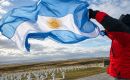
 Argentina's government sent Congress a National Sovereignty Defense Bill on Thursday, presented by President Javier Milei as “a milestone in the process of recovering” the Falklands, a text that toughens penalties for exploiting natural resources in the disputed area and also creates a registry of people linked to terrorism that does not require a prior criminal case.
The bill, signed by Milei alongside Cabinet Chief Diego Santilli and ministers Pablo Quirno, Carlos Presti and Luis Caputo, replaces Law 26,659, in force since 2011, and broadens its scope: no longer just hydrocarbons, but any natural resource, renewable or not, on the Argentine continental shelf. According to the official statement, it rests on three pillars: “punishing those who illegitimately exploit our natural resources; creating incentives for them to stop that conduct; and equipping the national state with tools to protect itself against external threats.” Companies that are barred would risk being unable to operate anywhere in the country, beyond their activity linked to the archipelago.
The bill creates a National Security Council, chaired by Milei, empowered to order “urgent measures” in the face of a grave and imminent threat: restricting foreign exchange and financial operations, temporarily freezing funds and assets, suspending authorizations or contracts, and restricting foreign trade. It also authorizes the armed forces to intervene in protecting facilities deemed strategic.
The most contested element is the creation, with legal status, of the Public Registry of Persons and Entities Linked to Acts of Terrorism and Its Financing (RePET), run by the Financial Information Unit. Inclusion in the registry “will not be conditioned on the existence of a criminal case”: “reasonable grounds for suspicion” of a link to terrorism suffice, or a designation by the UN Security Council. The measure immediately triggers the freezing of funds and assets and disqualification from contracting with the state, though the unit must subsequently notify a federal judge for ratification. The bill also creates a specific offense, carrying five to fifteen years in prison, for providing material support to terrorist organizations, and bars contributions from foreigners without permanent residency to political parties and campaigns.
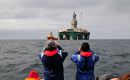
Hours before the bill reached Congress, federal judge Mariel Borruto, of Río Grande, Tierra del Fuego, had granted an injunction — an environmental matter, unrelated to the government's bill — filed on September 1 by the Falklands War Veterans Center of La Plata and the Civil Association of Environmental Lawyers. The judge ordered Rockhopper Exploration and Navitas Petroleum Development and Production to refrain from starting or continuing work on the Sea Lion project, which envisions 23 wells, and called the environmental risk “neither hypothetical nor remote.” She stated explicitly that the ruling does not amount to a final finding on the companies' liability nor resolve the sovereignty dispute with the United Kingdom, which, along with the companies, maintains that Argentina has no jurisdiction to apply its law in the archipelago.
The bill drew immediate criticism, including from sectors aligned with the sovereignty claim. Cecim's lawyer, Jerónimo Guerrero Iraola, warned that the National Security Council, as drafted, amounts to “sweeping away the democratic and constitutional boundaries separating internal security from defense.” Socialist deputy Esteban Paulón argued that, “behind a heartfelt cause and a call for national unity,” the government seeks to “concentrate all power over public security” and “install a generalized state of suspicion.”
On Wednesday, in an interview with streaming channel Neura, Milei rejected the idea that the campaign over the islands responds to electoral calculation ahead of the 2027 election, in which he will seek reelection: “Political analysts say we pushed Malvinas for image reasons and political opportunism. That's a massive stupidity,” he said, adding that the strategy had been in the works for three years and that the trigger was a remark by US President Donald Trump about reviewing his country's neutral stance in the dispute.


Top Comments
Disclaimer & comment rules-

-

Read all commentsA sovereignty claim without a case can only be described as worthless. Good for fools and indoctrinated minds.
Sep 19th, 2026 - 01:47 pm 0As far as I am concerned, this bouffanted clown should be immediately proclaimed a terrorist. The posters would be pretty funny, and and a reward should be offered...
Sep 20th, 2026 - 06:08 pm 0Commenting for this story is now closed.
If you have a Facebook account, become a fan and comment on our Facebook Page!