MercoPress. South Atlantic News Agency



Brazil reaches the election with its top court under suspicion and the candidates tied
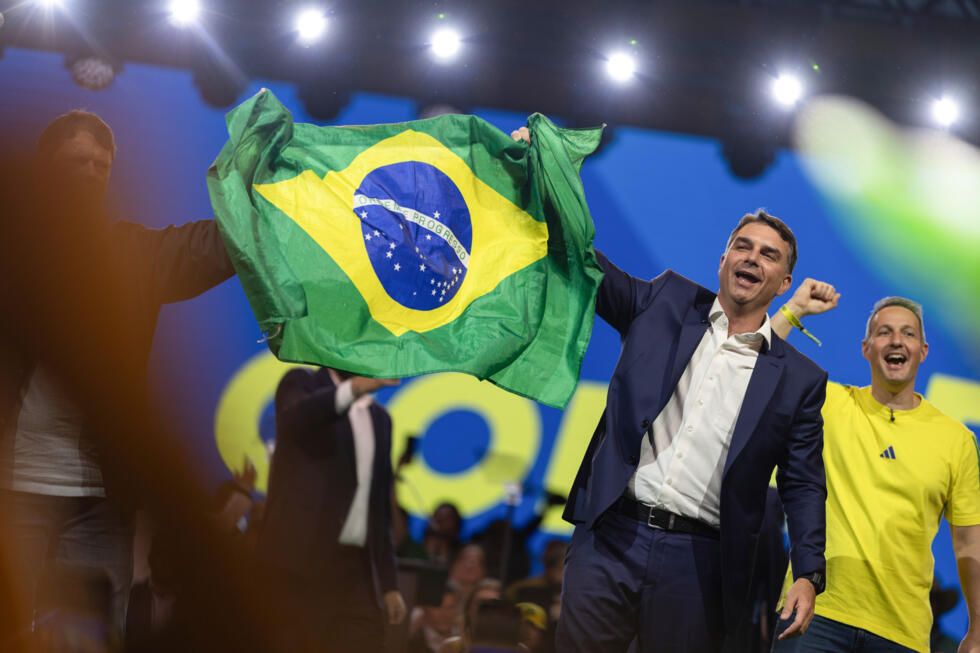 Flávio Bolsonaro has said that, if he wins, his priorities will be to grant his father an amnesty and to bring Brazil into the security alliance Trump is promoting in the region
 Brazil votes next Sunday in a presidential election that arrives with the Supreme Federal Court mired in its worst institutional crisis since the return to democracy, the right's candidate formally under investigation in the same case, and the two leading contenders tied within the margin of error in every poll.
The Banco Master case, in which the bank's former owner, Daniel Vorcaro, was arrested on Supreme Court orders over an alleged fraud of up to 12 billion reais, has reached both Senator Flávio Bolsonaro and several justices of the court itself. The Liberal Party candidate has been formally under investigation since July for alleged money laundering, currency evasion and corruption, focused on his contacts with Vorcaro and on the financing of “Dark Horse”, a film about his father. There is no formal indictment or conviction. In February, a Brasília judge ordered the removal of false online content claiming an arrest warrant existed against him.
The institutional dimension came later. The law firm of Justice Alexandre de Moraes's wife held a contract with the bank, and a police report revealed around a hundred messages between Vorcaro and the justice three weeks before his arrest. Justice André Mendonça, appointed by Jair Bolsonaro and responsible for a central part of the investigation, acknowledged receiving Vorcaro once and defended the lawfulness of his conduct. The court's president, Edson Fachin, ordered the case files unsealed. No irregularity has been established regarding any of the justices. Flávio Bolsonaro called at a São Paulo rally for Moraes's removal and demanded that other cases also be made public, including one involving a son of Lula.
Polling remains stable. The latest Datafolha survey, conducted last Tuesday and Wednesday among 2,002 voters with a two-point margin, gave Lula 40% and Bolsonaro 36% in the first round, and 47% to 45% in a prospective October 25 runoff. Earlier surveys by Quaest, BTG/Nexus and AtlasIntel produced different results, all within their margins. Neither man approaches the 50% plus one needed to win outright.
Jair Bolsonaro, 71, was sentenced on September 11, 2025 to 27 years and three months in prison for attempting a coup and four other offences, alongside seven allies of what the court called the plot's core group. He is barred from office and is under house arrest with an electronic tag, granted in March on humanitarian grounds after pneumonia. In May a law was enacted allowing applications for sentence reductions, which are not automatic. He designated as his successor his eldest son, a senator for Rio de Janeiro after 16 years as a city councillor, despite establishment preferences for a candidate without the family name.
Researchers quoted by the Brazilian press attribute Bolsonarismo's electoral resilience to the combination of a discourse centred on moral questions with the growth of evangelical churches in urban peripheries. “Bolsonaro did not create moral conservatism. He did not bring broad evangelical sectors into politics, nor did he create the Brazilian far right. What he did was assemble those elements very effectively around a candidacy,” says political anthropologist Mercia Alves, of the Centro Brasileiro de Análise e Planejamento. David Magalhães, of the Observatório da Extrema Direita, says suspicions surrounding the court feed the idea that the former president is “a victim of a system”.
Flávio Bolsonaro has said that, if he wins, his priorities will be to grant his father an amnesty and to bring Brazil into the security alliance Trump is promoting in the region, from which the country was left out after Lula rejected the designation of the PCC and Comando Vermelho as terrorist organisations.


Top Comments
Disclaimer & comment rulesCommenting for this story is now closed.
If you have a Facebook account, become a fan and comment on our Facebook Page!