MercoPress. South Atlantic News Agency
Argentina
-
Wednesday, July 8th 2026 - 07:20 UTC
Milei plans US-style government shutdown mechanism to cap Argentina's spending

Argentine President Javier Milei announced on Tuesday that he will send Congress a bill to introduce a government “shutdown” mechanism, modeled on the US system, that would bar the executive from continuing to spend once budget allocations run out. The measure is part of a package of economic reforms with which the president aims to relaunch his administration.
-
Monday, July 6th 2026 - 20:12 UTC
Argentine lawmaker files criminal complaint against Milei over US military exercises
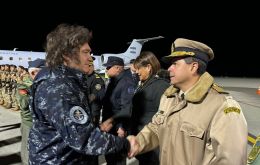
An opposition lawmaker has filed a criminal complaint against President Javier Milei and four current and former government officials for authorizing, by decree, the entry of US troops that took part in military exercises on Argentine soil without congressional approval.
-
Sunday, July 5th 2026 - 20:51 UTC
Argentina sends fresh rescue brigades to Venezuela as most foreign teams begin to withdraw
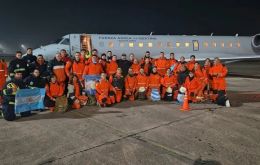
A new contingent of Argentine rescue workers left for Venezuela on Sunday to relieve the search-and-rescue teams deployed after the June 24 twin earthquake, which according to the official toll has left 2,954 dead and more than 16,500 injured. The dispatch coincides with the start of the withdrawal of most international missions, at the point when operations are shifting away from rescuing survivors toward the recovery phase.
-
Saturday, July 4th 2026 - 06:43 UTC
Argentina survives a scare from debutant Cape Verde to reach the World Cup quarterfinals
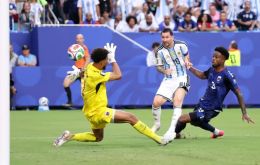
Argentina beat Cape Verde 3-2 on Friday, in a match settled in extra time, to reach the quarterfinals of the World Cup being held in the United States, Mexico and Canada. The side coached by Lionel Scaloni had to dig deep to overcome a debutant that pushed the tie to the limit at the Miami stadium.
-
Friday, July 3rd 2026 - 09:58 UTC
Mercosur backs Argentina days after Islanders' UN appeal for self-determination
Within the span of a week, the two opposing positions in the Falklands dispute were laid out clearly in two separate arenas: South American governments' backing for Argentina's sovereignty claim, and the defense of self-determination that two representatives of the Islanders took to the United Nations. Neither pronouncement was a reply to the other, but together they illustrate the distance between two hard-to-reconcile logics.
-
Friday, July 3rd 2026 - 07:53 UTC
Milei abolishes the Interior Ministry, expanding Santilli's role ahead of Congress talks

Argentina's government abolished the Interior Ministry and transferred its functions to the cabinet chief's office, headed by Diego Santilli, through an emergency decree published on Thursday in the Official Gazette. The measure places the political relationship with governors, provinces, municipalities, the City of Buenos Aires and Congress under the coordinating minister's remit, along with powers over the electoral system and political parties. With the change, the national cabinet is reduced to eight ministries.
-
Friday, July 3rd 2026 - 07:47 UTC
Snow blankets Mar del Plata as a record polar cold wave grips Argentina
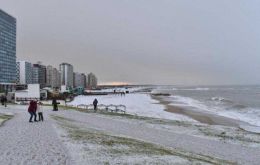
The seaside city of Mar del Plata, one of the main tourist destinations on Argentina's Atlantic coast, woke up covered in snow on Thursday, an unusual sight for a temperate-climate city that became the most widely shared image of the intense polar cold wave sweeping the country. Thermometers read around 1 degree below zero, with a wind-chill close to -3 °C, and snow and sleet were recorded from the early hours in various parts of the General Pueyrredón district, with heavier accumulation in the Sierra de los Padres area.
-
Thursday, July 2nd 2026 - 22:12 UTC
Argentine ex-official Insaurralde seeks to bar the cash-stacks video from his graft case

The former cabinet chief of Buenos Aires province and ex-mayor of Lomas de Zamora, Martín Insaurralde, asked the courts not to use as evidence the video in which his ex-wife, television host Jesica Cirio, appears alongside stacks of dollars in the closet of the house they shared, as part of a case for alleged illicit enrichment and money laundering. The motion, filed before federal judge Luis Armella, mirrors the one Cirio herself had made days earlier; she also faces a pending order to give testimony.
-
Thursday, July 2nd 2026 - 09:55 UTC
A Spanish investigation tracks how Asia's squid fleet is upending the South Atlantic market
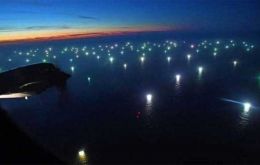
An international investigation published by the Spanish newspaper El Confidencial, with an extensive interactive report, describes how the expansion of Asian fishing fleets in international waters —mainly Chinese— has transformed the global market for frozen squid, with a direct impact on the European fleet and consequences for fishing in the South Atlantic, one of the main sources of income for the Falklands.
-
Thursday, July 2nd 2026 - 08:54 UTC
Milei focuses on his domestic agenda after the Adorni reshuffle, forgoing a US trip
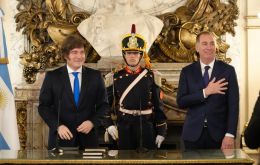
Argentine President Javier Milei will prioritize his domestic agenda in the coming days and will not travel to the United States for that country's Independence Day celebrations on July 4, official sources confirmed. The decision comes amid a reshaping of his cabinet following the departure of his cabinet chief, Manuel Adorni, and marks the second time in a matter of days that the president has set aside an international commitment to focus on domestic matters.

