MercoPress. South Atlantic News Agency
Economy
-
Monday, October 14th 2013 - 05:31 UTC
IMF warns US default means massive disruption and world recession

The head of the International Monetary Fund, Christine Lagarde, has warned that a US default could tip the world into recession. In a US TV interview she said a default would result in “massive disruption the world over”.
-
Sunday, October 13th 2013 - 12:14 UTC
Bye, bye Mercosur: Brazil advances on its own in trade agreement with EU

Mercosur has many internal problems and therefore it is much easier to work with Brazil, said European Commission Vice-President for Industry and Entrepreneurship Antonio Tajani who spent this week two days of negotiations with top officials in Brasilia.
-
Saturday, October 12th 2013 - 22:11 UTC
Argentina and Brazil blast IMF for its excess of pessimism regarding emerging economies

Argentina and Brazil strongly questioned the IMF generalized “excess of pessimism” because of a slowing down in emerging economies but also underlined that these countries have the sufficient ‘training’ and recent experience to confront the new challenges.
-
Saturday, October 12th 2013 - 22:08 UTC
IMF calls for financial markets to be monitored by political supervision

Central banks should be independent in setting monetary policy but they should also be tasked with monitoring financial market stability under political supervision, the International Monetary Fund's (IMF) chief economist said.
-
Saturday, October 12th 2013 - 21:55 UTC
Argentina denies having set any ultimatum regarding the pulp mill controversy with Uruguay
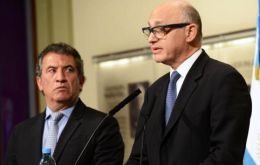
The Argentine Foreign ministry denied on Friday it had given a two-day ultimatum to Uruguay to suspend the decision allowing the controversial Botnia/UPM pulp mill a production expansion and also demanded an immediate return to bilateral negotiations.
-
Friday, October 11th 2013 - 18:24 UTC
Three million Spaniards living in extreme poverty, and becoming chronic says Caritas

The number of Spaniards living in severe poverty has doubled to 3 million since the economic crisis erupted in 2008, according to a report released by the Caritas charity, taking as poverty line those who live on less than 307 €euros (414 dollars) a month.
-
Friday, October 11th 2013 - 13:28 UTC
Venezuela inflation soars to 49%; Maduro promises more dollars to help with imports
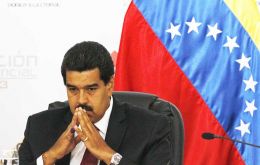
Venezuela's annual inflation rate rose to 49.4% in September, from 45.4% in August. Consumer prices increased 4.4% month-on-month, the central bank said, compared with 3.0% in August. It was the highest annual rate since the Venezuelan government changed the formula used to calculate the figure five years ago.
-
Friday, October 11th 2013 - 13:23 UTC
Argentina September ‘Congress index’ inflation 2.11% and 25.44% in twelve months

Argentina’s “Congress” Consumer Price Index which is an average of private consultants and is released by opposition lawmakers, showed that inflation in September increased 2.11%, the highest September since 1991, accumulating 25.44% in the last twelve months.
-
Friday, October 11th 2013 - 13:15 UTC
Foreign direct investment in Latam remains strong and increases 6% in first half of 2013
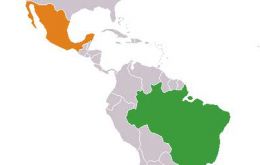
Foreign direct investment (FDI) to Latin America displayed moderate growth in the first half of this year, compared with the 2012 similar period, according to the Economic Commission for Latin America and the Caribbean (ECLAC). The 13 countries of the region that provided data received 102.951 billion dollars, which was 6% higher than the first six months of the previous year.
-
Friday, October 11th 2013 - 13:11 UTC
Paraguay congress votes 10% export tax on grains and soybeans. Cartes expected to veto the bill

A controversial bill imposing a 10% tax on grains and oil seeds exported in their natural state was finally approved by the Paraguayan congress. The bill presented in 2012 was passed in the Senate, rejected in the Lower House and again ratified by the Upper House, however Deputies could not round up the necessary 53 votes to again reject it.

