MercoPress. South Atlantic News Agency
Economy
-
Tuesday, May 12th 2026 - 13:14 UTC
Argentina sees new university protest as government pledges post-march dialogue

Argentina's public universities are staging the fourth Federal University March on Tuesday against the budget adjustment imposed by Javier Milei's government, with the main rally in Plaza de Mayo and simultaneous mobilizations in the country's major cities, while the national administration announced it will meet with rectors after the protest to discuss the allocation of funds for university hospitals. The day combines a strike with suspended classes, a broad opposition turnout, and an official discursive shift aimed at opening a dialogue channel without yielding on the substance of the dispute.
-
Monday, May 11th 2026 - 20:32 UTC
Milei government cuts nearly 1.79 billion dollar from budget with sharp education adjustment

The government of Javier Milei amended Argentina's 2026 budget on Monday with a cut of nearly 2.5 trillion pesos (around 1.79 billion dollars at the parallel exchange rate) —equivalent to approximately 1.6% of the total— in an administrative decision that deepens the adjustment effort to sustain the fiscal surplus target agreed with the International Monetary Fund. The measure, signed by Chief of Staff Manuel Adorni and Economy Minister Luis Caputo, comes one day before the fourth Federal University March, called for Tuesday with its main event in Plaza de Mayo.
-
Monday, May 11th 2026 - 03:55 UTC
Trade, Iran and Taiwan dominate agenda of Trump-Xi summit beginning Wednesday in Beijing
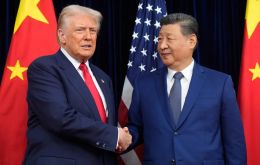
China confirmed on Monday that US President Donald Trump will pay a state visit from 13 to 15 May at the invitation of his Chinese counterpart, Xi Jinping. It will be the first trip by a US president to the country in nearly a decade —since Trump's own November 2017 visit— and will unfold against the backdrop of the US war against Iran, the fragile trade truce between the two powers, and the dispute over Taiwan's sovereignty.
-
Friday, May 8th 2026 - 05:08 UTC
Lula and Trump declare bilateral relationship reset after three-hour meeting at the White House
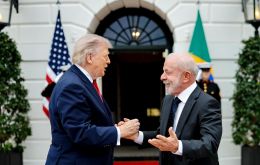
The presidents of Brazil, Luiz Inácio Lula da Silva, and the United States, Donald Trump, held a meeting of close to three hours at the White House on Thursday in which both leaders declared an end to one of the most severe bilateral crises in two centuries of relations between the two largest economies in the Americas. The encounter, formalized as a working meeting, unfolded in a climate of personal fluency and allowed for the agreement to establish bilateral channels to address commercial, security, and regional cooperation matters.
-
Friday, May 8th 2026 - 01:20 UTC
Falklands brace for Middle East fallout with fuel, shipping and supply contingencies
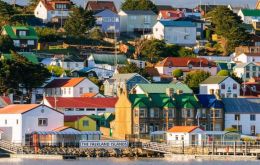
The conflict in the Strait of Hormuz and its consequences for the global supply of oil and other derivative products have not bypassed the Falkland Islands, which, as one local lawmaker put it, sit “at the tail end of global distribution.”
-
Thursday, May 7th 2026 - 09:31 UTC
Brazil central bank cuts Selic interest rate 25 points to 14.50%

Brazil’s Central Bank following its two days meeting 28–29 April of the Monetary Policy Committee (COPOM) announced the reduction of its SELIC rate by 25 basis points to 14.50%.
-
Wednesday, May 6th 2026 - 12:14 UTC
Uruguay's president meets Brazilian executives in São Paulo to open 'new phase' of commercial ties

Uruguayan President Yamandú Orsi made a day trip to São Paulo on Tuesday to meet Brazilian business leaders interested in investing in Uruguay, in an agenda Foreign Minister Mario Lubetkin described as an opportunity to “move to a new phase in the levels of commercial development and Brazilian investments” in the South American country. The official delegation included Lubetkin himself, Economy and Finance Minister Gabriel Oddone, Uruguay's ambassador to Brazil Rodolfo Nin Novoa, and the executive director of investment promotion agency Uruguay XXI, Mariana Ferreira.
-
Thursday, April 30th 2026 - 13:25 UTC
Brazil's fiscal deficit climbs to 9.41% of GDP amid economic slowdown and election year
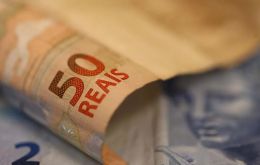
Brazil's nominal public sector deficit reached 9.41% of gross domestic product in the twelve months to March 2026, nearly one percentage point higher than the previous period, according to data published on Thursday by the Central Bank. The combined shortfall of all public administrations — central government, states, and municipalities — stood at 1.21 trillion reais, equivalent to around $244 billion, in one of the highest readings in recent years for Latin America's largest economy.
-
Thursday, April 30th 2026 - 13:09 UTC
US intervention forces end to decade of statistical opacity at Venezuela's Central Bank
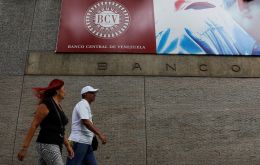
The Central Bank of Venezuela (BCV) has begun systematically publishing economic indicators that had been held under wraps for at least a decade, in an institutional shift driven by the US military intervention that culminated on January 3 with the capture of former president Nicolás Maduro and by the subsequent reconfiguration of Venezuela's financial system under Washington's oversight. The updating of historical series on the central bank's website now makes it possible to learn for the first time in years that monthly inflation reached 32% in January, 14.6% in February and 13.1% in March, while the year-on-year figure stood at 649.5% at the end of the first quarter.
-
Wednesday, April 29th 2026 - 15:11 UTC
Chile's labor market hits 38 months of unemployment above 8% as growth forecast is revised down

Chile's unemployment rate stood at 8.9% during the moving quarter from January to March 2026, a 0.2 percentage point increase over twelve months, according to data released on Wednesday by the National Statistics Institute (INE). The figure exceeded market expectations, which projected 8.6% according to the Bloomberg consensus, and completes 38 consecutive months with the indicator above 8%, confirming a structural weakness in the Chilean labor market that remains one of the main concerns of President José Antonio Kast's administration, in office since March 11.

