MercoPress. South Atlantic News Agency
Economy
-
Friday, October 17th 2008 - 20:00 UTC
Latam estimated to grow 3% in 2009, says IDB
Latinamerica will grow 3% in 2009, below the 4 to 4.5% forecasted for this year said on Friday the president of the Inter-American Development Bank (IDB) Luis Alberto Moreno.
” -
Friday, October 17th 2008 - 20:00 UTC
To ensure supply and price Asian steelers buy iron ore mines
A consortium of five Japanese steelmakers and a South Korean trading firm will invest 3.1 billion US dollars to acquire 40% of a Brazilian iron ore mining company Mineiros S.A. to secure supplies of iron ore, trading house Itochu Corp. announced Friday.
-
Friday, October 17th 2008 - 20:00 UTC
Czechs helping to reforest Torres del Paine devastated area
Chile's Forestry Corporation, Conaf is reforesting the 15.000 hectares from the world famous Torres del Paine national park in Chilean Pataogonia which were devastated by fire in February 2005, according to Punta Arenas La Prensa Austral.
-
Friday, October 17th 2008 - 20:00 UTC
Chilean Tierra del Fuego farm sold for 20 million USD
A long established traditional farm in Chilean Tierra del Fuego in the Timaukel area, has been sold “closed gate” to a group of Chilean investors for which they paid the equivalent of almost 20 million US dollars.
-
Friday, October 17th 2008 - 20:00 UTC
Brazil eases foreign currency credit to exporters

Brazil's central bank will offer credit lines in foreign currencies as of next week in a bid to ease a credit crunch afflicting the country's exporters, the bank's president, Henrique Meirelles announced on Friday.
-
Friday, October 17th 2008 - 20:00 UTC
Melting Arctic sees first vessel through Northwest Passage
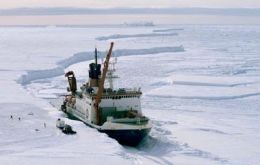
The German Institute Alfred Wegener said on Friday that a scientific expedition for the first time was able to navigate the fabled Northwest Passage linking the Atlantic and the Pacific oceans along Arctic waters bordering Russia and North America because they were free of ice
-
Thursday, October 16th 2008 - 20:00 UTC
Argentine finances need agreement with “holdouts” for 2009

The global financial crisis is likely to delay a deal between Argentina and “holdout” creditors who rejected a 2005 debt swap, leaving the country to rely heavily on domestic sources to confront its financing needs next year.
-
Thursday, October 16th 2008 - 20:00 UTC
Speaking for EU Sarkozy calls for “new Bretton Woods summit”

All 27 European Union states broadly support the bank rescue plan proposed for the bloc and the holding of a world finance summit, France's president has said.
-
Thursday, October 16th 2008 - 20:00 UTC
Upbeat message from Bernanke but colleagues talk of recession
The chairman of the US Federal Reserve said on Wednesday the US economy will eventually emerge from the financial crisis with “renewed vigour”, but warns it will not happen quickly.
-
Thursday, October 16th 2008 - 20:00 UTC
Stiglitz describes financial crisis as a “social problem”

Nobel laureate and renowned economist Professor Joseph Stiglitz described the current financial crisis not as a predominantly economic problem, but as a social one, citing the three million US citizens who have already lost their homes, with another two million expected to lose theirs over the next few months.