MercoPress. South Atlantic News Agency
Economy
-
Saturday, April 25th 2009 - 10:38 UTC
Brazilian unemployment climbs to 9% in March

Brazilian unemployment remained steady with a growing tendency in March, having reached the highest since September 2007, 9%, reported the country’s Statistics and Geography Institute, Ibge.
-
Saturday, April 25th 2009 - 10:31 UTC
EIU downgrades Uruguay’s 2009 growth to 0.2%

Uruguay will experience a serious deterioration of its exports in 2009 with impacts on the rest of the economy and growth limited to a mere 0.2%, according to The Economist Intelligence Unit, EIU.
-
Saturday, April 25th 2009 - 10:26 UTC
China poised to become the world’s second economy in 2010

In spite of a considerable slowdown this year, China is poised to become in 2010 the world’s second largest economy, behind United States and ahead of Japan, according to the IMF World Economic Outlook released this week.
-
Saturday, April 25th 2009 - 07:20 UTC
UK economy shrinks 1.9% in the first quarter of 2009

The UK economy shrank 1.9% in the first three months of 2009, according to gross domestic product (GDP) data from the Office for National Statistics. The contraction was much worse than had been expected and was the biggest three-month decline in GDP since the third quarter of 1979.
-
Saturday, April 25th 2009 - 07:18 UTC
Record unemployment in Spain: 17.36%, heading for 19.4%

Spain's jobless rate rose sharply, to 17.36% in the first quarter of 2009 with more than 4 million people out of work, the government said Friday. Nearly half of the 4 million lost their jobs in the past year, the National Statistics Institute pointed out
-
Friday, April 24th 2009 - 09:48 UTC
Brazil not satisfied with IMF capitalization proposals
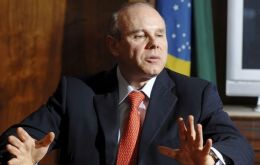
Brazil and other emerging economies are willing to provide additional financing to the International Monetary Fund but they are still not happy with the capitalization mechanism proposed by the institution, Finance Minister Guido Mantega said on Thursday.
-
Friday, April 24th 2009 - 05:09 UTC
Ecuador firm on its sovereign bonds sharp discount buy-back scheme

Ecuador will not change its offer to buy back 3.2 billion of defaulted debt at a sharp discount (70%), and appealed to investors to be mindful of its economic problems, Finance Minister Elsa Viteri said in a letter to bondholders, according to press reports from Quito.
-
Friday, April 24th 2009 - 04:00 UTC
Mercosur is going through “one of its worst moments”

Mercosur is going through “one of its worst moments” and has several “pending critical issues” such as “free circulation of goods and people and mitigating asymmetries” said Walter Cancela head of Uruguay’s Economic Affairs, Integration and Mercosur Office.
-
Thursday, April 23rd 2009 - 13:39 UTC
IMF more upbeat about Chilean economy than the locals

Chile's GDP will likely grow a marginal 0.1% on the year in 2009, recovering to a 3% in 2010, said the International Monetary Fund in its April World Economic Outlook released Wednesday. The IMF outlook is more optimistic than local analysts' outlook who forecast the Chilean economy will contract 0.5% this year.
-
Thursday, April 23rd 2009 - 13:33 UTC
Coming battle to reform IMF and World Bank decision making process

This week-end, ministers of finance and central bankers will meet with officials of the International Monetary Fund and World Bank in Washington to address the reform of the two global financial institutions, which were created by the United States and its allies to fund and guide economic development after World War II.