MercoPress. South Atlantic News Agency
Economy
-
Thursday, November 20th 2025 - 21:06 UTC
Paraguay finalizes first poultry shipment to Philippines
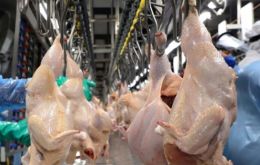
Paraguay has successfully completed its first-ever export of poultry meat to the Philippines, achieving a significant milestone in its strategy to expand trade with the Asian market. The inaugural shipment took place just two months after the Philippine market was officially opened to the South American country's poultry products, it was reported this week in Asunción.
-
Thursday, November 20th 2025 - 18:37 UTC
UK inflation down to 3.6% in October; Autumn Budget to be announced next week

UK’s twelve-month inflation rate slid to 3.6% in October, down from 3.8% in September, and a major achievement ahead of the government’s Autumn Budget next week, according to the Office for National Statistics. Core inflation, excluding energy, food, alcohol and tobacco, rose by 3.4% in the year to October, down from 3.5% in September.
-
Wednesday, November 19th 2025 - 10:55 UTC
Argentina’s $LIBRA scandal: report says Milei promoted private scheme, violated ethics rules

The Argentine House of Deputies' Investigative Commission on the $LIBRA cryptofiasco has concluded in its final report that President Javier Milei may have committed misconduct in the exercise of his duties by promoting a private venture, which would violate the Public Ethics Law.
-
Monday, November 17th 2025 - 10:55 UTC
Maybe Argentina-US deal is ”an advantage,” says Orsi

Uruguayan President Yamandú Orsi pointed out that the recently announced Reciprocal Trade and Investment Framework between Argentina and the United States placed his country in a position where it is “best to be attentive, maybe it's an advantage.”
-
Saturday, November 15th 2025 - 10:58 UTC
Argentina-US deal shakes up Uruguay

The recent announcement by Washington and Buenos Aires of a joint trade agreement has generated controversy in Montevideo, where it is perceived as a violation of the Southern Common Market (Mercosur) rules, so the government of President Yamandú Orsi will monitor the case closely.
-
Friday, November 14th 2025 - 10:47 UTC
Bolivian President describes country's state as a “sewer of extraordinary proportions”
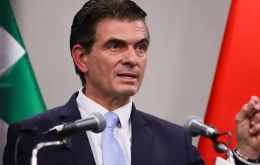
Bolivian President Rodrigo Paz Pereira delivered a harsh public assessment on Thursday of the national economy and state institutions, describing the government he inherited from the Movement Toward Socialism (MAS) as a “sewer of extraordinary proportions.”
-
Thursday, November 13th 2025 - 20:42 UTC
Trump pardons Lewis in insider trading case

British billionaire Joe Lewis, who has significant business interests in Argentine Patagonia and other parts of South America, has been granted an official pardon by US President Donald Trump, it was confirmed Thursday. The measure came after Lewis, 88, pleaded guilty last year in New York to insider trading charges. He was subsequently sentenced to pay a US$5 million fine and serve three years of probation.
-
Thursday, November 13th 2025 - 14:07 UTC
UNICEF report on hardships facing Argentine households released

Three out of every ten households with children and adolescents in Argentina are unable to cover their monthly expenses, according to the ninth “Rapid Survey” conducted by the United Nations Children's Fund (UNICEF) in August released this week.
-
Wednesday, November 12th 2025 - 20:12 UTC
Argentina: Indec says inflation in October climbs 2.3%

Argentina's Consumer Prices Index (CPI) rose by 2.3% in October, accelerating from the 2.1% recorded in September, the National Institute of Statistics and Censuses (INDEC) reported Wednesday. The new data brings the total accumulated inflation for the first ten months of 2025 to 24.8%. The year-on-year inflation rate climbed to 31.3%.
-
Wednesday, November 12th 2025 - 10:55 UTC
Argentina to lift all currency exchange restrictions “soon”

While Argentina's Central Bank (BCRA) announced the “imminent” removal of all remaining controls on foreign exchange transactions, the South American country's National Institute of Statistics and Census (Indec) is about to report October's inflation on Wednesday. Most experts predict it will be above 2%.