MercoPress. South Atlantic News Agency
Economy
-
Monday, September 29th 2025 - 09:26 UTC
Bolivia: YPFB lawyer says current refining scheme is profitable

Bolivia's State-run oil company YPFB's Legal Affairs Manager, Eduardo Saucedo, defended the creation of Botrading, a refining subsidiary, arguing that it resulted in savings worth over US$300 million despite prosecutors claiming otherwise.
-
Saturday, September 27th 2025 - 10:46 UTC
Paraguay's economy grows 5.9% in first semester of 2025

According to the Central Bank of Paraguay's (BCP) “Quarterly National Accounts” report released on Friday in Asunción, the South American country's quarterly Gross Domestic Product (GDP) grew significantly, resulting in 5.9% year-on-year growth in the first semester of 2025, following positive outcomes in most sectors.
-
Wednesday, September 24th 2025 - 10:45 UTC
Trump highlights “excellent chemistry” with Lula
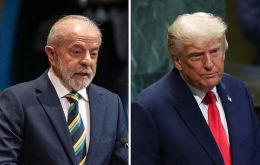
US President Donald Trump said on Tuesday that he had a good “chemistry” with his Brazilian counterpart, Luiz Inácio Lula da Silva, with whom he plans to hold talks next week. Trump described Lula as a “very nice man” after their brief meeting on the sidelines of the 80th United Nations General Assembly in New York.
-
Wednesday, September 24th 2025 - 10:35 UTC
Additional financial help for Argentina announced

Following meetings in the United States, including the one between President Javier Milei and his US colleague Donald Trump, the South American country has secured significant financial support from international agencies.
-
Wednesday, September 24th 2025 - 09:33 UTC
Trump expresses “full support” for Milei's Argentina

US President Donald Trump publicly endorsed his Argentine colleague Javier Milei for the upcoming Oct. 26 midterm elections after a meeting in New York on the sidelines of the 80th United Nations General Assembly.
-
Wednesday, September 24th 2025 - 09:17 UTC
Trump underscores Europe's failures on immigration and energy
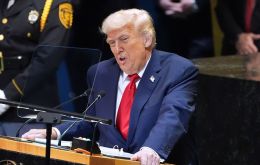
US President Donald Trump stressed during his speech at the UN General Assembly on Tuesday that other countries' policies on immigration and energy were “destroying a large part of the free world” and causing nations to “go to hell.”
-
Monday, September 22nd 2025 - 23:19 UTC
Argentine economic frenzy slows down after US support and gov't's measures
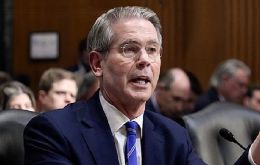
After securing US financial support and implementing a temporary reduction in agricultural export taxes, Argentina's financial markets saw a significant turnaround on Monday.
-
Monday, September 22nd 2025 - 10:34 UTC
Milei postpones trip to US

Argentine President Javier Milei and Economy Minister Luis Toto Caputo have postponed their departure to the United States from Sunday to Monday, it was announced in Buenos Aires. Hence, their meetings with International Monetary Fund (IMF) Managing Director Kristalina Georgieva and other engagements have been rescheduled accordingly.
-
Monday, September 22nd 2025 - 10:19 UTC
Fitch praises Uruguay's economy, but points out some risks

Fitch Ratings held Uruguay's grading as “BBB” with a “stable” outlook, but pointed out some risks the South American country should avert. In any case, Montevideo still qualified within the agency's “investment grade.”
-
Saturday, September 20th 2025 - 10:55 UTC
Milei: bailout from Washington being negotiated

Argentine President Javier Milei confirmed on Friday that his government was in “very advanced” negotiations with the US for an emergency loan from the Treasury's Exchange Stabilization Fund. If secured, the bailout would be used to cover more than US$8.5 billion in debt maturities due in January and July of 2026.