MercoPress. South Atlantic News Agency
Politics
-
Wednesday, July 18th 2012 - 08:15 UTC
Jewish community remembers 18th anniversary of bombing in Buenos Aires

Wednesday marks the 18th anniversary of the fatal bombing of the AMIA Jewish community centre in Buenos Aires, Argentina. Eighty-five people were killed by the blast with hundreds wounded.
-
Wednesday, July 18th 2012 - 08:03 UTC
Wave of anti-mining protest about to knock out another Peruvian cabinet
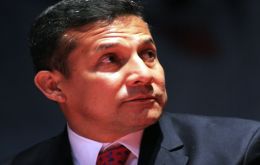
Peruvian President Ollanta Humala has begun sounding out replacements for his prime minister as part of a widely expected Cabinet shuffle designed to calm a wave of violent anti-mining protests in one of the world's leading exporters of minerals.
-
Wednesday, July 18th 2012 - 07:59 UTC
Mexico banking regulator says it repeatedly warned HSBC on money laundering
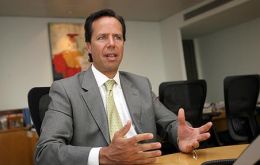
Mexico's banking regulator on Tuesday defended its role in a money laundering scandal engulfing HSBC Holdings Plc, saying it had repeatedly told the bank to improve lax controls over suspect funds passing through its accounts.
-
Wednesday, July 18th 2012 - 07:52 UTC
Buenos Aires sends forces to Santa Cruz province to help with law and order
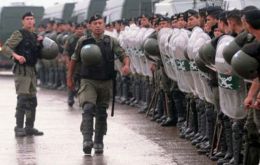
Argentine President Cristina Fernandez political turf, the Patagonian province of Santa Cruz has formally requested the deployment of federal forces to help keep law and order because of a 16-day strike by the provincial police.
-
Wednesday, July 18th 2012 - 07:34 UTC
Indian company scraps largest iron-steel development plan in Bolivia history
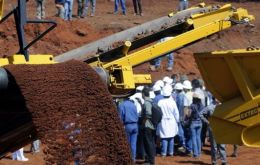
India's Jindal Steel and Power scrapped plans Tuesday to invest 2.1 billion dollars in a Bolivian mining project and blamed the country’s “non-friendly business attitude” for the deal's collapse.
-
Tuesday, July 17th 2012 - 23:36 UTC
Argentine pro-government unions don’t trust Cristina’s stats and official inflation
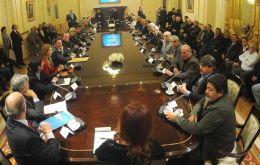
Despite having managed to split organized labour and declared war on its most powerful exponent the teamsters boss Hugo Moyano, the government of Argentine president Cristina Fernandez still has to deal with its unconvincing stats office and rampant inflation.
-
Tuesday, July 17th 2012 - 20:13 UTC
Bernanke concerned with US economy but with no clues about what steps to follow
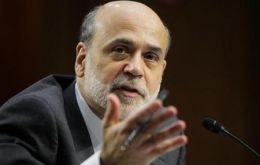
Federal Reserve Chairman Ben Bernanke on Tuesday offered few new clues on whether the US central bank was moving closer to a fresh round of monetary stimulus, even as he underscored his concerns over the economy's weakness.
-
Tuesday, July 17th 2012 - 19:27 UTC
HSBC grilled in US Senate for lax controls enabling billions of money laundering

The CEO of the U.S. division of the big international bank HSBC is apologizing for lax controls that lawmakers say allowed Mexican drug cartels to launder billions of dollars through the US operation and many other illicit transactions for years.
-
Tuesday, July 17th 2012 - 19:21 UTC
YPF contracting “outstanding professionals” to develop technology department

Argentina’s nationalized oil and gas corporation YPF announced the incorporation to its staff of two “outstanding professionals” for its technology department, Bernard Gremillet and Gustavo Bianchi, which at some time belonged to the company but had left for personal reasons.
-
Tuesday, July 17th 2012 - 18:27 UTC
MEP's surprised at Mercosur and Unasur drastic decisions on Paraguay
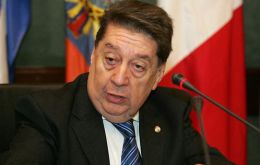
The European lawmakers’ delegation said it was surprised with the drastic and quick determinations, with no right to defence or appeal, decided against Paraguay by Mercosur and Unasur, said Paraguayan Foreign Minister Jose Felix Fernandez Estigarribia, following a meeting in Asuncion with the visiting MEPs.