MercoPress. South Atlantic News Agency
Politics
-
Monday, June 29th 2026 - 08:24 UTC
Milei brings open disputes with Brazil to a Mercosur summit focused on trade deals
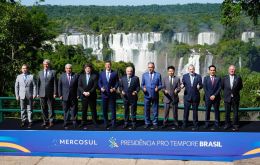
Argentine President Javier Milei will take part on Monday and Tuesday in the Mercosur summit of heads of state in Asunción, a meeting whose trade agenda —led by the agreement with the European Union— will coexist with open political tensions with Brazil that threaten to overshadow the bloc's progress. Paraguay's Foreign Minister, Rubén Ramírez, confirmed the presence of seven leaders, among them the presidents of Chile, José Antonio Kast, and Ecuador, Daniel Noboa.
-
Monday, June 29th 2026 - 06:53 UTC
Russia says it is developing AI-based air defense systems, expects results in November
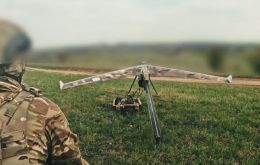
Russia is developing new air defense systems based on artificial intelligence technologies, the country's defense minister, Andrei Belousov, announced on Monday. The official said it was one of the priority projects the country aims to complete before the end of the year, against the backdrop of mounting Ukrainian drone attacks on Russian territory.
-
Sunday, June 28th 2026 - 20:42 UTC
Milei's government seeks to close a political crisis after cabinet chief Adorni resigns

The resignation of Manuel Adorni as cabinet chief of the Argentine government represents an attempt by President Javier Milei to close a political crisis that dominated the public agenda for more than four months, though analysts warn that the impact on the government's credibility will persist as the judicial investigation into the former official's alleged illicit enrichment advances. Adorni, who denies any act of corruption, submitted his resignation on Saturday in a letter released on the social network X.
-
Saturday, June 27th 2026 - 09:28 UTC
Falklands' annual reception in London celebrates the Islands' sporting culture
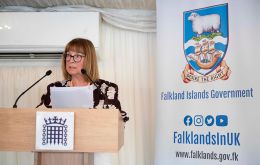
The Falkland Islands Government held its annual parliamentary reception in London on Tuesday, an event that brought together some 200 guests and was dedicated to the role of sport in the archipelago's community life, ahead of the Commonwealth Games that begin next month in Glasgow. The gathering took place on the Terrace Pavilion of the House of Commons.
-
Friday, June 26th 2026 - 14:09 UTC
Falkland Islanders urge Canada to back their self-determination at the OAS assembly
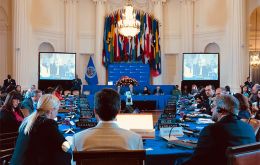
The Falkland Islands Government has called on Canada to use the General Assembly of the Organization of American States (OAS), held this week in Panama, to publicly support the Islanders' right to self-determination. Last week, two members of the archipelago's Legislative Assembly traveled to Ottawa to meet with Global Affairs officials, members of parliament and senators, in search of support.
-
Friday, June 26th 2026 - 13:30 UTC
Falklands representatives take the Islanders' case for self-determination to the UN
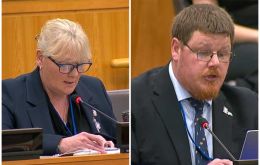
Two members of the Falkland Islands Legislative Assembly, Dorothy “Dot” Gould and Michael Goss, addressed the United Nations Special Committee on Decolonisation, known as the Committee of 24 (C24), on June 25, where they defended the right to self-determination of the archipelago's inhabitants and renewed their invitation for the body to send a visiting mission to the Islands, something that has never happened since the UN began considering the question in 1965.
-
Thursday, June 25th 2026 - 22:13 UTC
The EU deal's quota split will dominate the Mercosur summit as Uruguay takes the helm
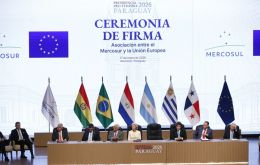
The internal distribution of export quotas under the trade agreement between Mercosur and the European Union will dominate much of the debate at the bloc's summit of heads of state, to be held on June 30 in Asunción, where Paraguay will hand over the six-month presidency to Uruguay. The meeting coincides with the 35th anniversary of the Treaty of Asunción, the bloc's founding charter.
-
Thursday, June 25th 2026 - 21:10 UTC
The Falklands question “must be considered in the light of the wishes of the people who live there”
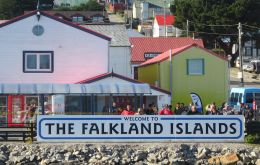
The question of the Falkland Islands must be considered in light of the wishes of the people who live there. The Islanders have the right to determine their own political future, and they have expressed that choice clearly and democratically, pointed out Deputy Leader of the House of Lords, Lord Collins speaking during the 56th regular session of the OAS General Assembly in Panama City, Panama.
-
Thursday, June 25th 2026 - 09:30 UTC
Two powerful earthquakes strike northern Venezuela and collapse buildings in Caracas
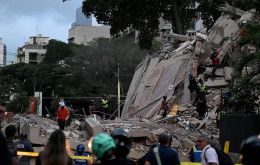
Two powerful earthquakes of magnitude 7.2 and 7.5, about 39 seconds apart, struck north-central Venezuela on Wednesday afternoon, collapsing buildings in the capital, Caracas, and leaving rescue teams working through the rubble, according to the US Geological Survey (USGS). Acting President Delcy Rodríguez declared a state of emergency, though she did not provide figures for the injured or dead.
-
Thursday, June 25th 2026 - 09:04 UTC
Venezuela's earthquake toll rises to at least 164 dead and nearly 1,000 injured
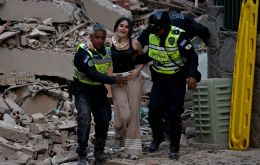
The number of victims from the twin earthquake that struck north-central Venezuela rose to at least 164 dead and 971 injured, acting President Delcy Rodríguez reported on Thursday, warning that the figure would keep rising as rescue work progressed. The quakes, of magnitude 7.2 and 7.5, hit on Wednesday afternoon and left dozens of buildings collapsed across several regions of the country.