MercoPress. South Atlantic News Agency
Tag: British Overseas Territory
-
Tuesday, July 21st 2026 - 07:10 UTC
The Falklands, FIFA and the Future of the British Overseas Territories

By Peter Clegg (*) <br />
<br />
I have been researching the British Overseas Territories (BOTs) and their geopolitical relationships for over twenty years, and I cannot remember so much focus on them as there has been in recent days. The FIFA World Cup match between England and Argentina provoked heated discussions over the future of the Falkland Islands (or Malvinas if you are Argentine). Gibraltar has received significant media coverage with the removal of the border infrastructure with Spain. The Caricom Reparations Committee has called for the British Virgin Islands (BVI) to be decolonized by the UK, and new UK Prime Minister Andy Burnham will likely retain the government’s commitment to return the Chagos Islands to Mauritius. So, are we witnessing centrifugal forces that could fracture the BOTs’ relationship with the ‘UK family’? -
Friday, March 13th 2026 - 02:41 UTC
Falklands mark anniversary of March 2013 referendum

The Falkland Islands this week mark thirteen years since the referendum in which residents overwhelmingly voted to remain a British Overseas Territory of the United Kingdom.
-
Thursday, May 22nd 2025 - 06:15 UTC
Falklands present at BOTs and UK Speakers’ conference on using AI in Legislatures
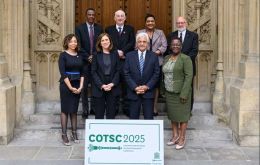
Hosted by the Speaker of the UK House of Commons, Honorable Sir Lindsay Hoyle, MP, the 4th Commons and Overseas Territories Speakers’ Conference (COTSC) took place in London from May 13 to 16, 2025.
-
Tuesday, September 5th 2023 - 10:36 UTC
South Georgia celebrates Toothfish Day; marks the end of Dissostichus eleginoides', fishing season

Toothfish Day is a public holiday celebrated in the British Overseas Territory of South Georgia and the South Sandwich Islands. It is annually on 4th September, but if that falls on a weekend it may be observed on a weekday.
-
Wednesday, January 11th 2023 - 10:32 UTC
Reminder of the Falkland Islands Status Amendments 2022
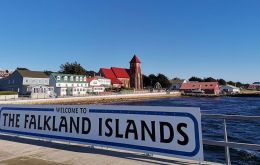
In September 2022 the elected Legislative Assembly approved amendments to the Falkland Islands Status Ordinance 1998. The amended Ordinance narrows the definition of a “qualified person” (which at the moment includes a Commonwealth citizen), limiting the definition to include a British citizen, a British Overseas Territory citizen or a British Overseas citizen.
-
Tuesday, November 8th 2022 - 09:11 UTC
Former St Helena sea link, turned into “floating paddock” for Extreme E competitions visiting Uruguay
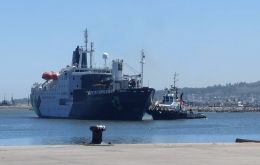
A completely refurbished former RMS St Helena, which sailed between the British Overseas Territory of St Helena, (occasionally Ascension Island) and Cape Town in South Africa until 2018, is currently in Uruguay although under a new purpose.
-
Friday, April 15th 2022 - 10:33 UTC
Forty years after the war, Falklands remain an Argentine obsession

By Henry Srebrnik (*) – Forty years since Argentina launched its disastrous invasion of the South Atlantic archipelago in early April of 1982, its claim to the Falkland Islands remains a national obsession, even enshrined in the country’s 1994 constitution.
-
Monday, February 15th 2021 - 09:54 UTC
Falklands defined as British Independent Overseas Territory by US Navy triggers reaction in Buenos Aires
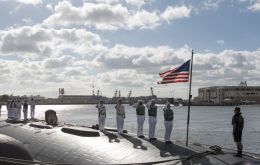
The Argentine government expressed deep concern following a report in the official twitter from the United States Commander Submarine Force Atlantic, (Comsublant) in which it reveals that it had recently operated in the South Atlantic, “with British support” from the Falklands, “in a display of the global reach of both nations.”
-
Monday, August 31st 2020 - 09:37 UTC
A Visitor's Guide: Frequently Asked Questions Where is South Georgia?
![King penguins at St Andrews Bay, South Georgia. [IAN PARKER, UNSPLASH]](/data/cache/noticias/77747/260x165/parker.jpg)
South Georgia is situated 800 miles SE of the Falkland Islands. The main island of South Georgia is approximately 170 km long and between 2 and 40 km wide and occupies an area of 3,755 km2, more than half of which is permanently ice covered. The coast is rich in wildlife and home to huge collies of penguins, seals and albatross.
-
Tuesday, August 18th 2020 - 15:50 UTC
Falkland Islands and oil companies new approach to “stranded assets”
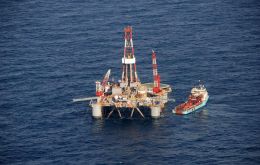
An article in World Oil by Laura Hurst refers to the term “stranded assets” and mentions the case of the Falkland Islands oil industry: the discovery a decade ago of as much as 1,7 billion barrels of crude offshore the British Overseas Territory, and rather than the next frontier, the project to extract energy risks being added to a list of what companies call “stranded assets” that could cost them huge sums to mothball.