MercoPress. South Atlantic News Agency
Tag: FIFA
-
Friday, August 21st 2026 - 21:52 UTC
FIFA sanctions Argentina over the final's brawl and the Falklands banner

FIFA's Disciplinary Committee on Friday imposed financial and sporting sanctions on the Argentine Football Association and four members of its national squad over the confrontations at the end of the 2026 World Cup final and over breaches committed throughout the tournament, among them the display of a banner asserting a sovereignty claim over the Falklands.
-
Wednesday, August 12th 2026 - 06:13 UTC
Argentina to mark every July 15 with the World Cup win that revived the Falklands dispute

The Argentine Football Association (AFA) has established July 15 as National Football Teams Day, in tribute to the 2-1 win over England in the 2026 World Cup semi-final, the same match after which several players displayed a banner asserting a sovereignty claim over the Falklands that prompted a FIFA disciplinary case.
-
Monday, August 3rd 2026 - 20:24 UTC
Infantino opponents threaten non-cooperation with FIFA unless he resigns

Officials opposed to FIFA president Gianni Infantino are considering withdrawing cooperation with the governing body for as long as he remains in office, according to UEFA sources cited by the BBC, as the fallout deepens over the plan to open a commercial subsidiary handling the rights to its tournaments to private investors.
-
Friday, July 31st 2026 - 22:05 UTC
Three confederations reject selling part of the World Cup to private funds; Conmebol asks for explanations

The South American Football Confederation asked FIFA on Friday for additional information and clarification on the FIFA Forward Enterprise project, without coming out for or against it, a day after the confederations of Europe and of North and Central America and the Caribbean rejected the plan.
-
Wednesday, July 29th 2026 - 20:28 UTC
FIFA opens proceedings against three Argentine players, an assistant coach and Gavi

FIFA's Disciplinary Committee on Wednesday opened disciplinary proceedings against three Argentine footballers, a member of the national team's coaching staff and Spain's Gavi over incidents that followed the 2026 World Cup final, which Spain won 1-0 at MetLife Stadium in New Jersey.
-
Wednesday, July 22nd 2026 - 22:26 UTC
Report says Trump is pushing Infantino to lead the UN
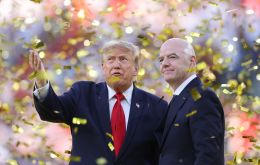
US President Donald Trump is promoting FIFA President Gianni Infantino as a candidate to succeed António Guterres at the head of the United Nations, according to the New York Post, which cited anonymous sources close to the White House. The information has not been officially confirmed by the US government or FIFA, and Infantino himself has not commented publicly.
-
Tuesday, July 21st 2026 - 21:34 UTC
Baseless conspiracy theories about Argentina's defeat go viral and are debunked

In the hours after Argentina's 1-0 defeat to Spain in the 2026 World Cup final, social media filled with posts claiming, without offering evidence, that the result was “fixed.” Fact-checkers and Argentina's own coach, Lionel Scaloni, moved to dismiss those versions.
-
Tuesday, July 21st 2026 - 21:08 UTC
Conmebol presses FIFA for a 64-team 2030 World Cup and more matches in South America

The South American Football Confederation (Conmebol) has stepped up its pressure on FIFA for the 2030 World Cup to be played with 64 teams, which would allow Uruguay, Argentina, and Paraguay to host more matches than currently planned. A day after the 2026 World Cup final, won by Spain, the body's president, Alejandro Domínguez, treated the format as all but settled in a message on the social network X: “In 2030 the World Cup is coming to Uruguay, Argentina, and Paraguay,” he wrote, proposing to mark the centenary “with a 64-team competition.”
-
Tuesday, July 21st 2026 - 07:10 UTC
The Falklands, FIFA and the Future of the British Overseas Territories

By Peter Clegg (*) <br />
<br />
I have been researching the British Overseas Territories (BOTs) and their geopolitical relationships for over twenty years, and I cannot remember so much focus on them as there has been in recent days. The FIFA World Cup match between England and Argentina provoked heated discussions over the future of the Falkland Islands (or Malvinas if you are Argentine). Gibraltar has received significant media coverage with the removal of the border infrastructure with Spain. The Caricom Reparations Committee has called for the British Virgin Islands (BVI) to be decolonized by the UK, and new UK Prime Minister Andy Burnham will likely retain the government’s commitment to return the Chagos Islands to Mauritius. So, are we witnessing centrifugal forces that could fracture the BOTs’ relationship with the ‘UK family’? -
Monday, July 20th 2026 - 19:17 UTC
Argentina players spark brawl and snub trophy ceremony after World Cup final defeat

The 2026 World Cup final between Spain and Argentina ended on Sunday with Spain champions by 1-0 after extra time, but the sporting outcome was overshadowed by a brawl between players from both sides moments after the final whistle at MetLife Stadium in New Jersey, and by the decision of Argentina's players to turn their backs on the trophy ceremony.