MercoPress. South Atlantic News Agency
Tag: Inflation
-
Monday, March 16th 2026 - 16:00 UTC
Fed and ECB face a pivotal week as the oil shock revives inflation risk
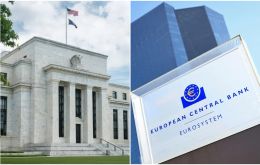
The U.S. Federal Reserve and the European Central Bank head into this week’s policy meetings in a far more uncertain environment than they faced just two weeks ago. The Fed meets on March 17-18, and the ECB on March 18-19, just after the Middle East war pushed oil prices above US$100 a barrel and forced markets to rethink the expected path of interest rates. Even so, neither institution is expected to change borrowing costs at these meetings.
-
Saturday, March 14th 2026 - 01:54 UTC
Global volatility hits Argentine assets as country risk edges back toward 600 points

Argentine assets ended the week under pressure, pulled lower by international volatility linked to the Middle East war, in a session marked by falling stocks and bonds, a higher country risk index and renewed oil-driven pressure on inflation and financial expectations. Brent crude settled at $103.14 a barrel, while Wall Street extended its weekly losses amid concern over global energy supply.
-
Thursday, March 12th 2026 - 10:40 UTC
Argentina: Fuel price rises complicate March inflation and tighten the government’s peso strategy

Rising fuel prices have added new pressure to Argentina’s March inflation outlook, in a month already burdened by the start of the school year, utility adjustments and seasonal pressure on food prices. In the local market, gasoline prices have risen by roughly 7% to 8% so far in March, increasing the risk that monthly inflation could move back toward the 3% range.
-
Wednesday, March 11th 2026 - 22:33 UTC
Uruguayans see security as top national concern, cost of living as main personal problem

Uruguayans continue to identify security and crime as the country’s main problem, but when the question shifts to everyday life, the dominant concern becomes the cost of living, according to a new survey by University of the Republic academics analysed in a report by El Observador. The poll also found that about one-third of respondents believe such problems stem from “longer inheritances” or broader trends that no government has managed to solve.
-
Monday, March 9th 2026 - 17:04 UTC
UK warns of higher inflation and backs oil reserve release amid Middle East war

British finance minister Rachel Reeves said on Monday that the United Kingdom was ready to support a coordinated release of international oil reserves if the Middle East crisis keeps pushing up energy prices, though no formal G7 decision has yet been taken. Reeves made the statement after joining a virtual meeting of G7 finance ministers, as oil prices remained elevated because of disruption to shipping through the Strait of Hormuz. Reuters reported that the option under discussion is a joint emergency stock release under the International Energy Agency framework.
-
Wednesday, March 4th 2026 - 13:27 UTC
Uruguay cuts policy rate to 5.75% after external shock, with inflation still below target
Uruguay’s Central Bank cut its benchmark policy rate by 75 basis points to 5.75%, from 6.5%, in a unanimous decision and the seventh consecutive reduction, as it weighed the market impact of the renewed Middle East conflict and a rebound in the U.S. dollar.
-
Tuesday, March 3rd 2026 - 02:57 UTC
Paraguay central bank cuts rates as inflation runs below target

Paraguay’s central bank chief Carlos Carvallo says the country is dealing with a “nice problem”: inflation is converging to the official goal “from below,” an unusual pattern in the region that has prompted policymakers to start trimming interest rates to prevent price growth from staying too low.
-
Monday, February 23rd 2026 - 04:48 UTC
IMF flags risks of outdated inflation metrics in fast-changing economies

The International Monetary Fund (IMF) is urging countries to modernize how they measure inflation and other key indicators, integrating point-of-sale and online data to reduce “blind spots” that, the institution argues, are widening as the economy becomes more digital and traditional surveys lose accuracy.
-
Tuesday, February 10th 2026 - 21:14 UTC
Argentina: January inflation hits 2.9% and 12-month rate reaches 32.4%, INDEC says
Argentina’s inflation came in at 2.9% in January, taking the 12-month rate to 32.4%, according to the national statistics agency INDEC. The reading marked an acceleration of 0.1 percentage points from December.
-
Wednesday, February 4th 2026 - 02:51 UTC
Argentine shares slide in New York as country risk climbs above 500 points

Argentine stocks and hard-currency bonds fell on Tuesday, hit by a risk-off turn in global markets and fresh domestic uncertainty tied to the stalled overhaul of inflation measurement following Marco Lavagna’s departure from INDEC.

