MercoPress. South Atlantic News Agency
Tag: Yamandú Orsi
-
Friday, October 16th 2026 - 09:52 UTC
Uruguay signs a US$5.7 billion data centre investment with Spain’s Solaria
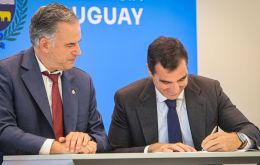
Uruguayan President Yamandú Orsi on Wednesday signed an agreement with Spanish company Solaria Energía y Medio Ambiente to develop a data centre campus of up to 500 megawatts with its own solar generation, a US$5.7 billion investment the government described as the largest in the country’s history. The opposition has demanded explanations about the company’s financial capacity and the jobs the project will create.
Add your comment! -
Tuesday, September 29th 2026 - 07:17 UTC
Five shipping lines warn Uruguay the port dispute is damaging its international standing

Five of the main shipping lines operating at the port of Montevideo have warned the Uruguayan government that the labour dispute at the Terminal Cuenca del Plata is causing “severe economic and commercial harm” and has “severely damaged Uruguay's international prestige”, in a letter addressed to six ministers.
-
Friday, September 25th 2026 - 10:41 UTC
“The UN has more reason to exist every day”, Uruguay's president said two days after Milei
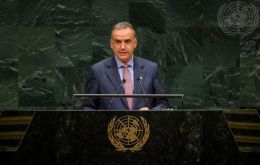
Uruguayan President Yamandú Orsi defended the United Nations' relevance and condemned the economic embargo on Cuba before the General Assembly on Thursday, in an address of just under twenty minutes that contrasted with that of his Argentine counterpart, Javier Milei, two days earlier from the same podium.
-
Tuesday, September 1st 2026 - 10:32 UTC
Uruguay and Argentina seek to stop the green hydrogen plant repeating the pulp mill conflict
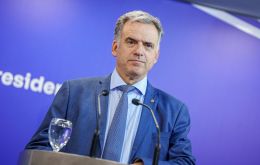
The governments of Uruguay and Argentina are trying to contain tensions surrounding the green hydrogen and synthetic fuels plant that HIF Global plans to build in the Uruguayan department of Paysandú, on the Uruguay river, after a statement by President Yamandú Orsi drew three consecutive denials from the Argentine side.
-
Friday, August 21st 2026 - 22:41 UTC
Uruguay's president meets Kicillof and agrees to cooperate on food and scientific research

Uruguayan President Yamandú Orsi on Friday received the governor of Argentina's Buenos Aires province, Axel Kicillof, at the Torre Ejecutiva in Montevideo, where the two signed two cooperation agreements covering agrifood and scientific matters.
-
Thursday, August 13th 2026 - 10:16 UTC
Disapproval of Orsi's government climbs to 57% in the third quarter, Opción finds
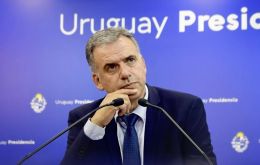
Fifty-seven percent of Uruguayans disapprove of the performance of the government led by Yamandú Orsi and 19% approve, according to the third-quarter 2026 Public Opinion Monitor released on Wednesday by the polling firm Opción. In the previous measurement the figures were 48% and 20% respectively.
-
Wednesday, July 29th 2026 - 23:03 UTC
IMF chief arrives in Montevideo for talks with Orsi and the economic team
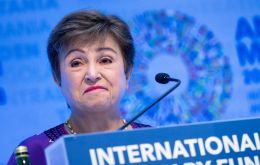
International Monetary Fund Managing Director Kristalina Georgieva arrived in Montevideo for talks on Thursday with President Yamandú Orsi and the country's senior economic officials, on a visit made at the invitation of the Uruguayan government.
-
Saturday, July 25th 2026 - 09:10 UTC
Uruguay: nearly half of those polled say the government is falling short of expectations
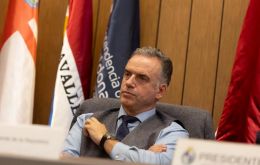
For 49% of Uruguayans surveyed, Yamandú Orsi's government is performing below the expectations they held at the start of the administration, according to the latest poll by the consultancy Factum, covering the third two-month period of 2026. The study, with fieldwork conducted between June 2 and 20 and released by VTV Noticias, shows a sustained deterioration in perceptions of the government since the beginning of the term.
-
Monday, July 6th 2026 - 02:08 UTC
Orsi praises Fujimori's 'exemplary perseverance' in a cross-ideological call
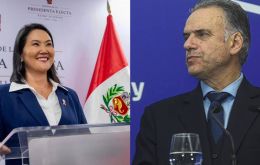
Uruguay's left-wing President Yamandú Orsi congratulated Peru's right-wing president-elect, Keiko Fujimori, by phone on her runoff victory, in a contact that bridged the ideological divide in a region where most governments have shifted to the right. The conversation, released by the Office of Peru's President-Elect, came amid the government transition in the Andean country, with the handover set for July 28.
-
Friday, July 3rd 2026 - 08:55 UTC
In Uruguay, Kast urges harsher penalties for crime leaders and total prison isolation
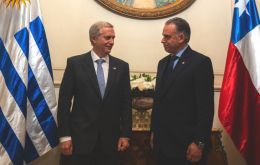
Chile's President José Antonio Kast argued on Wednesday in Montevideo that the region's countries must toughen their laws to combat organized crime, with life sentences for those who lead gangs and a regime of total isolation in prisons to stop them from continuing to operate from behind bars. The president laid out his position after meeting with Uruguayan President Yamandú Orsi, as part of an official visit to Uruguay.