MercoPress. South Atlantic News Agency
Tag: Yamandú Orsi
-
Wednesday, July 1st 2026 - 08:26 UTC
Uruguay takes over the Mercosur presidency vowing to modernize and open the bloc
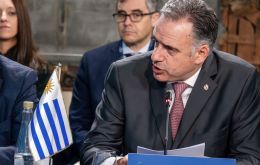
Uruguay's President Yamandú Orsi on Tuesday assumed the pro tempore presidency of Mercosur and set as a priority of his term to “keep modernizing” the bloc and consolidate its trade opening, following the provisional entry into force of the agreement with the European Union. “We want a more modern, more dynamic Mercosur, more open to the world, but above all a Mercosur that produces concrete results for its citizens,” he said as he received the rotating presidency from host Santiago Peña of Paraguay, at the 68th summit of heads of state held in Luque.
-
Tuesday, June 9th 2026 - 07:07 UTC
Uruguay's Orsi slips to 12th in a regional presidential ranking; Bukele leads
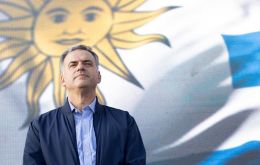
Uruguay's President Yamandú Orsi fell to 12th among the 18 leaders in the June ranking of best-rated Latin American presidents compiled by the Argentine consultancy CB. With a 38.8% positive image, Orsi dropped one spot from May and remains in the survey's “regular” band.
-
Thursday, June 4th 2026 - 15:32 UTC
Uruguay's anti-graft body faces Congress as opposition alleges 'political use' in Orsi case
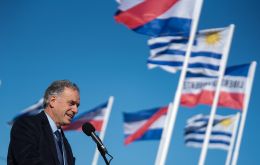
The directorate of Uruguay's Transparency and Public Ethics Board (Jutep) appeared on Thursday before the Chamber of Deputies' Security and Coexistence Commission, amid the controversy over President Yamandú Orsi's purchase of a Hyundai Santa Fe. National Party deputy Pablo Abdala, who requested the summons, accused the body of “political use.”
-
Tuesday, June 2nd 2026 - 10:54 UTC
Orsi used a campaign-donated car to help pay for his Hyundai, Búsqueda reports
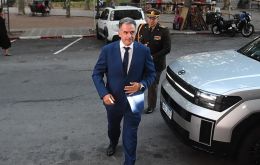
Uruguay's president, Yamandú Orsi, used a vehicle that had been donated to his 2024 election campaign as part of the payment for the Hyundai he bought days before taking office, according to the weekly Búsqueda, which reconstructed the deal from various sources. The car, a Renault Stepway, had been provided by the dealership CarOne during the Frente Amplio's presidential campaign.
-
Monday, June 1st 2026 - 05:17 UTC
Uruguay submits EUR 60 million offer to acquire three Royal Navy used patrol vessels

The Uruguayan government will this week present a formal offer to the United Kingdom's embassy for the acquisition of three used offshore patrol vessels belonging to the British Royal Navy, for an approximate amount of 60 million euros, as announced by the Deputy Secretary of the Presidency, Jorge Díaz. The operation, structured as a direct state-to-state purchase, fits within the administration of President Yamandú Orsi's search to replace the contract terminated with the Spanish shipyard Cardama, in parallel with the hardening of accusations from the Uruguayan executive against the Vigo-based company over the use of public funds transferred.
-
Monday, June 1st 2026 - 04:58 UTC
Uruguayan opposition accuses Orsi of “mocking” public after response on vehicle discount
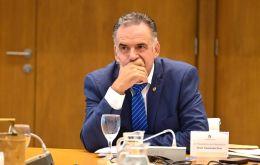
The main opposition forces of Uruguay coincided on Sunday in questioning the public response of President Yamandú Orsi to the discount of approximately USD 25,000 he obtained in the purchase of a zero-kilometre Hyundai Santa Fe SUV a few days before assuming the presidency on 1 March 2025. The Board of Transparency and Public Ethics (Jutep) will review the transaction after receiving three formal citizen complaints, in an episode that is eroding one of the main political assets of the president, associated with an image of transparency and austerity.
-
Wednesday, May 27th 2026 - 20:41 UTC
Uruguay: President Orsi faces questions over purchase of vehicle with USD 25,000 discount
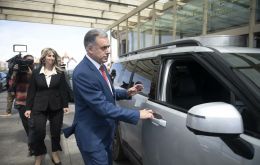
Uruguayan President Yamandú Orsi is this week facing public questioning over the purchase, eight days before his inauguration on 1 March 2025, of a zero-kilometre Hyundai Santa Fe SUV for an invoiced value of USD 54,000, although the model was being offered by the same company at around USD 78,990. The difference, close to USD 25,000, was confirmed by the presidential entourage as a “discount or rebate” on the transaction, without specifying whether it corresponded to a standard commercial policy of the dealership or to a particular condition extended to the then-president-elect.
-
Saturday, May 23rd 2026 - 02:34 UTC
Uruguay captures 63% of Mercosur's annual rice quota to the European Union

Uruguay this week filled 63% of the annual zero-tariff rice quota granted by the European Union to Mercosur, in the first significant trade milestone since the provisional entry into force, on 1 May, of the association agreement between the two blocs. The total quota of 6,667 tons for the current year was covered within a few weeks of activity, according to Acting Foreign Minister Valeria Csukasi, in what amounts to one of the first operational tests of the treaty signed on 17 January in Asunción.
-
Tuesday, May 19th 2026 - 02:31 UTC
Uruguay: Orsi's approval falls to 29% and disapproval climbs to 46%, new survey shows
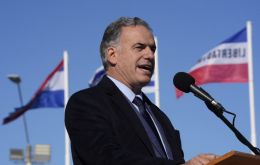
The administration of Uruguayan President Yamandú Orsi has reached its lowest approval level since he took office as head of state in March 2025, according to the national survey by the polling firm Factum released on Monday for the second two-month period of 2026. The poll places presidential approval at 29% and disapproval at 46%, while 24% of those surveyed neither approve nor disapprove of the administration. The firm describes the dynamic as “a systematic process of falling approval and rising disapproval,” confirming the trend already identified last week by the polling firm Equipos, which had placed disapproval at 48%.
-
Friday, May 15th 2026 - 13:27 UTC
Chilean former president defends “people-centered” multilateralism in Montevideo against authoritarian projects

Former Chilean President Michelle Bachelet, currently a candidate for the United Nations Secretary General, defended on Thursday in Montevideo the need for “a more representative, inclusive, and people-centered multilateralism” in the face of advancing “authoritarian projects” in the international order, during the keynote of the seminar “Geopolitics, Multilateralism, and Risks to Gender-Parity Democracy in the New International Order.” The event, organized by IDEA Internacional, is taking place at Uruguay's Legislative Palace as part of the Latin American Women in Politics Meeting, which brings together regional political leaders until Friday.