MercoPress. South Atlantic News Agency
Stories for January 3rd 2026
-
Saturday, January 3rd 2026 - 22:03 UTC
Falklands, Argentina recalls the 193 anniversary of UK “illegitimate” occupation and calls for bilateral dialogue

In its annual routine statement, the Argentine Foreign ministry has recalled the 193rd anniversary of 3 January 1833, when ‘the illegitimate occupation of the Malvinas Islands’ and ‘has reaffirmed its legitimate and imprescriptible sovereignty rights over the Malvinas, South Georgia and South Sandwich Islands and their surrounding maritime spaces’.
-
Saturday, January 3rd 2026 - 20:11 UTC
Trump says U.S. will govern Venezuela until a “safe transition” after Maduro’s capture
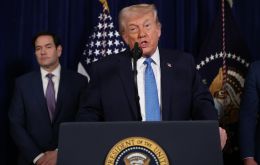
U.S. President Donald Trump said Washington will govern Venezuela until a “safe transition” is achieved, following the capture of Venezuelan leader Nicolás Maduro in a large-scale military operation.
-
Saturday, January 3rd 2026 - 10:58 UTC
Trump claims Maduro captured after “large-scale strike” on Venezuela
U.S. President Donald Trump said on Saturday that Venezuelan leader Nicolás Maduro had been captured and removed from the country following what he described as a “large-scale” U.S. military operation carried out overnight.
-
Saturday, January 3rd 2026 - 10:55 UTC
Explosions and reported bombings in Caracas and Venezuelan military bases

A wave of powerful explosions shook Caracas during the early hours of Saturday, marking the most serious escalation to date in the confrontation between the United States and Venezuela. Residents reported repeated blasts, aircraft flying at low altitude, and widespread power outages, while images and videos circulating on social media showed fires and thick columns of smoke rising from several strategic areas of the capital.
-
Saturday, January 3rd 2026 - 09:12 UTC
Chile's Supreme Court rules against dictatorship criminals
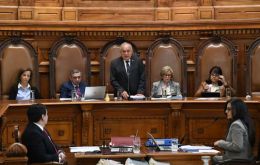
Chile's Supreme Court has struck down a legal mechanism known as “partial prescription” for crimes against humanity committed during the Augusto Pinochet dictatorship (1973–1990). The decision was made in compliance with a mandate from the Inter-American Court of Human Rights (IACHR).
-
Saturday, January 3rd 2026 - 08:52 UTC
Buenos Aires updates advisory against traveling to Venezuela

Argentina's Foreign Ministry on Friday updated a travel advisory warning against visiting Venezuela, given the growing number of “arbitrary detentions” under the Chavista regime of Nicolás Maduro.
-
Saturday, January 3rd 2026 - 08:50 UTC
Paraguayan group buys over major Uruguayan retail business

Paraguay's Grupo Vierci has signed a binding agreement to acquire 100% of GDN Uruguay's shares, encompassing key retail brands including Supermercados TaTa, Farmacia San Roque, BAS apparel, MultiAhorro Hogar home goods, and wholesale chain Frontoy.
-
Saturday, January 3rd 2026 - 08:48 UTC
Argentina shifts exchange rate policy
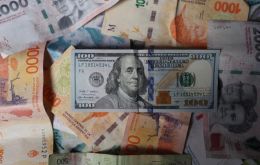
The Argentine exchange market entered a new era on Friday, following the partial removal of credit card surcharges on expenditures in foreign currency. Additionally, the parity with the local peso now hinges on an inflation-linked floating scheme.
-
Saturday, January 3rd 2026 - 08:44 UTC
Bolivian President to rule electronically from abroad
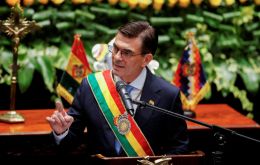
Bolivian President Rodrigo Paz Pereira issued Supreme Decree 5515, allowing him to exercise full constitutional powers through digital means and electronic signatures while outside the country. The move comes amid escalating nationwide protests over the so-called Gasolinazo (end of fuel subsidies resulting in price hikes) and a notorious rift between the head of State and Vice President Edmand Lara.
-
Saturday, January 3rd 2026 - 08:24 UTC
Europeans are all Peronists now, where are the leaders willing to make hard choices?
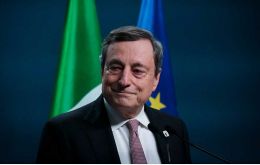
By Cristina Martinez (*) - European voters increasingly resemble their Argentinian counterparts, who, until recently, believed the unsustainable promises offered by Peronist politicians. To avoid the economic shock therapy that has befallen Argentina, Europe’s leaders must be willing to make hard choices, and electorates must be willing to reward them for it.