MercoPress. South Atlantic News Agency


Latin American presidents seek common ground as regional blocs weaken
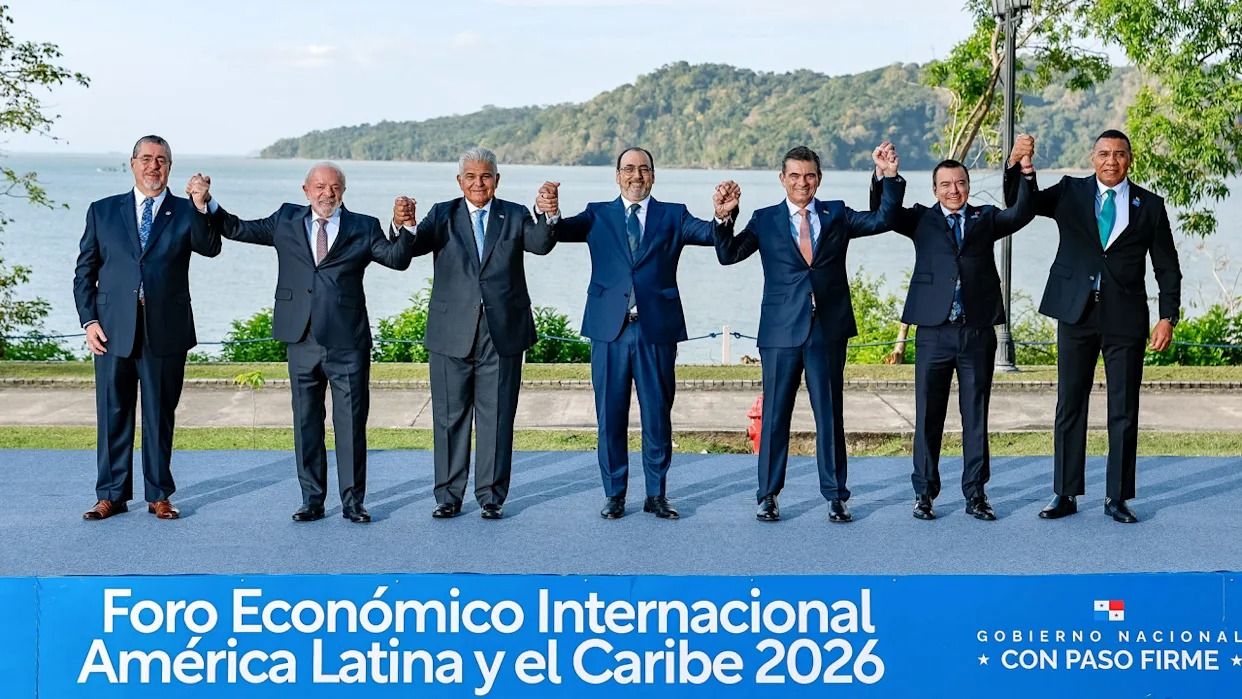 Bernardo Arévalo, Luiz Inácio Lula da Silva, José Raúl Mulino, Sergio Díaz-Granados, Rodrigo Paz, Daniel Noboa and Andrew Holness.
 Seven sitting heads of government and one president-elect from Latin America and the Caribbean shared the stage in Panama on Wednesday to call for deeper regional integration, an increasingly rare show of cross-ideological alignment in a polarized region. The message was delivered at the International Economic Forum Latin America and the Caribbean, backed by CAF and designed as a high-level convening point for governments, business leaders and multilaterals.
Brazil’s President Luiz Inácio Lula da Silva, the main speaker, said “no country can solve its problems alone,” arguing the region is living through “one of the biggest setbacks” in integration. He criticised the weakness of regional mechanisms and pointed to CELAC’s paralysis and thin top-level attendance at recent summits as symptoms of fragmentation.
CAF executive president Sergio Díaz-Granados framed the turnout —with large international delegations— as a political signal amid what he described as a fracture in the rules-based system, insisting Latin America is “not a marginal player” in the global chessboard.
Geopolitics and security featured prominently. Colombia’s President Gustavo Petro delivered the sharpest warning, saying: “We don’t want missiles over Caracas or any other country in the Americas,” reflecting broader regional unease after Venezuela’s crisis. Ecuador’s President Daniel Noboa, without engaging Petro’s public invitation to address bilateral tensions, focused on cross-border security and urged a coordinated approach to criminal networks operating “from country to country.”
Panama’s President José Raúl Mulino, Guatemala’s President Bernardo Arévalo, Bolivia’s President Rodrigo Paz, Jamaica’s Prime Minister Andrew Holness, and Chile’s president-elect José Antonio Kast also attended. Kast argued the region must “cross borders” —including ideological ones— and warned that “fragmentation weakens us.”
No binding political commitments emerged, but the economic backdrop reinforced the repeated “regional bloc” argument. In Uruguay, competitiveness concerns have intensified alongside a weak dollar: the Economy and Finance Ministry has announced measures aimed at cushioning the impact of global dollar softness on exporters and on sectors competing with imports.
Uruguay’s trade profile underlines why external coordination keeps returning to the agenda. Uruguay XXI reported goods exports of US$ 13.493 billion in 2025 —a decade high— with China as the top destination and Brazil a key partner, leaving the economy exposed to global shifts and regional decisions alike.
Against that backdrop, the EU-Mercosur trade agreement signed on Jan. 17 —still awaiting ratification and facing political pushback in Europe— has been treated by governments and analysts as a test case for how far coordinated regional strategy can go on trade and investment, regardless of domestic ideological cycles.


Top Comments
Disclaimer & comment rulesCommenting for this story is now closed.
If you have a Facebook account, become a fan and comment on our Facebook Page!