MercoPress. South Atlantic News Agency
Trump delivers longest recorded State of the Union amid polarization, with tariffs and foreign policy under scrutiny
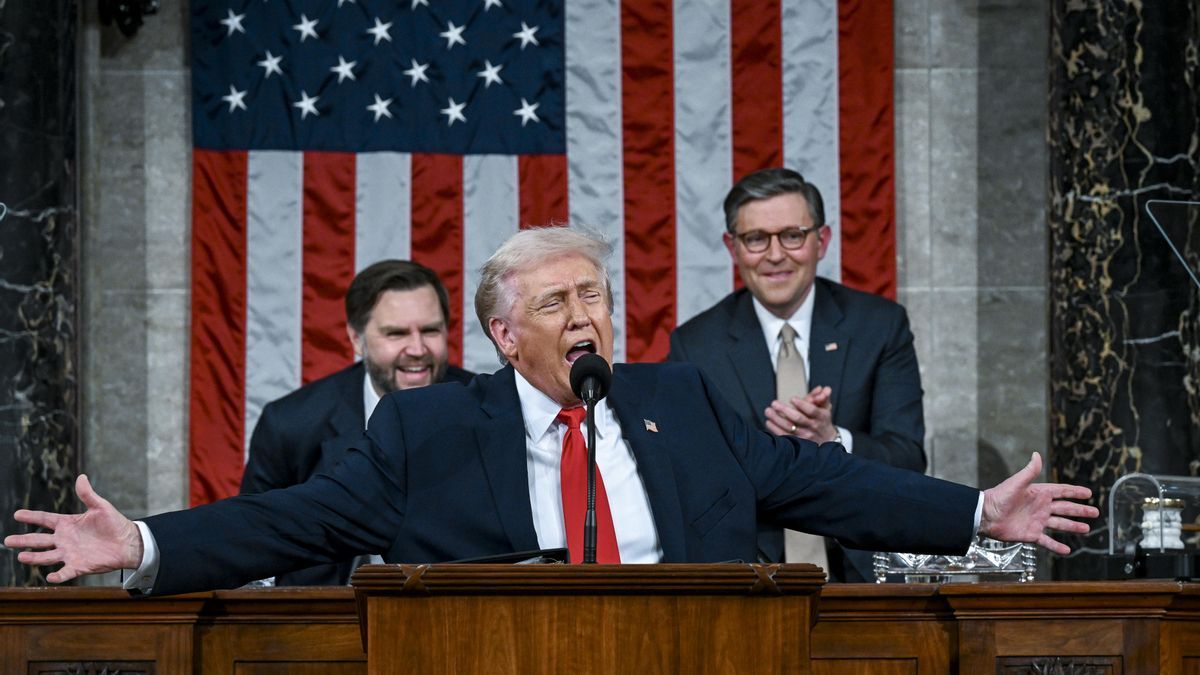 Trump defended his economic agenda and again framed tariffs as a central tool of industrial and trade policy
 US President Donald Trump delivered the longest recorded State of the Union address on Tuesday, February 24, 2026, speaking for 108 minutes before a joint session of Congress, as Washington enters a highly charged political stretch ahead of the midterm elections.
The evening featured visible Democratic dissent in and around the chamber. Representative Al Green (D-Texas) was removed shortly after the speech began after holding up a sign that read “BLACK PEOPLE AREN’T APES!”, a protest linked to a racist video circulated weeks earlier from the president’s social media account and later deleted.
Tariffs and the economic message after a court setback
Trump defended his economic agenda and again framed tariffs as a central tool of industrial and trade policy, days after a Supreme Court ruling that narrowed the legal basis used to impose parts of his global duties. In the ruling, the Court held, among other points, that the statute invoked by the administration “does not authorize the President to impose tariffs.”
At the same time, new baseline tariffs have begun to take effect while the White House works to rebuild its trade framework.
International coverage and fact-check reporting challenged several of the address’s claims on costs, prices and security, and highlighted public opinion headwinds cited in the press.
Immigration and partisan confrontation
Trump devoted substantial time to immigration and domestic security, themes that have defined much of the administration’s messaging. The Green incident became the first major flashpoint inside the chamber and underscored the depth of the partisan divide, with Democrats using protest gestures and some lawmakers boycotting the event.
Foreign policy: Venezuela, Mexico and Iran
In the foreign policy segment, Trump spotlighted a Venezuela-linked operation and presented a Medal of Honor to Army Chief Warrant Officer 5 Eric Slover for actions during a raid that resulted in the capture of then-Venezuelan President Nicolás Maduro.
Trump also referenced the killing of Mexican cartel leader Nemesio Oseguera Cervantes, “El Mencho,” following a military operation reported by international agencies, amid subsequent violence in parts of Mexico.
On Iran, he reiterated a deterrence posture regarding Tehran’s nuclear ambitions as part of broader remarks combining calls for peace with warnings about US responses to threats.


Top Comments
Disclaimer & comment rulesCommenting for this story is now closed.
If you have a Facebook account, become a fan and comment on our Facebook Page!