MercoPress. South Atlantic News Agency

Latin America’s best- and worst-rated presidents in new poll: Bukele the best, Delcy the worst
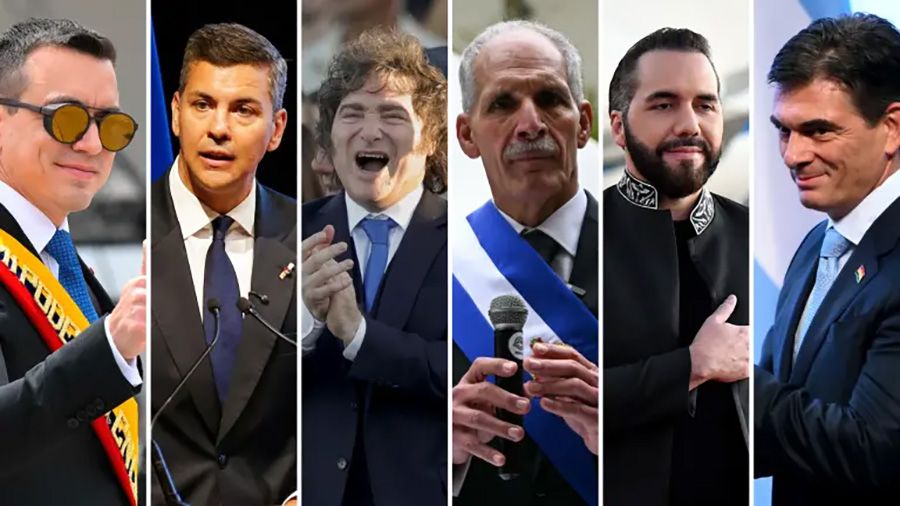 CB Consultora said fieldwork ran from February 10 to 15 across 18 countries, surveying 22,487 people in total
 El Salvador’s President Nayib Bukele tops a February 2026 regional ranking of Latin American leaders’ public approval, according to a survey by Argentina-based CB Consultora Opinión Pública. Bukele posts 72.6% approval and 24.8% disapproval.
Mexico’s President Claudia Sheinbaum ranks second with 68.5% positive ratings and 29.9% negative. Nicaragua’s President Daniel Ortega places third at 62.1% approval and 35.1% disapproval—one of the month’s most striking results given Nicaragua’s domestic political backdrop.
At the bottom of the table, Venezuela’s acting president Delcy Rodríguez records the weakest numbers in the ranking, with 23.7% positive image and 72.7% negative. Rodríguez was sworn in on January 5 after U.S. forces captured Nicolás Maduro, a political shift that has reverberated across the region and coincided with moves such as the passage of an amnesty law in February.
Higher up the list, the survey places Dominican Republic President Luis Abinader (54.8% positive; 41.1% negative) and Costa Rica’s President Rodrigo Chaves (53.2% positive; 43.3% negative) among the stronger performers.
In the middle tier, Brazil’s President Luiz Inácio Lula da Silva stands at 49.2% positive and 47.5% negative. Argentina’s President Javier Milei posts 46.8% approval against 51.7% disapproval, after having led a previous regional reading in the firm’s tracking.
Lower down are, among others, Chile’s Gabriel Boric, Paraguay’s Santiago Peña and Uruguay’s Yamandú Orsi—who is listed at 40.7% positive image and 56.5% negative.
CB Consultora said fieldwork ran from February 10 to 15 across 18 countries, surveying 22,487 people in total. National samples ranged from 2,004 to 2,630 respondents, with a 95% confidence level and a country-level margin of error of roughly ±1.9 to ±2.2 percentage points, according to the technical details released with the results.


Top Comments
Disclaimer & comment rules-

Read all commentsYou see! I told you all Lula was the world's greatest leader.
Feb 27th, 2026 - 02:05 am 0And Brazil is the world's greatest country.
This article just proves what I've been saying all along,
Brazil is great! U.S.A. is bad.
Down with the U.S.A.!
Go China!! Go Russia!! Go Iran!!
Commenting for this story is now closed.
If you have a Facebook account, become a fan and comment on our Facebook Page!