MercoPress. South Atlantic News Agency

Kast–Paz rapprochement opens door to potential restoration of Bolivia–Chile relations
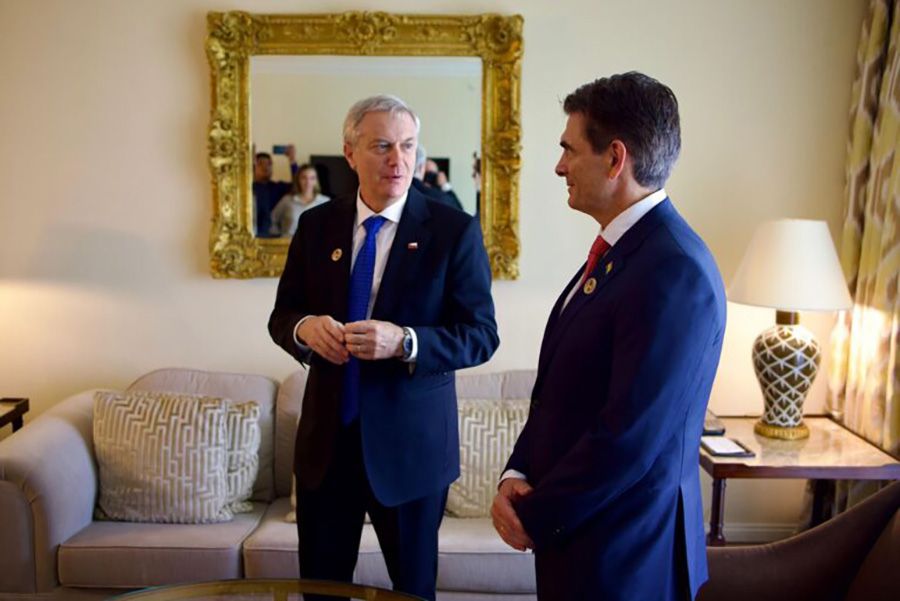 The diplomatic shift responds to a direct “mandate” from the presidents of both countries — far-right José Antonio Kast, who took office in Chile on March 11, and center-right Rodrigo Paz
 The foreign ministers of Bolivia, Fernando Aramayo, and Chile, Francisco Pérez Mackenna, agreed on Friday to deepen bilateral ties and advance a joint economic agenda, amid a decisive diplomatic rapprochement between the two countries after nearly five decades without ambassador-level relations. The meeting, held at an event organized by the Chamber of Industry, Commerce, Services, and Tourism (Cainco) in Santa Cruz, concluded a two-day official visit by the Chilean minister.
The diplomatic shift responds to a direct “mandate” from the presidents of both countries — far-right José Antonio Kast, who took office in Chile on March 11, and center-right Rodrigo Paz, who has led the Bolivian government since last November — according to Aramayo. “The need to deepen ties with a brotherly country like Chile is unmistakable,” said the Bolivian minister, who stressed that the goal is to “revitalize” his country's economy in partnership with the business sector.
Pérez Mackenna, in turn, underlined the constructive tone of the process. “We have discovered great opportunities for the future, but we have also identified problems. We are going to solve them together, through dialogue, visiting each other in La Paz, in Santa Cruz, but also in Santiago,” he said. The agenda discussed with nearly 70 business representatives from both countries included improvements in bilateral trade, customs and border facilitation, and the challenges associated with technological innovation.
The visit marks the most substantive advance in the bilateral relationship since 1978, when both countries formally broke diplomatic ties over the lack of a solution to Bolivia's centuries-old maritime claim. Since then, Bolivia and Chile have maintained only general consulates in La Paz and Santiago. On the Monday preceding the Santa Cruz meeting, the foreign ministers had issued a joint statement noting that “it is possible to advance toward the normalization of diplomatic relations in a constructive and proactive manner.”
As a concrete step, both governments signed an Air Services Agreement during the visit to improve bilateral connectivity and agreed to convene the Bolivia–Chile Political Consultation Mechanism in the near future; its last meeting was held in La Paz in 2010. The cooperation agenda also includes the fight against transnational organized crime, migration coordination, and the possibility of negotiating a free trade agreement.
The process unfolds within a settled legal framework. In October 2018, the International Court of Justice ruled that Chile has no legal obligation to negotiate Bolivia's maritime claim, the country having lost its access to the Pacific Ocean in the War of the Pacific (1879–1883). That ruling, adverse to La Paz, removed from the center of the bilateral agenda the claim that had historically blocked any progress. From the Bolivian side, interest has already been expressed in welcoming President Kast for a future official visit, which could consolidate the initial phase of this rapprochement.


Top Comments
Disclaimer & comment rulesCommenting for this story is now closed.
If you have a Facebook account, become a fan and comment on our Facebook Page!