MercoPress. South Atlantic News Agency



Argentine government pulls chapter on land sales to foreigners from Senate debate
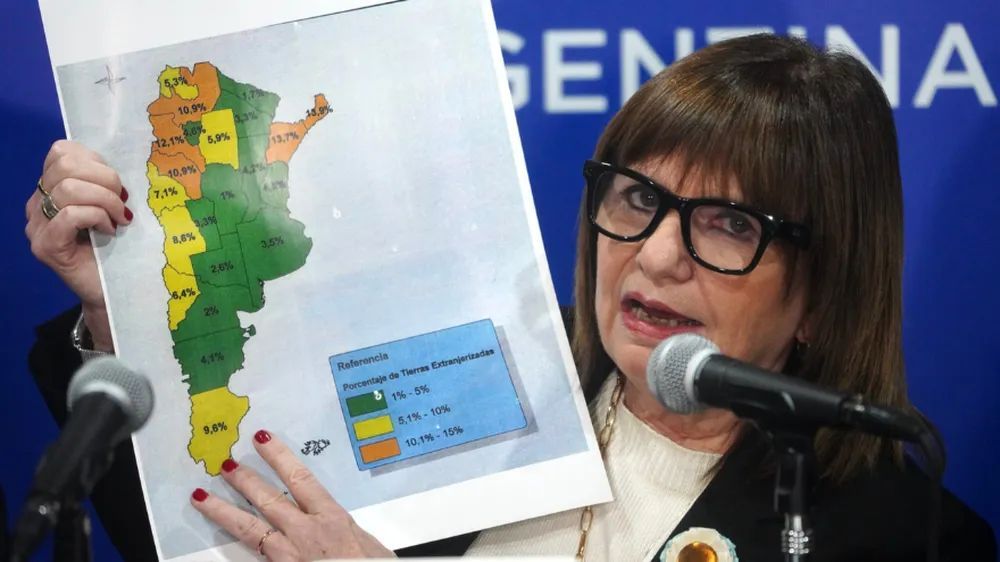 The decision was sealed at a meeting led by the governing bloc's leader, Senator Patricia Bullrich, with allied caucus chiefs, after several governors signaled their senators would vote against
 Argentina's governing bloc withdrew on Wednesday the rural land chapter of the Inviolability of Private Property bill from the Senate agenda, lacking the votes to pass it and hours before the session scheduled for Thursday.
“It was resolved by consensus to postpone consideration of the chapter of the bill concerning the rural land regime,” a spokesman for the La Libertad Avanza bloc and its allies told EFE, adding that the decision was unanimous, aimed at building broader consensus, and does not amount to permanent removal. Other outlets describe it as the chapter being dropped; according to Ámbito, reviving it would require a new bill from the executive.
The decision was sealed at a meeting led by the governing bloc's leader, Senator Patricia Bullrich, with allied caucus chiefs, after several governors signaled their senators would vote against. Tucumán's Osvaldo Jaldo and Neuquén's Rolando Figueroa said so publicly, along with figures close to Salta's Gustavo Sáenz, joined by Radical senator Daniel Kroneberger. Vote counts circulating in the Argentine press put the tally at 35 to 34 against.
It was the fourth attempt to take up the text, submitted on March 27 with 53 articles, after more than a dozen versions of the committee report. A demonstration is called for Thursday outside Congress under the slogan “The homeland is not for sale.” A poll released on July 28 put support for limiting land purchases by foreigners at 77%.
The law in force, passed in 2011, bars foreigners from holding more than 15% of rural land and applies that cap at three levels: national, provincial and municipal. It also limits any single foreign holder to 1,000 hectares in the core farming region.
The original bill eliminated the cap. Facing resistance, the government offered to raise it to 25%, but that version introduced a further change: it applied the limit by province only, removing the national and municipal levels. The modification is substantive because the operative constraint was never at the larger scales. According to the National Registry of Rural Land, no province comes close to the cap — Santa Cruz stands at 9.63%, Tierra del Fuego at 7.74% and Neuquén at 6.4% — while several departments exceed it substantially: San Carlos reaches 59% and Molinos 57% in Salta, General Lamadrid 56% in La Rioja and Lácar 54% in Neuquén. Those figures reflect holdings predating 2011, since the law was not retroactive, and the registry publishes data by department rather than by municipality.
The Land Observatory, made up of researchers from CONICET and the University of Buenos Aires, estimates 13.2 million hectares are in foreign hands, close to 5% of national territory and an area comparable to Greece or Nicaragua. It warned the bill opens the territory to market logic without sufficient safeguards. That measurement covers the whole country, and differs from the official registry's calculation for rural land.
The rest of the initiative, promoted by Deregulation Minister Federico Sturzenegger, will be debated on Thursday. It provides for a restrictive interpretation of public utility in expropriations, with compensation for lost profits when a direct consequence; faster evictions, extending standing to any party invoking a plausible right, with up to ten days to offer housing solutions where minors, people with disabilities or older adults are involved; and changes to the Real Estate Property Registry.
It also amends the Fire Management Law: it repeals the 60-year protection period following fires in native or planted forests and natural areas, while providing for restoration work, and removes the 30-year ban on real estate developments or farming activity on burned land in agricultural and grassland areas.


Top Comments
Disclaimer & comment rulesCommenting for this story is now closed.
If you have a Facebook account, become a fan and comment on our Facebook Page!