MercoPress. South Atlantic News Agency
Burnham at the UN: “the rights of British territories to remain British”
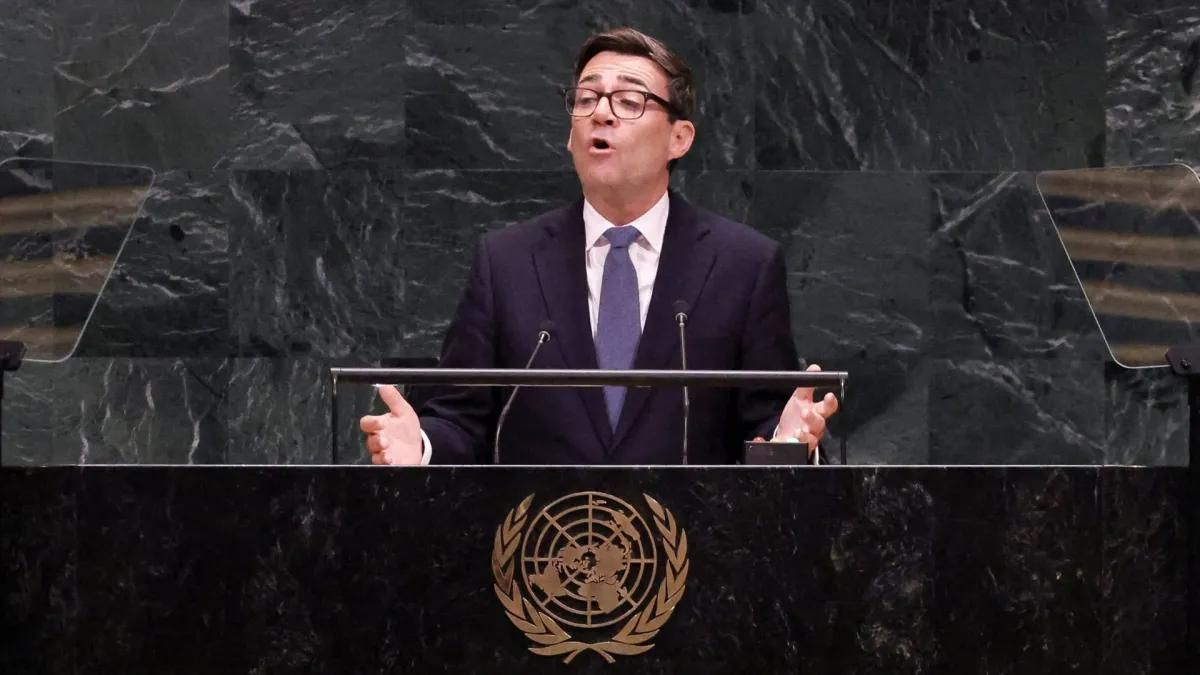 “We will stand firm in the face of any threats and challenges to the rule of law,” he said
 British Prime Minister Andy Burnham placed the Falklands among the challenges to the rule of law in his first address to the United Nations General Assembly, delivered on Tuesday evening in New York, setting them in the same sentence as Russia.
“We will stand firm in the face of any threats and challenges to the rule of law,” he said. “Not just from Russia, but also from others, including where they threaten the rights of British territories to remain British, such as the Falkland Islands.” He did not mention Argentina at any point in the speech.
The wording goes further than his September 9 statement to the House of Commons, when he said his government would be “relentless” in defending the islanders' right to choose to be British. Hours before the speech, after his first meeting with US President Donald Trump, the prime minister said he had raised the issue: “I felt I owed it to the people, obviously in the Falklands and back at home, to make the position very clear and that's what I've done today.”
The same day left the Chagos Islands agreement in doubt. The deal transfers sovereignty over that British territory to Mauritius, with a subsequent lease of the Diego Garcia base. Trump called it “terrible” and “ridiculous” and said Burnham was “going to be looking at it”; the prime minister replied “yep”. Asked later by the BBC whether the deal was dead, he did not deny it, saying he had inherited it and that “we need a resolution” safeguarding the base's future. The cost is measured three ways: the government cites £3.4 billion in net present value, around £101 million a year over 99 years; the Conservative opposition uses the £34.7 billion nominal cash total; a third measure puts it at about £10 billion.
Most of the speech was devoted to what Burnham called an “industrial-scale assault” by hostile actors on Britain's information environment. According to the prime minister, Russian agencies used bots, fake websites and falsified newspaper articles, forged the branding of 28 British organisations including universities and the BBC, amplified far-right narratives, and there is evidence they tried to interfere in the 2019 general election. He put Kremlin spending on information manipulation at around £1.3 billion a year. These are British government assertions, presented without accompanying public documentation. He announced he had tasked security chiefs with beginning work on a National Centre for Information Defence and offered to share British experience with other countries, following support given to Moldova.
On artificial intelligence, Burnham called for “a single set of global principles and standards” and said he would put the issue at the heart of Britain's G20 presidency next year, alongside a new AI defence partnership with the United States to protect critical national infrastructure. Trump, in his own address, rejected any “globalist scheme” of regulation.
The prime minister also backed Ukraine, criticised Russian strikes on civilian energy infrastructure and, on the Middle East, said the Israeli government's actions in Gaza and the West Bank are not justified, after condemning the Hamas attack of October 7, 2023. He listed measures taken with Foreign Secretary Ed Miliband: banning trade with illegal settlements, recognising the occupation as unlawful and sanctioning those involved in settlement construction.
Argentina claims sovereignty over the archipelago, has 60 administrative proceedings open with no penalty applied and three criminal complaints covering ten companies, and last week sent Congress a sovereignty bill. None of the allegations has been proven. In the 2013 referendum, 99.8% of voters chose to retain the status of a British overseas territory.

Top Comments
Disclaimer & comment rules-

Read all commentsAlong came 1970 - In 1945 the UN promoted decolonization. In 1970 only small territories remained to be decolonized, so the UN decided that these territories could remain as long as this was their free choice. (UNGA 2625 de 1970). A legal right.
Sep 23rd, 2026 - 02:19 pm 0Commenting for this story is now closed.
If you have a Facebook account, become a fan and comment on our Facebook Page!