MercoPress. South Atlantic News Agency


UK replies to Milei: “not the behaviour we expect of a democracy”
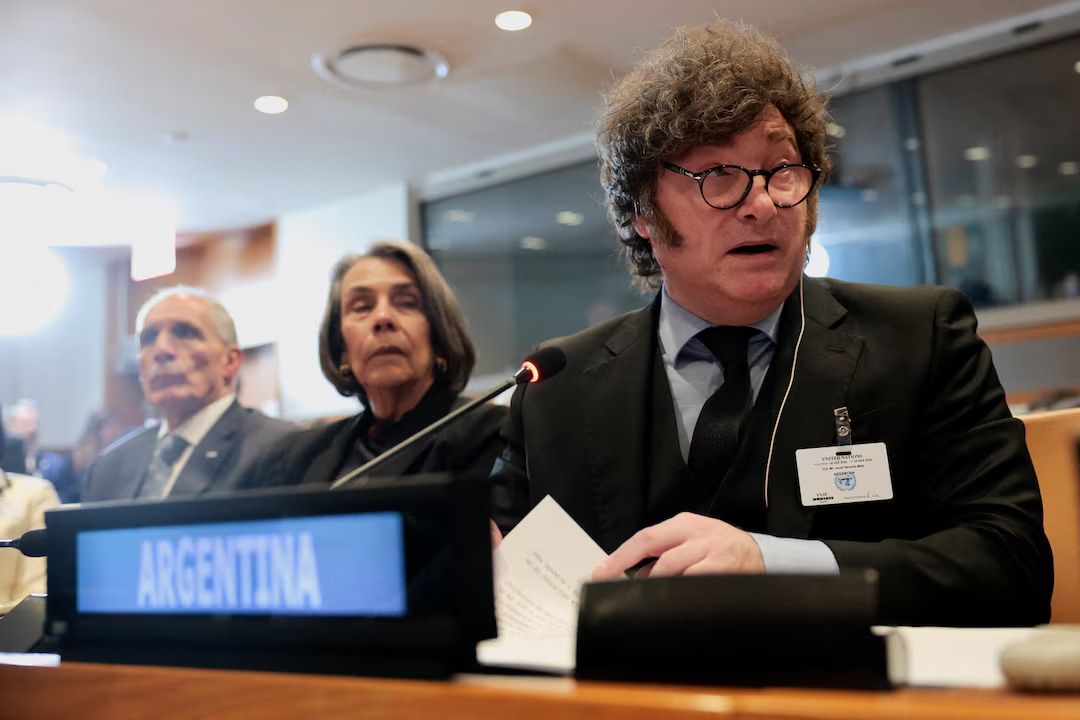 Photo: REUTERS/Kylie Cooper
 The United Kingdom has asked for a written statement to be placed in the official record of the UN General Assembly in response to Argentine President Javier Milei's address, saying Buenos Aires' conduct over the Falklands “is wholly incompatible with the principles established in the United Nations Charter and is not the behaviour we expect of a democracy”.
The text, released by the British mission to the organisation, was submitted under agenda item eight of the 81st session, after Milei referred on Wednesday to sovereignty over the archipelago and over South Georgia and the South Sandwich Islands. It is the same procedure London used in 2012 to reply to then president Cristina Fernández de Kirchner.
The document states that the United Kingdom “has no doubt” about its sovereignty over both territories and their surrounding maritime areas, and that it remains steadfast in supporting the islanders' right of self-determination, set out in the UN Charter and Article 1 of the two international human rights covenants. It says Argentina “continues to deny that this fundamental human right applies” to those inhabitants and actively seeks opportunities in international fora to assert its sovereignty claim.
The United Kingdom has no doubt about its sovereignty over the Falkland Islands.
— UK at the UN (@UKUN_NewYork) September 23, 2026
Our statement in response to the Argentine General Assembly Statement regarding the Falklands: pic.twitter.com/eWw8aS2MDI
The statement rebuts point by point the legal argument Milei set out. It says General Assembly Resolution 2065 “does not prohibit economic development or displace the Islanders' right of self-determination”, and that Resolution 31/49 “likewise does not limit or remove the rights of the Islanders to freely determine their political status and freely pursue their economic, social and cultural development”. It adds that calls for negotiations “do not modify or dilute the obligation of nations to respect the legally binding right of self-determination”. These are UK government positions, contested by Argentina.
On the ongoing dispute over oil companies, the text says efforts to obstruct and harass international companies involved in the archipelago's hydrocarbons, and other local industries, “are a wholly unacceptable attempt to exercise extra-territorial jurisdiction, and have no justification whatsoever in international law”, describing them as obstructive to global business and inconsistent with free trade. It further states that hydrocarbon development is a legitimate commercial venture regulated by the legislation of the archipelago's government in strict accordance with the UN Convention on the Law of the Sea, and that Argentine domestic law does not apply there.
The document includes a detail about the 2013 referendum that London does not usually highlight: alongside the 99.8% vote to maintain the current status, on a 92% turnout, the vote was supervised by independent observers from Canada, the United States, New Zealand and three South American countries: Uruguay, Chile and Brazil.
The statement closes a forty-eight-hour sequence. On Tuesday, Prime Minister Andy Burnham included the archipelago among the challenges to the rule of law in his address; that same night, Argentine Foreign Minister Pablo Quirno exercised the right of reply before the plenary and said “the illegal British occupation of the islands dates back to January 1833”, when the authorities and the established Argentine population were expelled. Milei spoke on Wednesday, and the British text followed hours later.
Argentina has 60 administrative proceedings open with no penalty applied and three criminal complaints covering ten companies and their directors. None of the allegations has been proven.

Top Comments
Disclaimer & comment rules-

-

-

Read all commentsMalvenense,
Sep 24th, 2026 - 05:28 pm +3A couple of historical facts:
1765 Great Britain raised the flag and claimed the Islands - Argentina not even the Provinces of the River Plate - existed then.
1833 - the civilians who were at Port Louis when the British returned again in and removed the couple of dozen or so militia of the Independent Provinces of the River Plate - Argentina still did not exist then.
Were addressed by the British Naval Commander and explained that they were totally free to decide to leave or to stay and carry on their lives etc there - but those who elected to stay would have to accept British Rules and Law and in due time become British Citizens.
2 couples- 1 Uruguayan and 1 Brazilian chose to leave.
All the others elected to stay and thus become British - this thus included all of those whose home had been the Provinces of the River Plate.
Their names and numbers were listed and given to the Captain to the vessel the took all back to Buenos and another copy went back to Britain and both are in the respective Archives of your Navy and the Royal Navy.
The oldest who remained, who came from your country- died in the 1860s and her headstone at her grave is there for all to see in Post Stanley Cemetery - remember all those at Port Louis were moved to Stanley in the 1840s as the settlement was moved.
Malvi
Sep 25th, 2026 - 01:34 pm +3You want to 'negotiate' yet at the same time say there is nothing to negotiate.
In the famous words of General Galtieri...“The Argentine people are the stupidest people on the planet”.
You do post some crap. you know very well the evidence does not support your claim, you know very well its you that needs to go to the ICJ but has refused more than once, Scotland had a vote and said no. their is no support in Wales for any independence from the UK, in time Northern Ireland NOT Ireland may choose to join the Irish republic, they will decide, at the moment the majority do not wish to join the Republic. and no the Falklands do not belong to Argentina and never have, such an idiotic post from someone who refuses to accept facts and chooses to live in a fantasy world, grow up you sully little boy.
Sep 24th, 2026 - 04:25 pm +2Commenting for this story is now closed.
If you have a Facebook account, become a fan and comment on our Facebook Page!