MercoPress. South Atlantic News Agency
Antarctica
-
Thursday, December 31st 2020 - 08:00 UTC
Australia's Antarctic Program MPV Everest scheduled to leave Hobart next 9 January

MPV Everest arrived in Hobart, Tasmania, on Wednesday to commence work for the Australian Antarctic Program, resupplying Australian stations and changing over personnel this summer.
-
Tuesday, December 22nd 2020 - 08:46 UTC
Chilean army base in Antarctica detects 36 positive Covid-19 cases; Navy support vessel blamed
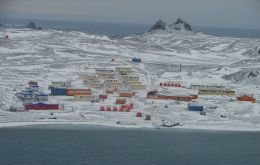
A coronavirus outbreak with 36 positive tests was reported on Monday at a Chilean Army base in Antarctica, the only continent, up to now, free of the virus. The army's Monday release said that at the Bernardo O'Higgins Riquelme base, following suspicions, swabbing testing was practiced in all personnel resulting in 36 positive cases, of which 26 belonging to the Army and ten to members of a contractor, doing maintenance work at the base.
-
Saturday, December 19th 2020 - 09:50 UTC
A68a iceberg heading for South Georgia shifts direction and loses a chunk of mass
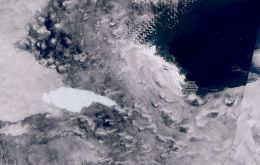
Strong currents have taken hold of a massive Antarctic iceberg that is on a collision course towards South Georgia Island, causing it to shift direction and lose a major chunk of mass, a scientist tracking its journey said on Friday.
-
Saturday, December 19th 2020 - 08:50 UTC
Falklands' register for UK's new polar ship RRS Sir David Attenborough
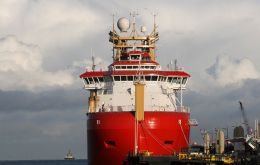
Britain’s new polar ship, the RRS Sir David Attenborough, has been registered on the British register of ships at Stanley, Falkland Islands.
-
Thursday, December 17th 2020 - 09:28 UTC
More than 30,000 tremors have rocked Antarctica since August, University of Chile
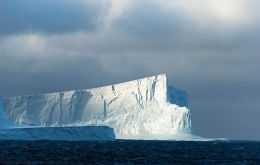
More than 30,000 tremors have rocked Antarctica since the end of August, according to the University of Chile, a spike in seismic activity that has intrigued researchers who study the remote, snowbound continent.
-
Tuesday, December 15th 2020 - 12:47 UTC
BAS to study impact of giant A'68 iceberg and fresh water on South Georgia's ecosystem
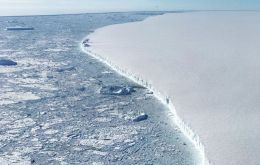
A research mission to determine the impact of the giant A-68a iceberg on one of the world’s most important ecosystems gets underway next month. A team of scientists, led by British Antarctic Survey (BAS), will set sail on the National Oceanography Centre’s (NOC) ship bound for the sub-Antarctic island of South Georgia.
-
Monday, December 7th 2020 - 09:20 UTC
World's largest iceberg approaching South Georgia: concerns it could get stuck in shallow waters
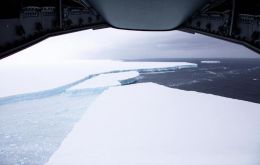
The world’s largest iceberg has been captured on camera drifting through the Southern Antarctic Front near the overseas British territory of South Georgia. British Forces South Atlantic Islands (BFSAI) used high-speed digital cameras attached to a military transport aircraft to capture rare images of the iceberg as it travelled towards the island.
-
Monday, December 7th 2020 - 09:06 UTC
Argentina launches the 2020/21 limited Antarctica campaign, with special care o no possible coronavirus contagion
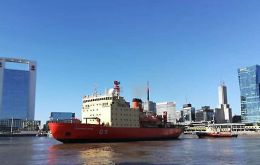
The official Argentine 2020/21 Antarctic season was launched last Friday with a ceremony at the Buenos Aires Navy pier where the icebreaker “ARA Almirante Irizar” was docked, but with no authorities boarding the vessel to avoid any possible coronavirus contagion.
-
Thursday, December 3rd 2020 - 09:39 UTC
RRS Sir David Attenborough delivered, BAS readies for intensive training and Arctic ice trials next year
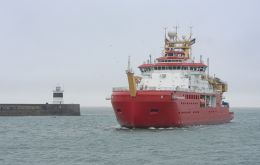
Britain’s new polar ship, the RRS Sir David Attenborough, has been handed over from Cammell Laird shipyard to the Natural Environment Research Council, NERC. Operated by British Antarctic Survey (BAS), the new polar ship will transform UK research in the polar regions. Its missions will be critical for understanding and making sense of our changing climate.
-
Thursday, December 3rd 2020 - 09:00 UTC
RRS James Clark Ross in South Georgia after seven weeks sailing
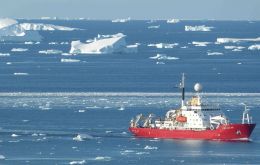
The RRS James Clark Ross has arrived at King Edward Point, South Georgia and the South Sandwich Islands, after seven weeks sailing south from the UK. For the staff disembarking at King Edward Point, this represents the culmination of a journey that started in quarantine in the UK in October to enable safe travel.

