MercoPress. South Atlantic News Agency
Economy
-
Friday, February 4th 2011 - 21:17 UTC
US recovery still needs help for stronger job creation, says Bernanke
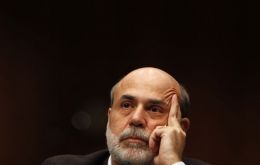
The US economic recovery still needs help from the Federal Reserve despite signs of improvement, the central bank's chairman Ben Bernanke said.
-
Friday, February 4th 2011 - 21:07 UTC
France and FAO call for greater regulation to curb commodities speculation

France and the U.N. food agency FAO warned on Friday about the risk of a new global food crisis and ensuing riots, calling for greater regulation to curb speculation on commodities markets.
-
Friday, February 4th 2011 - 21:02 UTC
EU top official visits Uruguay/Paraguay to advance trade talks with Mercosur

The European Union Trade Commissioner Karel De Gucht will travel next week to Paraguay and Uruguay to reinforce bilateral relations and to advance on the ongoing EU/Mercosur negotiations to reach an overall trade and cooperation agreement.
-
Thursday, February 3rd 2011 - 22:53 UTC
Copper hits a record price of 10.000 US dollars per ton and could keep soaring

Copper hit a record price of 10,000 USD per ton on Thursday on the back of growing worldwide economic optimism and concerns about the impact of an Australian cyclone on stretched global supplies.
-
Thursday, February 3rd 2011 - 22:02 UTC
UN forecasts period of “food volatility and supply disruptions”
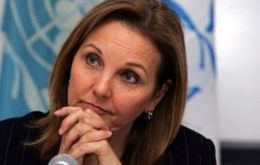
The world is going into a period of food volatility and supply disruptions due in part to weather related problems and a backdrop of rising prices, the UN World Food Program's executive director said.
-
Thursday, February 3rd 2011 - 21:56 UTC
Santander, Euro zone largest bank helped by solid results in UK and Brazil
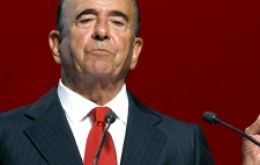
The collapse of the Spanish property prices helped pull annual profit down 8.5% at the Euro zone largest bank Santander. Solid results from Brazil and Britain, which each account for more profit than Spain at the diversified bank, failed to calm fears about exposure to a stagnant domestic economy, struggling to shake off the worst recession in half a century.
-
Thursday, February 3rd 2011 - 21:54 UTC
Brazilian industry loosing world market share to main trading partner, China
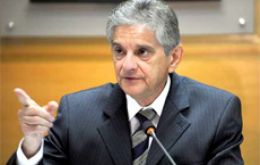
Competition with top trading partner China is costing Brazilian industry valuable market share, the National Confederation of Industry (CNI) in South America's largest economy said on Thursday.
-
Thursday, February 3rd 2011 - 21:17 UTC
With inflation pressures ‘contained’, ECB leaves interest rates unchanged

European Central Bank (ECB) has kept interest rates in the Euro zone unchanged at a record low 1%, despite fears of increasing inflation. Speaking at a press conference after the rate decision, the ECB president Jean-Claude Trichet claimed that inflation pressures remained contained.
-
Thursday, February 3rd 2011 - 19:12 UTC
Falklands receives 6.000 cruise visitors in one day; 90% satisfaction rate

FALKLAND Islands Tourist Board statistics showed a 90% satisfaction rate yesterday on the busiest day ever in Stanley’s cruise ship visitor history.
-
Thursday, February 3rd 2011 - 17:05 UTC
Air traffic strong recovery in 2010, but oil prices derail 2011 prospects

Air traffic increased 8.2% in the passenger business and 20.6% in freight according to the full 2010 report from the International Air Transport Association, IATA. Middle-East, Asia-Pacific and Africa regions were above average in passenger transport and Latinamerica led in cargo expansion.

