MercoPress. South Atlantic News Agency
International
-
Wednesday, April 4th 2012 - 22:33 UTC
Jimmy Burns updated edition of how Argentina lost the Falklands war

On the 30th anniversary of the invasion of the Falkland Islands Jimmy Burns launches an updated edition of “The Land that lost its Heroes” , How Argentina lost the Falklands war, which draws on unique access to military, diplomatic and intelligence sources in Argetina, the US and the UK plus other key players.
-
Wednesday, April 4th 2012 - 22:28 UTC
Falklands invites Peace laureates to visit the Islands and “see for themselves”

In an open letter the Falklands Islands elected government reminds Nobel Peace laureates that Falklanders as a people have the right to self-determination and that after 200 years of links with Britain, “we would consider any control (of the Islands) by Argentina as alien, and therefore a denial of our rights as a people”.
-
Wednesday, April 4th 2012 - 04:08 UTC
China says emerging economies suffering from major capital inflows caused by US monetary policy

China’s central bank Governor Zhou Xiaochuan said the US Federal Reserve must consider responsibility of the global effects of its actions as emerging-market economies suffer from capital inflows.
-
Wednesday, April 4th 2012 - 04:04 UTC
Spain with no relief: record unemployment and soaring national debt

Spain says its national debt will spiral sharply higher this year as data showed unemployment hit a record high in March, complicating efforts to stabilise the country's strained finances.
-
Wednesday, April 4th 2012 - 02:28 UTC
A decade later S&P lifts Uruguay’s rating to investment grade
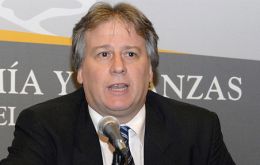
Uruguay’s credit rating was raised one level by Standard & Poor’s, which means the country has returned to investment grade for the first time in a decade.
-
Wednesday, April 4th 2012 - 01:47 UTC
YPF shares plummet on growing investors’ fear of Argentine government takeover
Shares in Argentina's biggest energy company, YPF plummeted on Tuesday because of growing investor fear over a possible government plan to seize control of the oil firm.
-
Wednesday, April 4th 2012 - 01:40 UTC
Argentina blasts PM Cameron ‘profound error’ of glorifying colonialism
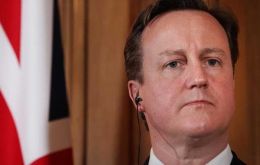
The Argentine Foreign Ministry strongly rebuked comments made by UK Prime Minister David Cameron on Monday, the thirtieth anniversary of the start of the Malvinas War and blasted the UK’s “persistent glorification of colonialism”.
-
Tuesday, April 3rd 2012 - 22:36 UTC
Foreign Office condemns violent actions against UK embassy in Buenos Aires
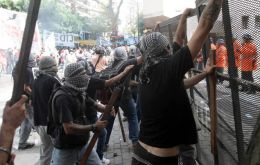
The Foreign Office condemned on Tuesday today what it called “violent actions of a minority” following Monday’s demonstration on the surroundings of the British Embassy located at the Recoleta neighbourhood, Buenos Aires City.
-
Tuesday, April 3rd 2012 - 22:33 UTC
Argentine Malvinas war June 14 surrender telegram auctioned for £ 7.250
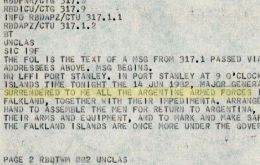
One day after the 30th anniversary of the beginning of the Malvinas war, Bonhams auction house sold a copy of the telegram with which Argentina surrendered in 1982, for £7.250.
-
Tuesday, April 3rd 2012 - 21:16 UTC
Standing invitation to C24 chair and fact finding commission to travel to Falklands
The Falklands government repeated on Tuesday its standing invitation to any current or future chair of the UN Decolonization Committee to visit the Islands and reiterated it welcomes any fact finding commission the C24 wishes to send.

