MercoPress. South Atlantic News Agency
Politics
-
Monday, February 14th 2022 - 08:47 UTC
Argentina to send military team to China to discuss arms deal
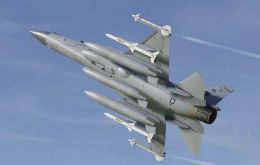
The Government of Argentina is planning to send a military team to China in March to broker the purchase of combat aircraft, for which over US $ 600 million have been allocated as per the 2022 Budget bill, it was reported.
-
Monday, February 14th 2022 - 08:13 UTC
UN envoy due in Bolivia to monitor Áñez's trial

A Special Rapporteur on the Independence of Judges and Lawyers sent by the United Nations (UN) is due in Bolivia this coming Tuesday at the invitation of the local government to assess the conditions under which former interim President Jeanine Áñez is brought to trial.
-
Monday, February 14th 2022 - 07:56 UTC
Russia-Nato war over Ukraine remains a distant possibility
By Gwynne Dyer - On January 18 US secretary of state Antony Blinken said that “our assessment has been that (a Russian invasion of Ukraine) could happen any time between mid-January and mid-February”.
-
Monday, February 14th 2022 - 07:45 UTC
Bolsonaro visits new populist friends, “strong man Putin” and Hungary's Viktor Orban

Brazilian President Jair Bolsonaro is scheduled to arrive in Russia on Tuesday for an official visit, which has been described at a highly awkward diplomatic timing, given the stand-off in Ukraine between Moscow and the Western alliance.
-
Monday, February 14th 2022 - 07:28 UTC
First Sea Lord outlines the Royal Navy of tomorrow, facing the challenges of Russia and China
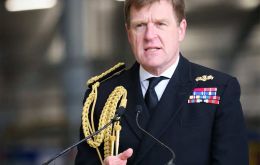
On the anniversary of the launch of Jacky Fisher’s HMS Dreadnought, First Sea Lord Admiral Sir Ben Key visited the Scottish shipyards building the Type 31 and Type 26 frigates and parts of the Dreadnought-class submarines.
-
Sunday, February 13th 2022 - 14:23 UTC
Eighty years since the “worst disaster and largest capitulation in British history”

This month marks 80 years since Singapore, a British colony with significant strategic importance was invaded and subsequently captured by the Empire of Japan. Its loss represented the lowest point of the war in the Far East and was a matter Prime Minister Winston Churchill never really got over.
-
Sunday, February 13th 2022 - 14:11 UTC
Royal Navy's fifth Astute-class submarine, HMS Anson, completes submerged dive tests
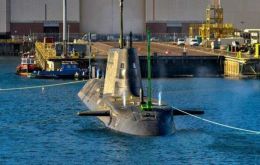
The Royal Navy's next attack submarine is one step closer to entering service after completing a major milestone. HMS Anson was submerged completely in a 'trim dive' at Devonshire Dock in Barrow.
-
Saturday, February 12th 2022 - 18:38 UTC
UK contribution to a Media Freedom Coalition and the safety of journalists

The UK has announced up to £600,000 for a new secretariat to help advance the work of the Media Freedom Coalition – a partnership of 50 countries working together to advocate for media freedom and safety of journalists and hold to account those who harm journalists for doing their job. The Coalition’s purpose is to defend media freedom where it is under threat.
-
Saturday, February 12th 2022 - 18:20 UTC
Antarctica thick ice conditions challenge RRS Sir David Attenborough and Le Commandant Charcot
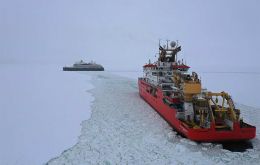
RRS Sir David Attenborough (SDA) has collaborated with the cruise ship Le Commandant Charcot in its efforts to deliver critical science cargo to the English Coast, Antarctica in support of the International Thwaites Glacier Collaboration.
-
Saturday, February 12th 2022 - 12:15 UTC
Britain, China and the Falkland Islands: Why the US must weigh in

By Dov S. Zakheim (*)This year marks the 40th anniversary of the Falklands War. Argentine forces invaded the Falkland Islands, a British Overseas Territory, on April 2, 1982.