MercoPress. South Atlantic News Agency
Tag: European Union
-
Tuesday, February 24th 2026 - 03:06 UTC
Uruguay moves toward ratifying EU–Mercosur deal after special committee approval
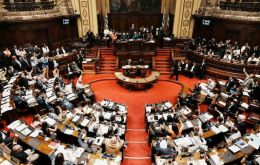
A special committee of Uruguay’s parliament tasked with reviewing the EU–Mercosur agreement approved the ratification bill on Monday, clearing the way for floor votes in the Senate and lower house in the coming days — a timetable that could make Uruguay the first Mercosur member to complete domestic approval.
-
Monday, February 23rd 2026 - 12:41 UTC
Italy seeks “clarity” from the US, urges calm amid renewed tariff uncertainty
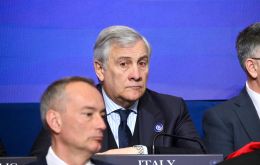
Italian Foreign Minister Antonio Tajani said on Monday he would seek “clarity” from the United States during a G7 videoconference on international trade and urged restraint as Washington’s latest tariff moves inject fresh uncertainty into transatlantic commerce.
-
Thursday, February 19th 2026 - 04:04 UTC
Mercosur–EU deal: Uruguay’s PIT-CNT urges sector impact studies for an “informed” Senate debate
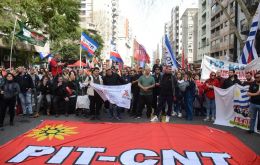
Uruguay’s PIT-CNT labour federation warned lawmakers that the debate on the Mercosur–European Union trade deal is moving forward without adequate sector-by-sector assessments, which it said “limits the possibility of an informed debate” on potential effects on industry, jobs and the country’s productive structure. The union confederation testified on Wednesday before a special Senate committee reviewing the agreement, alongside the Chamber of Industry (CIU) and the Rice Growers Association (ACA), ahead of a vote expected on Wednesday 25.
-
Sunday, February 15th 2026 - 16:28 UTC
Lagarde says Trump’s ‘kick in the butt’ has pulled European leaders closer
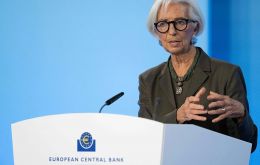
European Central Bank (ECB) President Christine Lagarde said on Sunday at the Munich Security Conference that a shift in US President Donald Trump’s stance toward Europe has acted as a political jolt, pushing European leaders into closer coordination.
-
Friday, February 13th 2026 - 04:09 UTC
Argentina moves first in Mercosur as lower house backs EU trade deal
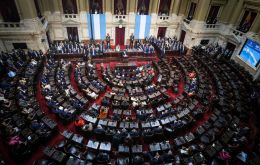
Argentina became the first Mercosur country to secure an initial legislative green light for the trade agreement with the European Union, after the Chamber of Deputies approved the text late on Thursday. The bloc also includes Brazil, Uruguay and Paraguay, which have launched their own domestic ratification processes.
-
Thursday, February 12th 2026 - 09:09 UTC
Hundreds of tractors roll into Madrid as farmers protest CAP cuts and EU-Mercosur accord

Thousands of farmers and ranchers, alongside hundreds of tractors, rallied in central Madrid on Wednesday to protest expected cuts in the next Common Agricultural Policy (CAP) and to denounce the European Union’s trade agreement with Mercosur, according to organisers and authorities.
-
Thursday, January 29th 2026 - 05:29 UTC
Latin American presidents seek common ground as regional blocs weaken
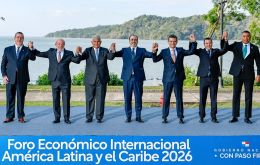
Seven sitting heads of government and one president-elect from Latin America and the Caribbean shared the stage in Panama on Wednesday to call for deeper regional integration, an increasingly rare show of cross-ideological alignment in a polarized region. The message was delivered at the International Economic Forum Latin America and the Caribbean, backed by CAF and designed as a high-level convening point for governments, business leaders and multilaterals.
-
Tuesday, January 27th 2026 - 15:33 UTC
EU and India seal historic trade deal after 18 years of talks
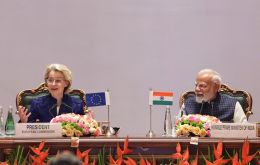
New Delhi and Brussels announced on Tuesday that they had concluded the largest bilateral trade deal in their histories after almost two decades of negotiations. The pact links India’s 1.4 billion-person economy with the 27-nation European Union and, according to both sides, will create a free-trade zone for around 2 billion consumers and sharply lower tariffs and other barriers that have long hindered commerce between the two regions.
-
Saturday, January 24th 2026 - 14:13 UTC
Brazil courted by U.S., EU over critical minerals amid geopolitical competition
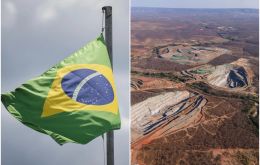
Brazil has positioned itself as a strategic player in the global competition for critical minerals such as graphite, nickel, and niobium, which are essential for clean energy technologies, batteries, and defense systems. Both the United States and the European Union have stepped up diplomatic and commercial engagement with Brasília to secure supply deals and cooperation in value chains considered vital for the energy transition and industrial security.
-
Friday, January 23rd 2026 - 23:04 UTC
EU and Ecuador wrap up talks on sustainable investment deal, EU’s first SIFA with Latin America
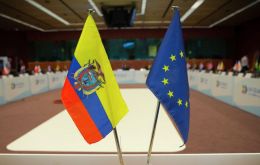
The European Union and Ecuador have concluded negotiations on a Sustainable Investment Facilitation Agreement (SIFA), in what Brussels is portraying as the bloc’s first such deal with a Latin American country, according to an EFE report on Friday.