MercoPress. South Atlantic News Agency
Tag: security
-
Friday, July 3rd 2026 - 08:55 UTC
In Uruguay, Kast urges harsher penalties for crime leaders and total prison isolation
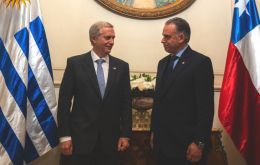
Chile's President José Antonio Kast argued on Wednesday in Montevideo that the region's countries must toughen their laws to combat organized crime, with life sentences for those who lead gangs and a regime of total isolation in prisons to stop them from continuing to operate from behind bars. The president laid out his position after meeting with Uruguayan President Yamandú Orsi, as part of an official visit to Uruguay.
-
Thursday, July 2nd 2026 - 09:11 UTC
Uruguay and Chile agree to coordinate against organized crime after an Orsi-Kast summit
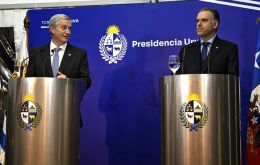
The presidents of Uruguay, Yamandú Orsi, and Chile, José Antonio Kast, agreed to strengthen bilateral cooperation against transnational organized crime, following a meeting held on Wednesday at the Suárez y Reyes presidential residence in Montevideo. In a joint statement, the leaders announced understandings on security, fisheries, Antarctica, the bi-oceanic corridor and economic integration, as part of Kast's official visit to Uruguay.
-
Wednesday, July 1st 2026 - 08:28 UTC
Mercosur leaders push for a regional security architecture against organized crime
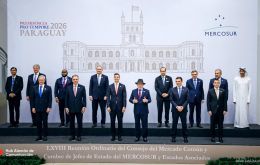
The fight against transnational organized crime emerged as one of the central themes of Mercosur's 68th summit of heads of state, held on Tuesday in the Paraguayan city of Luque, where several leaders called for building a regional security “architecture” with concrete goals and deadlines. The issue ran through the addresses of the bloc's presidents and those of its associated states, at a summit where Paraguay handed over the pro tempore presidency to Uruguay.
-
Wednesday, June 24th 2026 - 09:54 UTC
Uruguay to deploy army armored vehicles to patrol high-crime Montevideo neighborhoods
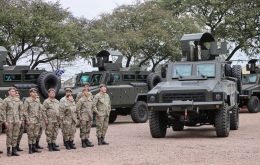
Uruguay's government announced that twelve Mamba MK-7 armored vehicles from the National Army will begin to patrol, under police command, the Montevideo neighborhoods with the highest crime rates, a measure to reinforce the fight against organized crime that has opened debate in the political system. Interior Minister Carlos Negro confirmed that his ministry is working on a “very advanced” agreement with the Defense Ministry to carry out the deployment in the coming days.
-
Wednesday, March 11th 2026 - 22:33 UTC
Uruguayans see security as top national concern, cost of living as main personal problem
Uruguayans continue to identify security and crime as the country’s main problem, but when the question shifts to everyday life, the dominant concern becomes the cost of living, according to a new survey by University of the Republic academics analysed in a report by El Observador. The poll also found that about one-third of respondents believe such problems stem from “longer inheritances” or broader trends that no government has managed to solve.
-
Saturday, April 8th 2023 - 10:17 UTC
Chilean Gov't to create a Security Ministry?
Chile's Interior Minister Carolina Tohá held a meeting Friday with the Speakers of both Houses of Congress to discuss concrete measures in the aftermath of the slain of three police officers. Senate Speaker Juan Antonio Coloma spoke of “a powerful effort by all” ahead as agreements between the Executive and the Legislature are to be reached. In addition to Lower House Speaker Vlado Mirosevic, the meeting was also attended by Justice Minister Luis Cordero.
-
Monday, June 6th 2022 - 10:29 UTC
Lacalle Pou: “it is not true that security has worsened” in Uruguay
Uruguayan president Luis Lacalle Pou addressed on Sunday public security and replied to criticism from opposition left-wing party Frente Amplio’s (Broad Front).
-
Tuesday, May 17th 2022 - 09:46 UTC
Security becomes a concern for Chile's gov't
Chile's Minister of the General Secretariat of the Presidency, Giorgio Jackson, Monday admitted the Government was reviewing security measures to be taken in the future following a robbery at the home of Defense Minister Maya Fernández and a shooting against one of President Gabriel Boric Font's bodyguards.
-
Saturday, July 4th 2020 - 07:15 UTC
UN questions as “vague and overly broad” Hong Kong's national security law
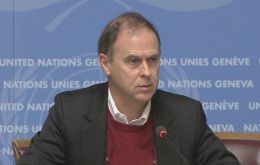
The UN human rights office voiced concern on Friday that “vague and overly broad” provisions in the national security law for Hong Kong may lead to arbitrary interpretation and prosecutions of activists in violation of freedoms of assembly and expression.
-
Tuesday, January 7th 2020 - 09:42 UTC
Argentina boosts security as US/Iran conflict escalates
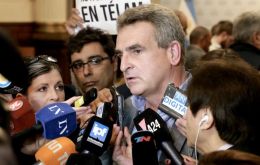
Argentina’s government boosted security at its airports, borders and the U.S. Embassy in Buenos Aires as tensions simmer between the United States and Iran, the Argentine defense minister told local media on Monday.