MercoPress. South Atlantic News Agency
Tag: security
-
Wednesday, May 8th 2019 - 09:58 UTC
Bolsonaro signs decree making it easier to own, carry and import weapons
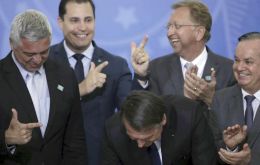
Brazil's President Jair Bolsonaro signed a decree on Tuesday making it easier for gun enthusiasts to own, carry and import weapons in one of the world's deadliest countries. Beaming members of Congress and industry lobbyists clapped and made pistol signs with their hands as the ex-army captain relaxed rules that critics fear could pave the way for the carrying of weapons in the streets.
-
Monday, April 22nd 2019 - 08:34 UTC
Record violence and killings in Mexico in the first quarter: 8.943 murders
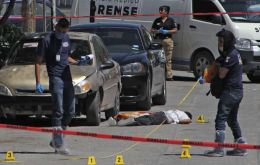
Violence in Mexico hit new heights in the first quarter of 2019, with 8,493 murders recorded from January to March, according to official figures. According to the Executive Secretariat of the Public Security National System, that number represents a 9.6% rise on the same period in 2018.
-
Monday, February 18th 2019 - 09:44 UTC
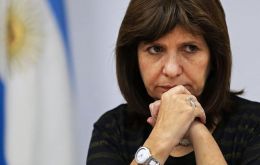
Argentine Security minister making headlines with her tough on crime policy
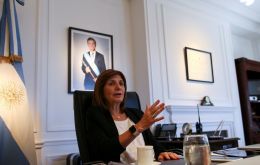
Argentina's government, with one eye on elections later in the year, is getting tough on crime, and one figure is taking centre stage: the country's security tsar. Patricia Bullrich, 62, the security minister, is pushing a series of new tough-on-crime measures, including dropping the age for juvenile convictions, equipping cops with stun guns and trialling facial recognition at train stations.
-
Tuesday, January 22nd 2019 - 10:11 UTC
Brazilian government trying to recover control over its overloaded prison system
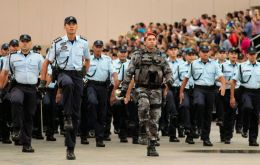
Police and soldiers are being deployed in large numbers to Brazil's northeast to fight a wave of gang violence fueled by the overloaded, collapsing prison system. More than 400 elite federal troops have been sent to the city of Fortaleza and the rest of Ceara state to reinforce overwhelmed local cops, who face a dramatic rash of attacks on government buildings, buses, police stations, banks and bridges by well-armed gang members.
-
Monday, January 7th 2019 - 09:23 UTC
Organized crime challenges Bolsonaro despite deployment of federal forces
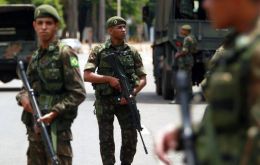
The attacks and fire-bombings sweeping Brazil's northeastern state of Ceara continued unabated Sunday despite the deployment of at least 300 members the elite, military-style National Police Force to help bring an end to the violence.
-
Friday, November 30th 2018 - 21:40 UTC
Anti-globalist protests and controversy over the use of lethal weapons: Argentine Minister of Security came out to clarify in the framework of the G20
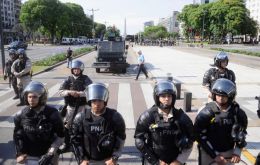
After the controversy generated by a resolution in which the Ministry of Security of Argentina allows the police to use lethal weapons against a person who flees in the framework of the summit of the Group of 20 in Buenos Aires, the minister Patricia Bullrich went to clarify that this disposition “has nothing to do with the mobilization” against the G20 crowded by social organizations this Friday.
-
Thursday, November 29th 2018 - 09:27 UTC
G 20 summit: Buenos Aires residents invited to leave the city Thursday afternoon for a long weekend
Argentina has launched a massive security operation to try to ensure a calm meeting of the leaders of the G20 bloc of nations in Buenos Aires, calling a national bank holiday on Friday and shutting down the city’s main business district.
-
Thursday, November 15th 2018 - 19:30 UTC
Giuliani lays out security plan with President Vázquez in Uruguay
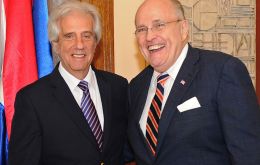
Former New York Mayor Rudolph Giuliani met Tuesday with Uruguay's President Tabaré Vázquez in Montevideo and agreed to work on a new security proposal adjusted to the local situation.
-
Thursday, February 15th 2018 - 01:14 UTC
United States Travel Advisory for Uruguay

The United States Travel Advisory for Uruguay offered a not very encouraging description of the country for foreign visitors but anyhow is well distanced from most of the rest of Latin American, and neighbors.
-
Friday, October 28th 2011 - 20:39 UTC
Six our of fourteen of the world’s most violent countries are in Latin America
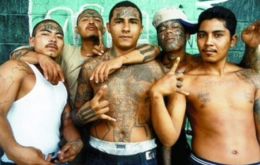
Six of the 14 most violent countries in the world are in Latin America revealed the second edition of the report “Armed Violence and Development” published Thursday in Geneva by the Secretariat from the Geneva Declaration on Violence and Development, a diplomatic initiative born in 2008.