MercoPress. South Atlantic News Agency
Tag: UK Natural Environment Research Council (NERC)
-
Thursday, February 5th 2026 - 00:36 UTC
The RRS Shackleton incident when an Argentine destroyer opened fire on the research vessel
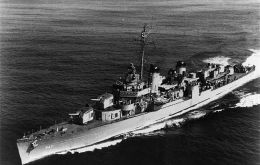
On this day but in 1976 a very serious incident occurred in the South West Atlantic when the British research vessel RRS Shackleton was intercepted and fired upon by the Argentine destroyer ARA Almirante Storni, some 78 miles south of Cape Pembroke in the Falkland Islands.
-
Monday, November 3rd 2025 - 19:52 UTC
Discovery Building, a milestone for Rothera Base and BAS in Antarctica

The 2025/2026 Antarctic season is a landmark for the British Antarctic Survey (BAS) and its Antarctic Infrastructure Modernization Project (AIMP), as the new Discovery Building begins to take on its operational role. Specialist teams will be on site from this month to check the building’s critical systems are working as expected and to carefully manage the removal of six older structures, the functions of which are now integrated within the Discovery Building.
-
Sunday, December 1st 2024 - 23:21 UTC
Argentina authorize RRS James Cook research missions in the Southwestern Atlantic
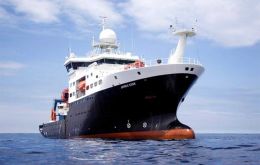
The Argentine Federal Fisheries Council has agreed to grant authorization to Britain’s RRS James Cook belonging to the Natural Environment Research Council, NERC, to advance scientific research operations in Argentina’s EEZ, involving two main projects.
-
Monday, April 18th 2022 - 09:49 UTC
UK investing heavily in Antarctica and Arctic research to remain world leader in polar science
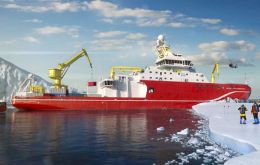
The UK is investing in modernizing its Antarctica and Arctic research facilities, with total funding of £670 million, including £290 million announced this week. As a world leader in polar science, UK research conducted in the region is of global importance. This is in addition to existing science funding activities.
-
Tuesday, March 2nd 2021 - 09:57 UTC
After thirty years of prolific research, RRS James Clark Ross makes final call to the Falklands
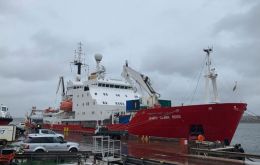
The RRS James Clark Ross (JCR) made her final call to her homeport of the Falkland Islands on Monday March first, since after thirty years of service, the JCR will be sold at the end of her 20/21 Antarctic season.
-
Saturday, December 19th 2020 - 08:50 UTC
Falklands' register for UK's new polar ship RRS Sir David Attenborough
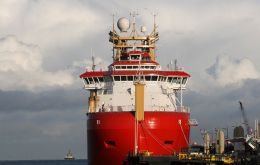
Britain’s new polar ship, the RRS Sir David Attenborough, has been registered on the British register of ships at Stanley, Falkland Islands.
-
Tuesday, April 28th 2020 - 08:17 UTC
Antarctica's Rothera new wharf becomes operational and is waiting for RRS Sir David Attenborough
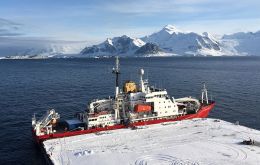
A new £40 million wharf to moor the RRS Sir David Attenborough has been used by polar ships for the first time at British Antarctic Survey’s Rothera Research Station in Antarctica to transport staff and materials back to the UK.
-
Wednesday, May 2nd 2018 - 08:13 UTC
UK-US launch Antarctica research program to predict sea-level rise
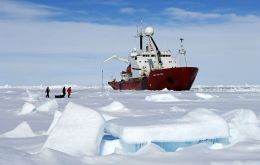
A new UK-U.S. Antarctic research program to improve the prediction of future sea-level rise was launched on Monday at British Antarctic Survey (BAS), Cambridge. The £20 million 5-year research collaboration, funded jointly by the UK Natural Environment Research Council (NERC) and the U.S. National Science Foundation (NSF), brings together over 100 polar scientists from leading UK and U.S. research organizations.