MercoPress. South Atlantic News Agency
United States
-
Tuesday, September 1st 2026 - 09:23 UTC
The Venezuelan oil concession goes to Alejandro Betancourt's firm, under investigation in Europe

The White House on Monday identified the company that will operate seventeen Venezuelan oil fields for a century in partnership with the US government: North American Blue Energy Partners, owned by Venezuelan businessman Alejandro Betancourt, who is under investigation in Switzerland and Spain over his alleged involvement in a scheme to launder funds from the state oil company PDVSA. There is no conviction against him.
-
Sunday, August 30th 2026 - 23:54 UTC
Maduro releases his first images from the Brooklyn jail, taken two months ago

Former Venezuelan president Nicolás Maduro released on Sunday, through his X account, the first known photographs since he entered the Metropolitan Detention Center in Brooklyn, New York, where he has been held since January. The images show him in sportswear making a victory sign.
-
Saturday, August 29th 2026 - 04:58 UTC
The US will control 55% of output from the new oil company in Venezuela
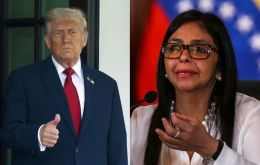
US President Donald Trump announced on Friday an agreement with Venezuela's interim government granting Washington majority control over more than 65 billion barrels of proven Venezuelan crude reserves, around 21% of the country's total. Acting president Delcy Rodríguez confirmed the deal.
-
Friday, August 28th 2026 - 19:35 UTC
The US waives beef tariffs for Brazil and Paraguay, but not for Argentina and Uruguay
US President Donald Trump signed a proclamation on August 26 temporarily waiving tariffs on imports of up to 300,000 tonnes of lean beef trimmings, a measure that excludes countries already holding their own quotas in the US market, among them Argentina and Uruguay. The main beneficiaries will be Brazil and Paraguay.
-
Friday, August 28th 2026 - 14:15 UTC
Washington negotiates stakes in Venezuelan oil fields with leases of up to a century
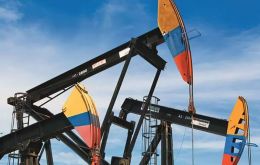
The United States government is negotiating with Venezuela's interim administration to acquire stakes in a group of the South American country's oil fields, under arrangements that would include leases of up to a hundred years, the outlets Axios and Bloomberg reported on Thursday citing unnamed senior US officials.
-
Thursday, August 27th 2026 - 21:32 UTC
Specialist outlets estimate GTA VI absenteeism could cost the US a billion dollars

Video game and technology outlets estimate that the launch of Grand Theft Auto VI, scheduled for November 19, could cost the United States economy more than a billion dollars in lost productivity, due to the number of workers expected to skip work to play. The estimate has circulated within the sector's digital ecosystem since last year and does not come from a published study.
-
Thursday, August 27th 2026 - 08:20 UTC
Beijing asks Washington to “overcome obstacles” before Xi's White House visit
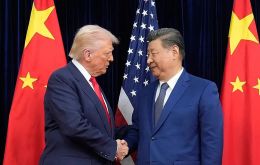
Chinese Foreign Minister Wang Yi has urged the United States to “remove interference” and “overcome obstacles” in high-level exchanges between the two countries, during a meeting in Beijing on Wednesday with US Ambassador David Perdue, as part of preparations for President Xi Jinping's state visit to Washington.
-
Wednesday, August 26th 2026 - 16:41 UTC
The US postpones residence visa interviews at all its consulates

The United States State Department has instructed its embassies and consulates worldwide to reschedule immigrant visa interviews, the category covering applicants for permanent residence from abroad, while consular officers complete a training programme on admissibility criteria.
-
Friday, August 21st 2026 - 05:20 UTC
US gross national debt passes 40 trillion dollars for the first time
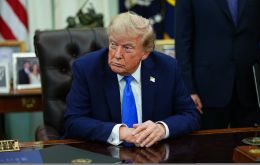
The gross public debt of the United States reached 40.047 trillion dollars on Tuesday, according to data released by the Treasury Department. It is the first time the figure has crossed that threshold, and it has arrived earlier than expected: the Congressional Budget Office had projected 39.4 trillion by the end of fiscal 2026 and placed the jump to 40 trillion in 2027.
-
Tuesday, August 18th 2026 - 22:06 UTC
Trump posts a map designating the Strait of Hormuz as “new US territory”
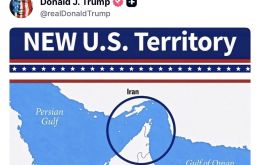
US President Donald Trump on Tuesday posted an image on his Truth Social platform showing a map of the Strait of Hormuz circled and captioned “NEW U.S. Territory,” above a band in the colours of the American flag. The post carried no accompanying text.