MercoPress. South Atlantic News Agency
Uruguay
-
Sunday, May 17th 2026 - 13:48 UTC
Brazil leads South America's military spending and Uruguay posts one of the largest relative rises, SIPRI says
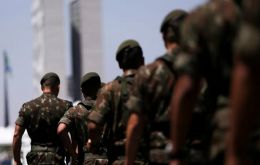
Brazil consolidated its position as South America's leading defense spender during 2025, with a military budget of approximately USD 23.9 billion and a 13% year-on-year increase, while Uruguay recorded one of the steepest relative rises in the region, according to the annual report of the Stockholm International Peace Research Institute (SIPRI) released on Saturday. The region as a whole increased its military spending by 3.4% compared with 2024, in line with a global trend of armed forces modernization, open conflicts, and growing geopolitical tensions.
-
Friday, May 15th 2026 - 13:27 UTC
Chilean former president defends “people-centered” multilateralism in Montevideo against authoritarian projects

Former Chilean President Michelle Bachelet, currently a candidate for the United Nations Secretary General, defended on Thursday in Montevideo the need for “a more representative, inclusive, and people-centered multilateralism” in the face of advancing “authoritarian projects” in the international order, during the keynote of the seminar “Geopolitics, Multilateralism, and Risks to Gender-Parity Democracy in the New International Order.” The event, organized by IDEA Internacional, is taking place at Uruguay's Legislative Palace as part of the Latin American Women in Politics Meeting, which brings together regional political leaders until Friday.
-
Friday, May 15th 2026 - 03:05 UTC
Uruguay: Orsi's disapproval climbs to 48% as approval falls to 27% in his first year in office
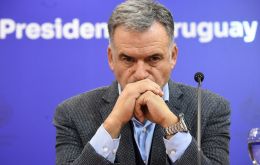
Uruguayan President Yamandú Orsi's administration recorded a significant deterioration in public approval as the government marked its first year in office, according to the latest survey by the polling firm Equipos released on Thursday on the Subrayado newscast. The president's disapproval rose to 48%, up from 40% in February, while approval fell from 33% to 27% over the same period. Intermediate assessments held roughly steady at around 23%, and 2% of respondents declined to answer.
-
Thursday, May 14th 2026 - 09:21 UTC
Orsi prepares for Washington visit after months of overtures to the Trump administration
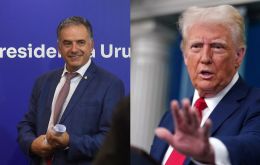
Uruguayan President Yamandú Orsi will travel to Washington “in the coming months” to meet with his US counterpart Donald Trump, in a meeting that national authorities describe as agreed and awaiting only the coordination of calendars, according to Foreign Minister Mario Lubetkin's confirmation on Wednesday before the Senate International Affairs Committee. The summit would crown a series of overtures by the Broad Front government toward the Republican administration, initiated in the early weeks of Orsi's term, which began in March, and which have generated controversy within the ruling coalition itself.
-
Wednesday, May 6th 2026 - 12:14 UTC
Uruguay's president meets Brazilian executives in São Paulo to open 'new phase' of commercial ties
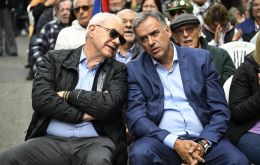
Uruguayan President Yamandú Orsi made a day trip to São Paulo on Tuesday to meet Brazilian business leaders interested in investing in Uruguay, in an agenda Foreign Minister Mario Lubetkin described as an opportunity to “move to a new phase in the levels of commercial development and Brazilian investments” in the South American country. The official delegation included Lubetkin himself, Economy and Finance Minister Gabriel Oddone, Uruguay's ambassador to Brazil Rodolfo Nin Novoa, and the executive director of investment promotion agency Uruguay XXI, Mariana Ferreira.
-
Monday, May 4th 2026 - 01:39 UTC
Orsi follows Milei and Kast aboard USS Nimitz as opposition alleges unconstitutionality
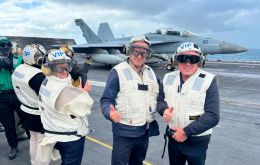
Uruguayan President Yamandú Orsi visited the nuclear-powered aircraft carrier USS Nimitz of the United States Navy in international waters off the Uruguayan coast on Saturday, in a new chapter of the Southern Seas 2026 regional deployment, following the steps of Argentine President Javier Milei and Chilean President José Antonio Kast, who had toured the same vessel in previous weeks. The invitation was extended by the US ambassador in Montevideo, Lou Rinaldi, and the delegation was transported from Carrasco Air Base No. 1 to the carrier's deck aboard a Grumman C-2 Greyhound military aircraft of the US Armed Forces.
-
Friday, May 1st 2026 - 06:40 UTC
After 25 years of negotiation, the Mercosur-EU agreement takes effect this Friday
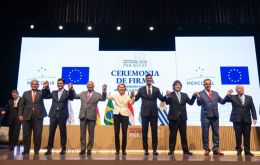
The association agreement between Mercosur and the European Union (EU) enters provisionally into force on Friday May 1, after more than a quarter-century of negotiations, in what constitutes one of the world's most ambitious trade deals and the largest reciprocal opening ever finalised by the South American bloc. The final signing took place on January 17 in Asunción and, although final ratification by the European Court of Justice and subsequent approval by the European Parliament remain pending, provisional entry into force allows the immediate start of tariff reductions covering 95% of Mercosur products and 91% of EU products.
-
Tuesday, April 28th 2026 - 19:22 UTC
Ex-President Lacalle Pou: 'I will not die without seeing Paraguay have a sea outlet in Uruguay'
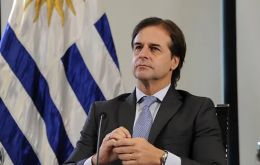
Former Uruguayan President Luis Lacalle Pou (2020-2025) reignited the debate on Tuesday over the construction of a port in Uruguayan territory aimed at providing Paraguay with maritime access, during an event in the Paraguayan city of Santa Rita, in the Alto Paraná department. “I will not die without truly seeing Paraguay have a sea outlet in Uruguay. I am convinced we must move forward on this,” the political leader said at the gathering held to mark the tenth anniversary of the alliance between local company Sul América Insumos Agrícolas and Uruguayan firm Proquimir.
-
Monday, April 27th 2026 - 20:45 UTC
Mercosur Parliament recalls Pope Francis as a 'peacebuilder' from the global south
The Mercosur Parliament (Parlasur) held a special session in Montevideo on Monday to mark the first anniversary of the death of Pope Francis, who passed away on April 21, 2025, in which lawmakers and religious representatives from the bloc's member states highlighted the late Argentine pontiff's legacy as an international mediator, advocate for the most vulnerable, and a geopolitical figure who emerged from “the periphery.” The tribute, titled “Francis, the Pope of peace: toward a geopolitics of peace in Mercosur,” took place in the Uruguayan Chamber of Representatives at the Legislative Palace.
-
Monday, April 27th 2026 - 03:04 UTC
Hungary's incoming PM says Orbán-linked oligarchs are moving funds to Uruguay and other destinations
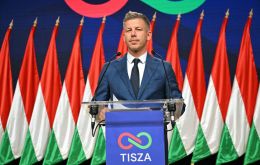
Hungary's incoming prime minister, Péter Magyar, alleged on Saturday that oligarchs linked to outgoing leader Viktor Orbán are transferring “tens of billions” of forints to Uruguay, the United Arab Emirates, the United States, and “other distant countries,” in what he described as a coordinated operation to move capital out of the country ahead of the government transition scheduled for May 9.