MercoPress. South Atlantic News Agency



Patagonian pumas add penguins to their diet in unprecedented predator-seabird interaction
 The dietary shift reflects a broader ecosystem transformation. Until the late twentieth century, the area was dominated by sheep ranching
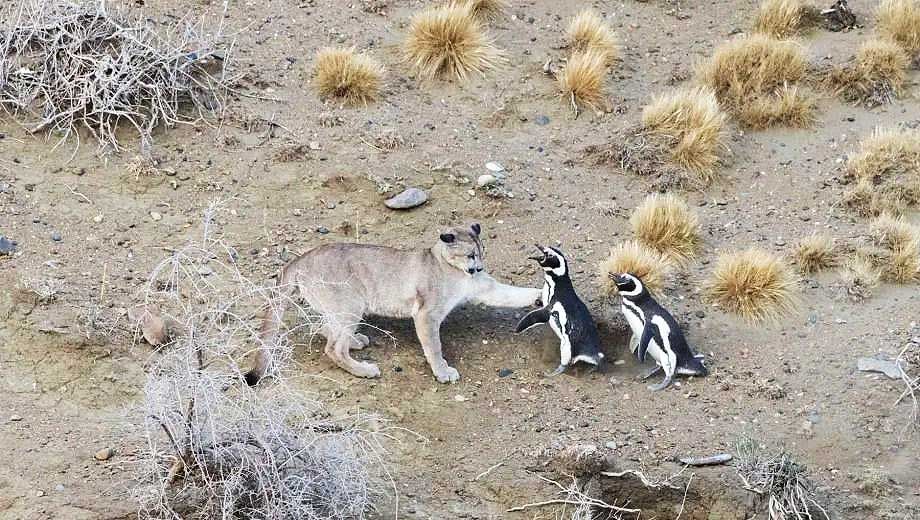
 A group of pumas in Monte León National Park, in Argentina's Santa Cruz province, has incorporated penguins as a regular part of its diet — an unprecedented phenomenon being studied by a National Geographic-funded scientific team, according to a report published by Argentine newspaper La Nación.
Biologist Emiliano Donadío, scientific director of Rewilding and head of the project, confirmed this is the first recorded instance of such intense interaction between the two species. Of the roughly 90 pumas inhabiting the park's surroundings, an initial estimate suggests about 65% have adopted the habit of hunting penguins during the breeding season, from October to March.
The dietary shift reflects a broader ecosystem transformation. Until the late twentieth century, the area was dominated by sheep ranching. At its peak between 1940 and 1960, the province held some 8 million sheep. Ranchers systematically hunted pumas and guanacos to protect their flocks, drastically reducing both populations. However, overgrazing eroded the vegetation and desertified much of the Patagonian steppe. More than 20% of the province's ranches are now abandoned, according to National Institute of Agricultural Technology (INTA) data.
The decline of sheep ranching and the park's creation — following philanthropist Douglas Tompkins' purchase of the estate in the late 1990s — allowed pumas and guanacos to recover. It also enabled penguins to colonize the continental coast, something that had not occurred previously due to predator presence. Historically, these birds nested on islands to avoid predation.
Donadío's team currently monitors 13 pumas fitted with GPS collars to study their movements and feeding patterns. Data show that pumas hunting penguins move significantly less in summer than those feeding exclusively on guanacos, as they have a fixed and abundant food source. However, the researcher says the predation does not threaten the penguin colony's survival.
The research also supports a broader hypothesis: the return of apex predators contributes to ecosystem health. According to Donadío, predation on herbivores like the guanaco allows grassland recovery, increasing photosynthesis and helping mitigate climate change. A similar dynamic was observed with the reintroduction of jaguars in the Iberá wetlands, where capybara populations dropped from 50 to 1 per square kilometer.
Local ranchers reject this view. Miguel O'Byrne, director of the Santa Cruz Agrarian Council, believes the park “killed whatever was left of economic activity.” Enrique Jameson, head of the provincial agricultural federation, proposes military intervention against guanacos and the opening of puma hunting grounds.
Donadío counters that eliminating native species “does not work” and advocates converting ranches into nature tourism destinations, with puma watching as the main attraction — an industry already established in Chile.


Top Comments
Disclaimer & comment rulesCommenting for this story is now closed.
If you have a Facebook account, become a fan and comment on our Facebook Page!