MercoPress. South Atlantic News Agency

Milei at the UN: “The Malvinas are a national cause for us”
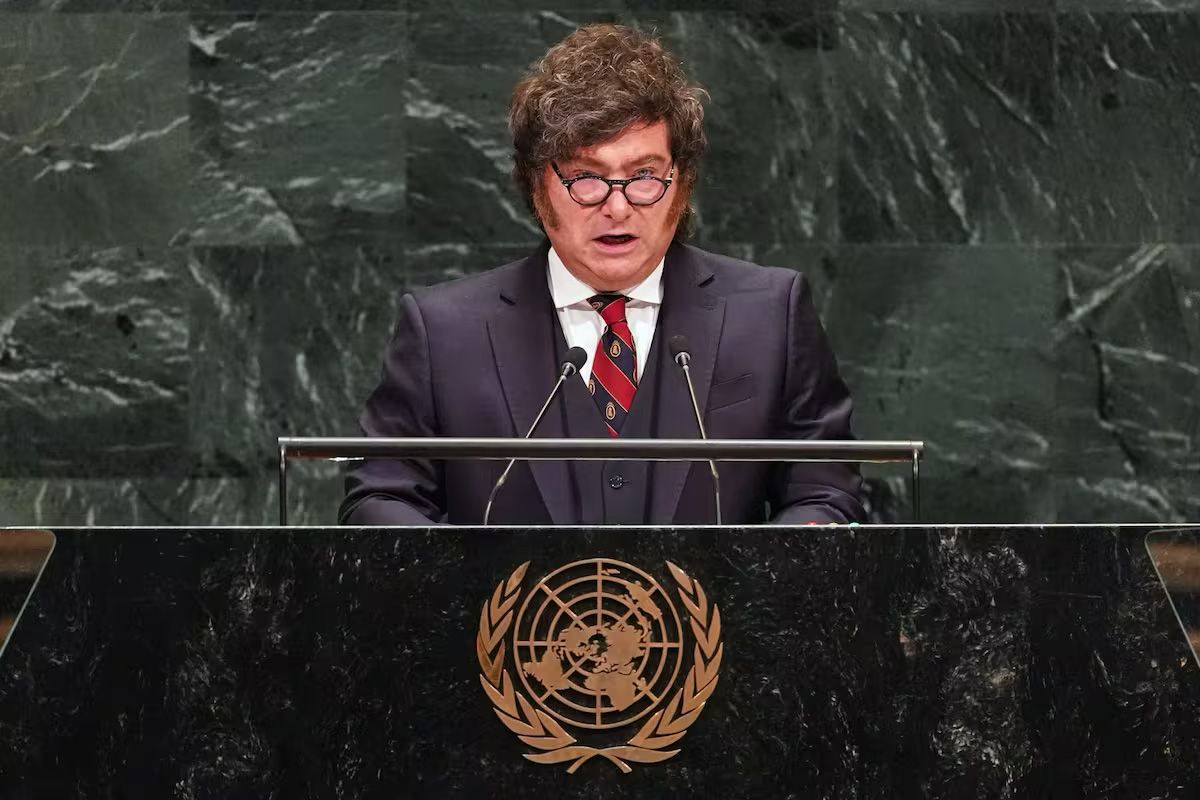 It was his third speech as president to the body and the eighth of the day's speakers, running 19 minutes
 Argentine President Javier Milei called on the United Nations General Assembly on Wednesday to act over what he described as unilateral British actions in the Falklands, and accused the organisation of having “decided to look the other way” on the dispute. “The Malvinas are a national cause for us,” he said, repeating the phrase twice at the start of his address.
It was his third speech as president to the body and the eighth of the day's speakers, running 19 minutes. Foreign Minister Pablo Quirno, Economy Minister Luis Caputo and UN Ambassador Francisco Tropepi listened from the floor.
Milei focused his criticism on non-compliance with Resolution 31/49, adopted in December 1976, which urges Argentina and the United Kingdom to refrain from introducing unilateral modifications while the dispute continues. “Fifty years later the situation has not changed, but the unilateral modifications continue,” he said, adding: “What use is a resolution if for decades the other party can act against it and that resolution remains intact in the archives but powerless before reality? There is no shortage of words or resolutions; what is missing is that they carry consequences.”
On the archipelago's population, he argued that the principle of self-determination does not apply “since this is a population implanted by the occupying power on a territory whose sovereignty is in dispute”, and said the Assembly itself has determined as much in numerous resolutions. That is Argentina's reading of those texts. The United Kingdom holds the opposite position: in his address on Tuesday, Prime Minister Andy Burnham said his country would stand firm against those who “threaten the rights of British territories to remain British, such as the Falkland Islands”. In the 2013 referendum, 99.8% of voters in the archipelago chose to retain the status of a British overseas territory.
Milei listed the measures taken: “We presented warning notices, we turned to the available legal tools, we sanctioned the companies involved and their suppliers, and we sent Congress a National Sovereignty Defence Bill.” According to official figures released so far, the foreign ministry has 60 administrative proceedings open with no penalty applied, three criminal complaints covering ten companies and their directors, and around 180 warning notices sent to individuals and companies in 30 countries. None of the allegations has been proven. He repeated the call on London to “resume negotiations to find a peaceful solution” and to exchange views on the exploitation of natural resources.
“Malvinas”:
— ¿Por qué es tendencia? (@porquetendencia) September 23, 2026
Por el reclamo de Javier Milei en la Asamblea General de la ONU pic.twitter.com/LX5iwTsBBB
Argentina had already responded to Burnham before the presidential address. Quirno exercised the right of reply before the plenary on Tuesday night, speaking for nearly three minutes alongside Tropepi: he reiterated Argentina's “full willingness” to resume bilateral negotiations and said the islands are “illegally occupied by the United Kingdom”. Asked whether the premier's remarks would require changes to Milei's speech, he said they would not, because “we already made the reply ourselves”. That same day, the foreign ministry delivered a formal protest note at the British embassy over the five-year extension of offshore oil licences, which it called an “unlawful act”.
Elsewhere in the speech, Milei described pandemic lockdown policies promoted by UN-affiliated bodies as “genocide”, saying they “cost the lives of millions of people who died alone”. It is an extreme and contested characterisation, made by the Argentine president.
On artificial intelligence, he announced that Argentina will not regulate pre-emptively and will offer “a cutting-edge legal framework”, with limited liability for companies and tax benefits, aligning with Donald Trump, who in Tuesday's address rejected any “globalist scheme” of regulation. Burnham, from the same podium on the same day, had called for the opposite: “a single set of global principles and standards”.

Top Comments
Disclaimer & comment rules-

-

-

Read all commentsStay of the drugs nitro, it was nothing more than the ramblings of a desperate man who is going to lose the election, the Falklands are not Argentinian and never have been, wake up and smell the coffee,
Sep 23rd, 2026 - 07:02 pm +2Yes “The Falklands” are a “National Cause” in Argentina. They are a convenient backstop to call out every time the people notice that something is not going the government's way.
Sep 24th, 2026 - 01:19 pm +2Unfortunately for Milei that is almost all the time.
But also unfortunately for Milei it is a LOST CAUSE.
They are only a national cause Milei because you choose to use as a deflection, just like all the previous governments, the Falklands exist and will always exist. your whole country needs to grow up, what ever happened 200 year a go is irrelevant, especially your made up fantasy,
Sep 24th, 2026 - 04:34 pm 0Commenting for this story is now closed.
If you have a Facebook account, become a fan and comment on our Facebook Page!