MercoPress. South Atlantic News Agency
Economy
-
Monday, July 14th 2014 - 23:26 UTC
Uruguayans believe government is on the right track, but performance is missing

A majority of Uruguayan believe the current government is on the right course but its performance is not satisfactory, according to a local public opinion poll from FACTUM. In effect seven out of ten agree with the course but the same percentages believe the performance is bad.
-
Monday, July 14th 2014 - 23:09 UTC
Paraguay's currency steadily becoming a 'strong' currency based on positive indicators

The Paraguayan currency, Guaraní, is expected to revalue 1.4% against the US dollar by the end of the year becoming one Latam's strongest given its positive macroeconomic indicators. This follows a strong performance during the first half of the year when the price of the dollar in the capital Asunción wholesale money exchanges dropped from 4.450 Guaraní to 4.240, according to private consultants “Consensus Economics”.
-
Monday, July 14th 2014 - 23:03 UTC
Mexico rapidly overtaking Brazil as Latam's leading auto producer

Pacific Alliance member Mexico is poised to overtake Brazil, the leading economy in Mercosur, as the top Latin American auto producer for the first time in more than a decade as surging exports to the U.S. spur factory openings and record output.
-
Monday, July 14th 2014 - 06:26 UTC
Promising scenario for European Union beef production and exports

European Union (EU) meat production is projected to start growing in 2014, according to the European Commission, as Europe’s economic recovery solidifies. This could represent an increase of 0.7% year-on-year for beef, veal, pork, poultry, sheep and goat meat.
-
Saturday, July 12th 2014 - 11:45 UTC
New state of the art bulk terminal in port of Montevideo in support of Nueva Palmira
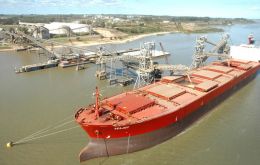
The Greek ship-owning Laskaridis family is investing in a new 100m dollars state-of-the-art grain and wood pellet terminal in Montevideo, Uruguay, adding to the already considerable Greek shipping presence in the country, reports London's Trade Winds.
-
Saturday, July 12th 2014 - 11:21 UTC
Holdouts claim the Argentine government refuses to negotiate with hedge funds

The holdout hedge fund Elliott Management Corp representative emerged on Friday from five hours of meetings in New York with a court-appointed mediator, claiming the Argentine government still refuses to have negotiation years after its historic default.
-
Saturday, July 12th 2014 - 11:00 UTC
Pollack's hope is that dialogue between holdouts and Argentina will continue

Argentine officials and holdout investors met separately with the New York court-appointed mediator or 'Special Master' for five hours on Friday, presenting their cases in hopes of resolving a litigation on defaulted bonds that has dragged on for years.
-
Saturday, July 12th 2014 - 10:13 UTC
CFK invites regional presidents to the official dinner for Russia's Putin

President Cristina Fernandez, CFK, invited her peers from Bolivia, Uruguay and Venezuela, Evo Morales, Jose Mujica and Nicolas Maduro respectively to participate in a special dinner after her meeting with the Russian head of state, Vladimir Putin on Saturday.
-
Friday, July 11th 2014 - 22:28 UTC
Falklands: Premier looking for a partner to develop the 5bn Sea Lion project

Premier Oil Plc newly appointed Chief Executive Officer Tony Durrant said that one of his priorities is to find a partner to share the 5bn dollar investment to develop the Sea Lion project off the Falkland Islands, because it does not want to become a 'pure Falkland Islands company in five years time'.
-
Friday, July 11th 2014 - 06:36 UTC
Brazil's next government will have to implement a tough fiscal tightening, says Fitch

Fitch Ratings on Thursday reaffirmed Brazil's “BBB” credit rating with a stable outlook, but added it expects the next government to control spending in order to avoid additional fiscal deterioration that could trigger a downgrade.

