MercoPress. South Atlantic News Agency
Economy
-
Tuesday, April 1st 2014 - 04:06 UTC
Bachelet sends corporate tax bill to Congress; first step for education reform
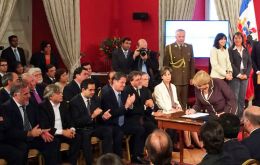
President Michelle Bachelet sent Chile's Congress a bill on Monday that would raise corporate taxes to fund a sweeping overhaul of the country's education system. The proposed reform aims to raise 8.2 billion dollars to fund tuition-free public universities, a demand that fueled massive student protests under Bachelet's conservative predecessor Sebastian Piñera.
-
Monday, March 31st 2014 - 19:42 UTC
Uruguay and Peru in line for a possible upgrading, according to Moody's
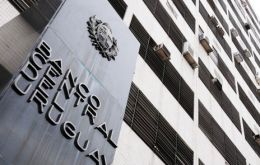
Uruguay and Peru are the first Latin American countries in line for a possible credit rating hike by Moody's Investors Service, at a moment when sovereign upgrades are expected to become more scarce in the region, a senior analyst with the ratings firm said.
-
Monday, March 31st 2014 - 19:28 UTC
Mercosur expects to exchange tariff-reduction proposals with EU next June

Mercosur expects to present a joint proposal regarding tariff reductions to the European Union during a meeting next June, according to Brazil's Minister of Development, Trade and Industry, Mauro Borges who apparently convinced a reluctant Argentina to join the group.
-
Monday, March 31st 2014 - 19:25 UTC
Brazil/Argentina agree on deal to promote bilateral trade by guaranteeing 'dollar liquidity'

Brazil and Argentina signed a deal over the weekend that seeks to guarantee importers will have enough U.S. dollars to pay for exports, a move to increase trade between both nations that has been hit hard by a sharp depreciation of the Argentine peso.
-
Monday, March 31st 2014 - 16:13 UTC
Latam forecasted to grow 3% this year, but fiscal deterioration is serious

Latin America and the Caribbean’s economy as a whole will grow by 3% this year and 3.3% in 2015 thanks to “improved economic conditions in the United States and Europe”, the Inter-American Development Bank said in a report released over the weekend.
-
Monday, March 31st 2014 - 12:01 UTC
Falklands reports record catches of Loligo and Illex squid
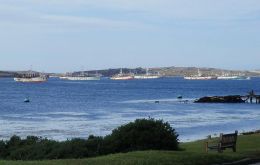
Falkland Islands is reporting record catches of Illex and Loligo squid this season. News first arrived last Sunday when it was announced that local jiggers had caught the highest daily catch and highest catch rate of Loligo squid since at least 2000.
-
Saturday, March 29th 2014 - 06:25 UTC
Falklands receives US oil company temporary dock facility for exploration operations
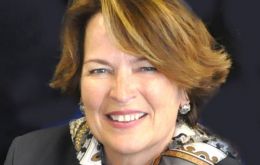
Houston based oil company Noble Energy expects to inject 4 million dollars into Falklands businesses with the construction of the temporary dock facility which arrived in the Islands this week, Senior Vice President Susan Cunningham told those attending a presentation in Stanley on Monday evening.
-
Saturday, March 29th 2014 - 06:11 UTC
Brazil's 2,3% growth in 2013 came as a surprise, even for Minister Mantega

Brazil's economy expanded 2.3% in 2013, compared with growth of 1% the previous year, the Brazilian Institute of Geography and Statistics, IBGE, said this week. The country's GDP for 2013 was estimated at 4.84 trillion Reais (some 2.05 trillion dollars), the IBGE said.
-
Saturday, March 29th 2014 - 05:46 UTC
Argentina takes EU biodiesel antidumping measures to WTO

Argentina formally requested the World Trade Organization's (WTO) Dispute Settlement Body (DSB) the establishment of a panel to address the European Union antidumping measures against Argentine bio-diesel. The initiative was rejected by the EU this week.
-
Saturday, March 29th 2014 - 05:43 UTC
Argentina denies the subsidies reduction will have an inflationary impact

Argentina's new subsidies’ scheme will have an “insignificant” impact on prices since the whole package basically involves a 'redistribution' of funds, argued Cabinet Chief Jorge Capitanich, emphasizing the decision aims at “encouraging the rational and responsible use of public services.”