MercoPress. South Atlantic News Agency
Economy
-
Saturday, December 18th 2010 - 19:04 UTC
Fiat targeting a production of over a million cars in Brazil
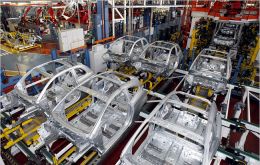
Fiat announced this week that it plans to invest 3 billion Real (approx. 1.7 billion USD) to build a second plant in Brazil, the carmaker’s No. 2 market after its native Italy.
-
Saturday, December 18th 2010 - 19:03 UTC
China targeting economic growth of 8% and 4% inflation for 2011

The Chinese government is targeting economic growth of around 8% and inflation of around 4% next year, state television reported this week, citing Zhang Ping, the head of the National Development and Reform Commission.
-
Saturday, December 18th 2010 - 18:39 UTC
Cars and construction spur Argentina industrial production 12.5% in November

Argentina's industrial production grew more than expected in November, on the back of big gains in automobile and construction materials output. Industrial production last month rose 12.5% on the year, and 4.1% in seasonally adjusted terms from October, the national statistics agency, Indec, reported Friday.
-
Saturday, December 18th 2010 - 18:30 UTC
Dragon and Elephant: complicated neighbourhood

*By Sameer Jafri - Year 2010 marks sixty years of diplomatic relationship between India and China. Though the relations between the two go back to ancient times, the period since 1950 till present is mainly fraught with boundary dispute, which also led to a short-lived war in 1962. But in recent times, both sides have successfully attempted to normalize the bilateral relationship, mainly driven by the mounting bilateral trade.
-
Saturday, December 18th 2010 - 09:02 UTC
UK, France, Germany join forces to freeze EU budget until end of the decade

British Prime Minister David Cameron has joined forces with France and Germany to demand a real-terms freeze in the European Union budget until the end of the decade.
-
Saturday, December 18th 2010 - 08:55 UTC
Obama signs bipartisan tax-cut bill resisted by hard core Democrats

United States president Barack Obama signed Friday into law an 858 billion US dollars bill extending for two years Bush-era tax cuts to boost a fragile economy and add jobs.
-
Saturday, December 18th 2010 - 00:22 UTC
Chilean Senators warn about ‘social impact’ of cheap US dollar for farm areas

Senators representing agricultural parts of Chile strongly criticized the Central Bank and President Sebastian Piñera this week for turning a deaf ear to the “social, cultural and economic problems” created by the falling value of the US dollar, now hovering at 470 pesos to the dollar.
-
Friday, December 17th 2010 - 23:04 UTC
IMF anticipates ‘soft-landing’ of Uruguay’s economy in next two years

The International Monetary Fund said economic growth in Uruguay will probably slow over the next two years, requiring policy makers to prepare for a “soft landing.”
-
Friday, December 17th 2010 - 22:43 UTC
Moody’s shocks EU: downgrades Irish debt five notches to Baa1

Moody's has downgraded debt-stricken Ireland by five notches just days after the Irish parliament approved a multi-billion euro international bailout.
-
Friday, December 17th 2010 - 07:05 UTC
Euro zone agrees (strict conditionality) bail out permanent mechanism

European Union leaders have agreed to set up a permanent mechanism to bail out any member state whose debt problems threaten the 16-nation Euro zone.