MercoPress. South Atlantic News Agency
Economy
-
Wednesday, July 8th 2026 - 07:10 UTC
Venezuela quake death toll reaches 3,685 as economists urge lifting of US sanctions

The death toll from the twin earthquakes that struck northern Venezuela on June 24 rose to at least 3,685, after another 150 fatalities were added to Monday's count, according to official figures. The number of injured held at 16,740 and that of people rescued at 6,462, while those who lost their homes rose to 17,907. Authorities present the data as provisional.
-
Thursday, July 2nd 2026 - 08:02 UTC
Argentina's country risk hits an eight-year low as rating upgrades lift dollar bonds

Argentina's country risk closed this week at 421 basis points, its lowest level in eight years, amid a strong recovery in dollar-denominated sovereign bonds driven by recent improvements in the country's credit rating. The indicator, compiled by the bank JP Morgan, reflects the premium Argentina must pay to borrow in dollars over US debt, considered risk-free.
-
Wednesday, July 1st 2026 - 08:26 UTC
Uruguay takes over the Mercosur presidency vowing to modernize and open the bloc

Uruguay's President Yamandú Orsi on Tuesday assumed the pro tempore presidency of Mercosur and set as a priority of his term to “keep modernizing” the bloc and consolidate its trade opening, following the provisional entry into force of the agreement with the European Union. “We want a more modern, more dynamic Mercosur, more open to the world, but above all a Mercosur that produces concrete results for its citizens,” he said as he received the rotating presidency from host Santiago Peña of Paraguay, at the 68th summit of heads of state held in Luque.
-
Tuesday, June 30th 2026 - 22:22 UTC
Mercosur turns to Asia with Japan talks as the EU quota split stays unresolved

Mercosur on Tuesday announced the start of trade negotiations with Japan and reaffirmed its intention to diversify alliances toward Asia during its biannual summit in Asunción, where Paraguay handed over the bloc's pro tempore presidency to Uruguay. The meeting, however, closed without an agreement on the internal distribution of export quotas under the treaty with the European Union, and again exposed the differences between Argentina and Brazil over the bloc's direction.
-
Tuesday, June 30th 2026 - 08:27 UTC
Argentina taps the local market to fund a $4.2 billion bondholder payment due July 9
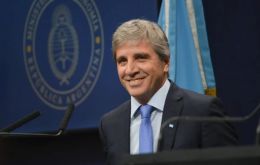
Argentina's Economy Ministry on Monday completed the placement of the Bonar 2028 (AO28), a dollar-denominated bond under local law, raising most of the funds needed to face a maturity of around $4.2 billion with private debt holders due on July 9. In the second round of the auction, the Finance Secretariat awarded $100 million, thereby reaching the authorized cap of $2 billion for that instrument.
-
Monday, June 29th 2026 - 08:30 UTC
Argentina's Pacific-pact bid would make it a trade partner of the UK, raising a Falklands dilemma
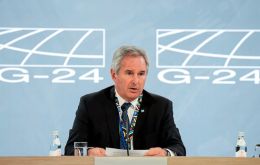
Argentina's request to join the Comprehensive and Progressive Agreement for Trans-Pacific Partnership (CPTPP) has reopened a question over its sovereignty claim to the Falklands, since the United Kingdom is a full member of that agreement. If it goes ahead, it would be the first trade pact of this magnitude, since the 1982 war, in which Argentina would share partner status with London outside traditional multilateral frameworks such as the United Nations or the World Trade Organization.
-
Tuesday, June 23rd 2026 - 05:43 UTC
Alan Greenspan, Fed chairman who served with four presidents and faced several recessions has died at 100

One of the most influential economic policymakers in the last four decades and chairman of the Federal Reserve for almost twenty years, under four different United States presidents from different parties, Alan Greenspan died this week at the age of 100.
-
Saturday, June 20th 2026 - 20:56 UTC
Tenth anniversary of Brexit, UK GDP per head cost of 8% in 2025, LSE professor estimates

Ten years ago, June 2016, the UK voted to leave the EU and since then, an extensive body of research has studied the impact of Brexit on the UK economy.
-
Saturday, June 20th 2026 - 06:28 UTC
Bank of England keeps rate at 3.75%; inflation 2.8% but energy prices remain volatile
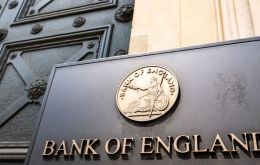
The Bank of England’s Monetary Policy Committee (MPC) voted by a majority of 7–2 to maintain Bank Rate at 3.75%. Two members voted to increase Bank Rate by 0.25 percentage points, to 4% during the MPC meeting on June 18.
-
Thursday, June 18th 2026 - 17:53 UTC
Brazil softens Selic rate but concerns grow about fiscal stimulus on election year and impact of El Niño

Brazil’s central bank interest rate-setting committee, Copom, unanimously voted on Wednesday to lower its benchmark Selic rate by 25 basis points to 14.25%, a level last seen in May 2025, but acknowledging a tougher inflation outlook given the risks from election-year fiscal stimulus and the impact of a likely El Nino weather pattern shock.