MercoPress. South Atlantic News Agency
Economy
-
Friday, January 22nd 2016 - 04:33 UTC
UK position on Falklands remains as expressed by 2013 referendum, Cameron tells Macri
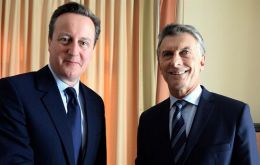
The United Kingdom government has released a statement pointing out the “three areas” British Prime Minister David Cameron and President Mauricio Macri “covered” during their Davos meeting on Thursday.
-
Friday, January 22nd 2016 - 04:15 UTC
US announced support for Argentina at multilateral development banks

The United States is ending its policy of opposing most lending to Argentina from multilateral development banks, the US Treasury Department announced. US Treasury Secretary Jack Lew informed Argentine Finance Minister Alfonso Prat-Gay of the move on Thursday when the two met in Davos, Switzerland, the department said in a statement.
-
Thursday, January 21st 2016 - 07:46 UTC
“Do not forget the poor” Francis tells the global economic elite in Davos

Pope Francis told members of the world's wealthy political and economic elite that they should not be deaf to the cry of the poor and must consider their own role in creating inequality. New technologies such as robotics must also not be allowed to replace humans with “soulless machines,” he said in a message to the World Economic Forum in Davos.
-
Thursday, January 21st 2016 - 07:33 UTC
Argentine Finance minister expected to meet IMF chief to renew formal ties
Argentine Finance Minister Alfonso Prat-Gay is planning to meet with IMF's Christine Lagarde at the World Economic Forum in Davos, Switzerland, to discuss resuming formal ties with the international lender, according to a report published by Bloomberg.
-
Thursday, January 21st 2016 - 07:24 UTC
Holdouts request postponement of Argentina's proposal to solve dispute

Representatives from holdout investment funds have requested the Argentine government to postpone until the first week of February, next week's scheduled proposal to overcome the country's debt situation which remains technically in default.
-
Thursday, January 21st 2016 - 07:13 UTC
In a surprise move, Brazil's central bank leaves interest rate unchanged at 14.25%
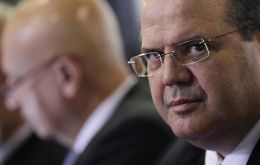
Recession-hit Brazil's central bank in a divided vote left the key interest rate untouched on Wednesday despite rising inflation, opting against an increase that could put a further brake on the world's seventh-biggest economy.
-
Tuesday, January 19th 2016 - 06:47 UTC
Bank of America anticipates strong devaluation for bankrupt Venezuela
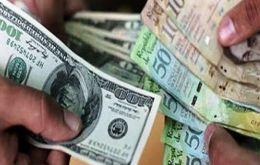
Bank of America predicted president Nicolas Maduro would merge Venezuela’s three-tier currency controls into two, replacing the strongest rate of 6.3 bolivars to the dollar with a level of 35. Greenbacks go for around 865 bolivars on the black market.
-
Monday, January 18th 2016 - 10:32 UTC
Oxfam claims the richest 1% has as much wealth as the rest of the world combined

The richest 1% now has as much wealth as the rest of the world combined, according to Oxfam. It uses data from Credit Suisse from October for the report, which urges leaders meeting in Davos this week to take action on inequality. Oxfam also calculated that the richest 62 people in the world had as much wealth as the poorest half of the global population.
-
Monday, January 18th 2016 - 08:36 UTC
Argentina new bills: Evita and Malvinas out, replaced by Andean deer and condor
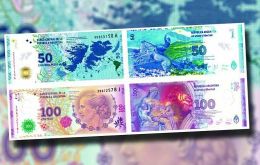
Inflation plagued Argentina will be issuing higher denomination bills and at the same time will avoid politics and history, concentrating on images of autochthonous fauna in danger of extinction. This means that the latest bills issued, 100 and 50 Pesos, with the image of Evita Peron, and Falklands/Malvinas and the notorious Gaucho Rivero, should quickly become collection pieces.
-
Monday, January 18th 2016 - 08:15 UTC
Petrobras increased pre-salt oil production by 56% during 2015

Brazil's state-controlled oil company Petrobras said it increased its crude production last year by 4.6% relative to 2014, exceeding the target set forth in its business plan for the first time in 13 years. Oil output in 2015 amounted to an average of 2.128 million barrels per day (bpd), up 0.15% from the 2.125 million bpd forecast by the company.