MercoPress. South Atlantic News Agency
Tag: Argentine Congress
-
Wednesday, February 25th 2015 - 05:37 UTC
Cristina Fernandez secluded to prepare her last 'State of the Nation' speech
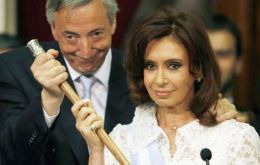
Argentine president Cristina Fernandez flew on Tuesday evening to Rio Gallegos, where according to the presidential agenda she will visit the mausoleum built by her to the memory of her late husband and former president Nestor Kirchner.
-
Thursday, December 5th 2013 - 14:44 UTC
Argentine government retains majority and initiative in new congress
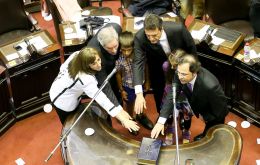
The 127 Argentine Lower House members who were elected in the 27 October midterm election took the oath of office during a ceremony in Congress on Wednesday which ensures the ruling coalition of President Cristina Fernandez the necessary votes for quorum and absolute majority.
-
Saturday, November 23rd 2013 - 06:40 UTC
Capitanich announces 50% tax on luxury goods and different rates for utility services
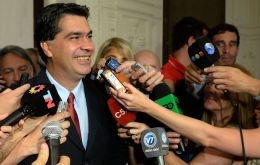
Argentine Cabinet Chief Jorge Capitanich announced on Friday the government sent a bill to Congress raising taxes on luxury goods such as premium model cars, recreation boats, motorbikes and aircraft, and underlined that ”those who want to buy luxury goods will have to pay more,” he warned.
-
Thursday, November 7th 2013 - 07:24 UTC
Argentina steps down from major air exercise in Brazil fearing repeat of flagship Libertad incident
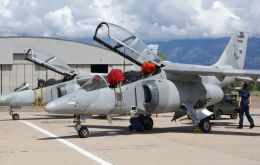
Argentina admitted that it stepped down at last minute from participating in South America's largest military air exercise in Brazil, Cruzex 2013 to avoid any possible injunction situations as that experienced by the Navy's three mast frigate that ended retained in a port of Ghana.
-
Monday, October 28th 2013 - 05:37 UTC
Argentine government retains congress; Massa and Macri confirm 2015 presidential ambition

Argentine President Cristina Fernandez's governing bloc held onto control of Congress in Sunday's mid-term elections, but the results also confirmed the emergence of a new group of powerful leaders who with different messages (and non-messages) anticipated on that same night that their target it the presidential chair in 2015.
-
Saturday, October 26th 2013 - 13:48 UTC
Sunday election, an anticipation for the 2015 post Cristina Fernandez chapter

Sunday's midterm election in Argentina has become crucial for the government of President Cristina Fernandez who must retain control of Congress in the last two years of her mandate ahead of the 2015 presidential election, otherwise she runs the risk of becoming a lame duck accompanied by a most unwished end for the legacy of the Kirchner couple decade-plus rule.
-
Tuesday, August 20th 2013 - 23:26 UTC
Malvinas debate: Ambassador Castro describes PM Cameron as ‘a fool and completely useless’
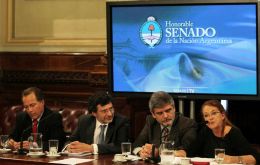
During a debate on the “Malvinas Question”, Argentine ambassador to the United Kingdom Alicia Castro launched a strong attack on Prime Minister David Cameron describing him as “a fool, dumb, and completely useless” politician, because of his comments when the election of Pope Francis.
-
Thursday, August 8th 2013 - 03:10 UTC
Argentina Electoral court urges Congress to revise laws on state advertising in campaign periods

Argentina’s National Electoral Court urged the Congress to revise the laws concerning state advertising in electoral periods so as not to benefit ruling party candidates. There have been several claims that President Cristina Fernandez is going over the line in supporting her candidates.
-
Thursday, March 14th 2013 - 08:58 UTC
Falkland Islands’ referendum vote blasted unanimously in both Houses of Argentina’s Congress

The Argentine Congress in extraordinary sessions held on Wednesday in both Houses unanimously rejected the Falkland Islands referendum in which the local population overwhelmingly decided to remain as a British Overseas Territory.
-
Wednesday, March 13th 2013 - 03:58 UTC
Falklands’ referendum to be condemned by Argentina’s congress two Houses

The Argentine congress is holding on Wednesday an extraordinary session to strongly reject the resounding Falklands/Malvinas referendum in which the Islanders overwhelmingly voted to remain a British Overseas Territory. Two statements have been drafted and will be discussed simultaneously at the Lower House and the Senate.