MercoPress. South Atlantic News Agency
Tag: Delcy Rodriguez
-
Thursday, June 25th 2026 - 09:04 UTC
Venezuela's earthquake toll rises to at least 164 dead and nearly 1,000 injured

The number of victims from the twin earthquake that struck north-central Venezuela rose to at least 164 dead and 971 injured, acting President Delcy Rodríguez reported on Thursday, warning that the figure would keep rising as rescue work progressed. The quakes, of magnitude 7.2 and 7.5, hit on Wednesday afternoon and left dozens of buildings collapsed across several regions of the country.
-
Thursday, June 25th 2026 - 05:59 UTC
Venezuela's earthquake tests US assistance to the interim government it helped install
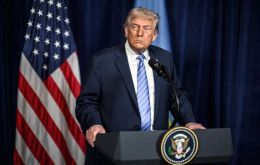
The twin earthquake that struck north-central Venezuela has become the first major test of US assistance to the interim government of Delcy Rodríguez, installed after the capture of former president Nicolás Maduro in a US military operation in January. Washington mobilized rescue teams and supplies for a country with which, until half a year ago, it maintained no cooperative relations.
-
Friday, June 19th 2026 - 06:49 UTC
US-backed opposition figure Figuera returns to Venezuela to negotiate a 'credible' electoral body
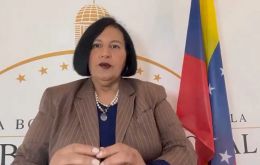
Opposition figure Dinorah Figuera, president of the National Assembly elected in 2015 and exiled in Spain for nearly eight years, returned to Venezuela on Thursday at the invitation of the US State Department to negotiate a “credible” electoral authority with Delcy Rodríguez's interim government. The return is part of Washington's plan for a democratic transition in the country.
-
Thursday, June 4th 2026 - 15:28 UTC
Venezuela moves to open its power sector to private investment after years of blackouts

Venezuela's National Assembly gave initial approval to a reform of the electricity law that opens the sector to private investment through long-term concessions, in an effort to reverse the collapse of a service battered by blackouts for two decades. The measure ends the monopoly held for more than 15 years by the state-owned National Electric Corporation (Corpoelec), though it still requires a second debate and final ratification in the coming days.
-
Saturday, May 16th 2026 - 03:25 UTC
Venezuela and World Bank agree to define technical cooperation areas after seven-year pause
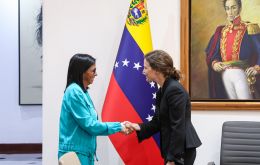
The Venezuelan government and the World Bank agreed on Friday in Caracas to work jointly on identifying concrete areas of technical cooperation, in the first high-level encounter between the two parties since the resumption of relations announced last month, which ended a seven-year pause in institutional contacts. The meeting was led by acting President Delcy Rodríguez, who received at the Miraflores Palace the World Bank's Vice President for Latin America and the Caribbean, Susana Cordeiro Guerra.
-
Monday, May 11th 2026 - 14:42 UTC
Delcy Rodríguez defends Essequibo claim at The Hague under temporary EU sanctions waiver
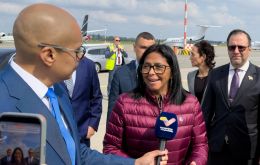
Venezuela's acting President Delcy Rodríguez arrived in the Netherlands on Sunday to defend her country's claim to the Essequibo, the border region disputed with Guyana, before the International Court of Justice (ICJ). The trip, authorized under a specific waiver to the European Union sanctions imposed on her, marks her first major international journey outside the Caribbean since the capture of President Nicolás Maduro by US forces in January, which paved the way for her to assume office as interim leader.
-
Friday, May 1st 2026 - 11:13 UTC
Caracas and Washington launch direct flights after seven years and sign two oil deals

The United States and Venezuela inaugurated on Thursday the first direct air connection between the two countries since 2019 and signed two new energy agreements, in a day the White House described as a substantive advance in the “economic revitalization” phase of the three-stage plan designed by President Donald Trump and Secretary of State Marco Rubio to reorganize the bilateral relationship following the capture of former president Nicolás Maduro by US troops on January 3.
-
Thursday, April 30th 2026 - 13:18 UTC
European Parliament urges sanctions on Venezuela to remain until verifiable democratic progress
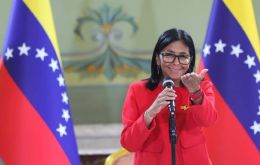
The European Parliament approved on Thursday, by a wide majority, a resolution urging the Council of the European Union not to lift sanctions imposed on those responsible for human rights violations in Venezuela until the country adopts “significant measures toward a peaceful transition to democracy.” The text, promoted by the European People's Party, gained 507 votes in favor, 31 against, and 35 abstentions, and was backed even by the Socialists and Democrats group despite internal divergences over the strategy toward the government of acting President Delcy Rodríguez.
-
Friday, April 24th 2026 - 11:31 UTC
Petro travels to Caracas to meet Delcy Rodríguez following failed Cúcuta summit
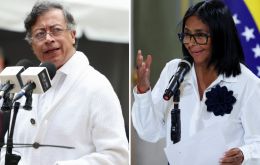
Colombian President Gustavo Petro will meet at midday on Friday in Caracas with Venezuela's acting President Delcy Rodríguez, in what marks the first official meeting between a head of state and the Venezuelan leader since she took office on January 5, following the capture of former president Nicolás Maduro in a US military operation on January 3 of this year.
-
Wednesday, April 22nd 2026 - 03:59 UTC
Milei drops to 14th among Latin American Presidents, ranks among region's five worst-rated

Argentine President Javier Milei fell to 14th place out of 18 leaders in the regional approval ranking for April 2026, consolidating his entry into the group of six worst-rated heads of state in Latin America. The survey, carried out by polling firm CB Global Data, registered a 36.2% positive image and a 59.7% negative reading, a 23.5-point gap that represents the widest imbalance since the start of his administration.