MercoPress. South Atlantic News Agency
Tag: Delcy Rodriguez
-
Monday, March 16th 2026 - 00:50 UTC
Former Chevron executive told CIA the opposition would struggle to control Venezuela

Ali Moshiri, Chevron’s former top executive for Venezuela and a longtime Washington interlocutor on energy matters, warned the CIA before Nicolás Maduro’s ouster that a direct handover of power to the opposition led by María Corina Machado could produce an unstable transition because she lacked control over the security apparatus and the state’s real power centers, according to a report published on Sunday. In that assessment, Moshiri recommended that the United States back Delcy Rodríguez as the more viable figure to manage the immediate succession.
-
Friday, March 13th 2026 - 03:12 UTC
Petro sends ministers to Caracas after meeting with Delcy Rodríguez is called off
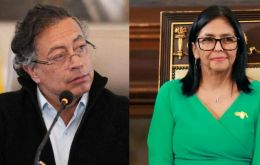
Colombia and Venezuela shifted their planned bilateral contact to the ministerial level on Friday after a presidential meeting announced for the border was abruptly canceled under the formula of “force majeure.” Instead of the face-to-face encounter scheduled between Gustavo Petro and Delcy Rodríguez at the Atanasio Girardot bridge, Bogotá sent a delegation to Caracas led by Foreign Minister Rosa Villavicencio and including the ministers of defense, trade, and mines and energy.
-
Thursday, March 12th 2026 - 02:50 UTC
U.S. formalizes before court its recognition of Delcy Rodríguez as Venezuela’s state authority
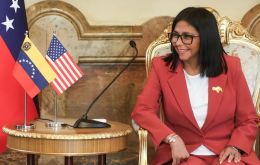
The U.S. government has formally recognized Delcy Rodríguez before a federal court in New York as the Venezuelan authority empowered to act on behalf of the state, giving legal effect to the diplomatic shift toward Caracas announced last week. The move appears in a “statement of interest” filed on March 10 in response to a court order on who legally represents Venezuela in ongoing litigation in U.S. courts.
-
Wednesday, March 11th 2026 - 14:23 UTC
Venezuela opens mining sector to foreign capital as US authorizes Minerven gold dealings
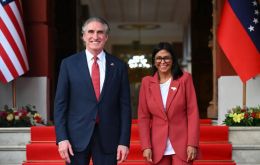
Venezuela this week took another step toward opening its extractive sector to foreign capital, while the United States authorized limited transactions involving Venezuelan gold. The National Assembly approved on first reading a mining reform pushed by Delcy Rodríguez’s interim government, as Washington issued a license allowing dealings with Minerven, Venezuela’s state gold company, just days after the two countries restored diplomatic and consular relations.
-
Friday, March 6th 2026 - 04:24 UTC
US and Venezuela restore diplomatic and consular ties after seven-year rupture
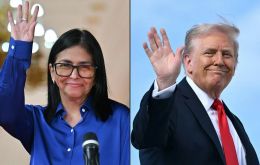
The United States and Venezuela’s interim authorities have agreed to restore diplomatic and consular relations, in a formal shift that ends a rupture dating back to 2019 and deepens the bilateral thaw that began after Nicolás Maduro was captured by U.S. forces in January. The announcement was made on Thursday by the State Department.
-
Wednesday, March 4th 2026 - 22:47 UTC
US interior secretary highlights Venezuela’s mineral wealth, says cooperation has “no limits”
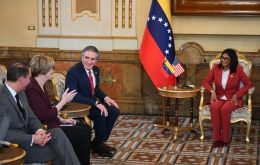
US Interior Secretary Doug Burgum said in Caracas on Wednesday that opportunities for cooperation between Washington and Venezuela “have no limits,” highlighting the South American country’s mineral potential during a visit focused on mining and access to critical minerals.
-
Wednesday, March 4th 2026 - 22:04 UTC
Released Argentine gendarme alleges “psychological torture” at Venezuela’s Rodeo I prison

Nahuel Gallo, the Argentine gendarme freed after 448 days in detention in Venezuela, urged the release of “24 foreign nationals” he said remain imprisoned at the Rodeo I facility and asked for time before detailing what he endured during captivity. “Until they release those 24 foreign nationals, I’m not free,” he said in a short statement to reporters, without taking questions.
-
Thursday, February 26th 2026 - 13:27 UTC
Latin America’s best- and worst-rated presidents in new poll: Bukele the best, Delcy the worst

El Salvador’s President Nayib Bukele tops a February 2026 regional ranking of Latin American leaders’ public approval, according to a survey by Argentina-based CB Consultora Opinión Pública. Bukele posts 72.6% approval and 24.8% disapproval.
-
Saturday, February 21st 2026 - 12:26 UTC
Venezuela sets fast-track protocol for amnesty as families wait for further releases
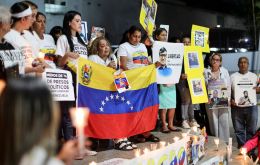
Venezuelan authorities approved on Friday a protocol to speed up implementation of an amnesty law passed the previous day by the National Assembly, as relatives of political detainees kept vigils outside several detention sites, calling for additional releases.
-
Friday, February 20th 2026 - 03:41 UTC
Venezuela passes unanimous amnesty law, excluding armed actions and serious crimes
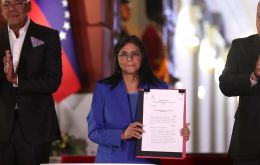
Venezuela’s National Assembly unanimously approved an amnesty law on Thursday aimed at covering people prosecuted or convicted in political-crisis episodes between 2002 and 2025, a measure lawmakers said is designed to speed releases and close related court cases. The bill was sent to the Miraflores presidential palace for enactment and would take effect once formally published.