MercoPress. South Atlantic News Agency
Tag: Donald Trump
-
Monday, March 23rd 2026 - 02:38 UTC
Iran threatens to destroy regional energy infrastructure after Trump's Hormuz ultimatum
Iran warned on Sunday that it will treat energy and oil infrastructure across the Middle East as “legitimate targets” if the United States attacks its power plants, responding to President Donald Trump's ultimatum issued late Saturday.
-
Saturday, March 21st 2026 - 22:08 UTC
US bolsters military presence in the Gulf with thousands of Marines and amphibious ships
The United States is deploying roughly 5,000 Marines and half a dozen warships toward the Persian Gulf in the largest force expansion since the war against Iran began on February 28. The buildup comes as American aircraft intensify strikes against Iranian positions along the coastline and islands of the Strait of Hormuz, the maritime chokepoint through which approximately 20% of global oil transits and which Iran has effectively closed since the start of the conflict.
-
Friday, March 20th 2026 - 16:16 UTC
Trump brands NATO allies “cowards” for refusing to help reopen the Strait of Hormuz
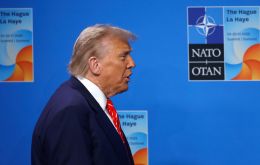
US President Donald Trump escalated his rhetoric against NATO allies on Friday, lambasting them as “cowards” for refusing to help reopen the Strait of Hormuz, the strategic waterway that has remained effectively closed since the start of the war with Iran. In a post on his Truth Social platform, Trump declared that without the US military, NATO amounts to nothing more than “a paper tiger,” and warned that Washington would not forget the alliance's stance.
-
Thursday, March 19th 2026 - 22:52 UTC
Trump jokes about Pearl Harbor in front of Japan’s prime minister during White House meeting

U.S. President Donald Trump made a joke about Pearl Harbor on Thursday during an Oval Office meeting with Japanese Prime Minister Sanae Takaichi, while answering a question about why Washington had not informed some allies in advance about its decision to strike Iran. The bilateral meeting was part of the White House’s official schedule for March 19.
-
Thursday, March 19th 2026 - 22:43 UTC
Netanyahu hints a ground phase may be needed as Iran war hits Gulf energy infrastructure
Israeli Prime Minister Benjamin Netanyahu suggested on Thursday that an air campaign alone would not be enough to bring down Iran’s regime, as the conflict entered a new phase marked by strikes on Gulf energy facilities and renewed warnings over the Strait of Hormuz.
-
Thursday, March 19th 2026 - 12:57 UTC
Western Democracies backsliding, with U.S. decline “unprecedented”

Democratic backsliding is now happening in well-established democracies. Democracy in the USA is deteriorating at unprecedented speed, and media and journalists are increasingly targeted across the world. This, and more, is reported in the latest Democracy Report from the V-Dem Institute at the University of Gothenburg.
-
Tuesday, March 17th 2026 - 22:31 UTC
US counterterrorism chief resigns over Iran war
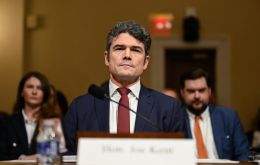
Joe Kent, director of the U.S. National Counterterrorism Center, resigned on Tuesday with immediate effect, saying he could not support Washington’s war against Iran in what became the first high-level public break inside Donald Trump’s national security apparatus since the offensive began. Kent said Tehran had posed no “imminent threat” to the United States.
-
Tuesday, March 17th 2026 - 22:15 UTC
Trump sharpens criticism of NATO after allies refuse to join Hormuz mission

U.S. President Donald Trump escalated his criticism of NATO and other allies on Tuesday after most of them rejected his request to send ships to help secure the Strait of Hormuz, the key waterway for Gulf energy exports. Speaking alongside Irish Prime Minister Micheál Martin, Trump called the refusal “a very foolish mistake” while also insisting Washington could proceed alone: “We don’t need help, actually.”
-
Tuesday, March 17th 2026 - 03:19 UTC
Trump says it would be “a great honor” to “take Cuba” as Washington presses Havana in talks
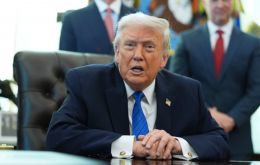
U.S. President Donald Trump sharply escalated his rhetoric toward Cuba on Monday, saying it would be “a great honor” for him to “take Cuba in some form” and that he can “do anything” he wants with the island. The comments came as Cuba was enduring a nationwide blackout and while bilateral contacts acknowledged by both governments since last week continued in the background.
-
Monday, March 16th 2026 - 16:14 UTC
Germany rejects sending ships to Hormuz as the EU seeks a diplomatic and logistical way forward
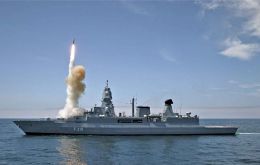
Germany on Monday rejected U.S. President Donald Trump’s request for allies to send warships to the Strait of Hormuz to help reopen the shipping route. Defence Minister Boris Pistorius questioned what “a handful” of European frigates could do that the U.S. Navy could not already do, and summed up Berlin’s position bluntly: “This is not our war.” Chancellor Friedrich Merz’s spokesperson added that the conflict “is not NATO’s war” and that Germany had no plans to be drawn into it.