MercoPress. South Atlantic News Agency
Tag: Donald Trump
-
Thursday, September 24th 2026 - 10:47 UTC
Delcy Rodríguez tells the UN there will be elections in Venezuela, without setting a date
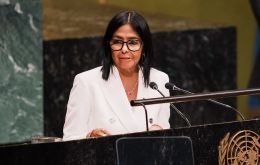
Venezuela's acting president, Delcy Rodríguez, announced on Wednesday before the United Nations General Assembly that her country will hold elections, without specifying when, and thanked US President Donald Trump for “his willingness to return to the path of diplomatic relations and cooperation”.
-
Wednesday, September 23rd 2026 - 08:55 UTC
Delcy Rodríguez calls her meeting with Trump “historic” and thanks him for his support
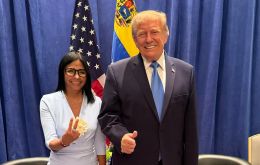
Venezuela's acting president, Delcy Rodríguez, described her first meeting with US President Donald Trump as “historic”. The encounter took place on Tuesday evening in New York behind closed doors and with no press access. Her post on the social network X is the only available account of what was discussed: the White House confirmed the meeting and those present but released no agenda or outcomes.
-
Tuesday, September 22nd 2026 - 19:45 UTC
Burnham says he raised the Falklands with Trump at their first meeting
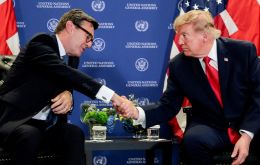
British Prime Minister Andy Burnham said on Tuesday that he raised the question of the Falklands with US President Donald Trump during their first meeting, held on the sidelines of the UN General Assembly in New York. “The Falklands we mentioned. And you were good enough to listen to us on those issues,” he told reporters. Trump made no public response on the archipelago.
-
Monday, September 21st 2026 - 10:15 UTC
Delcy Rodríguez arrives in New York for UN General Assembly, ahead of meeting with Trump
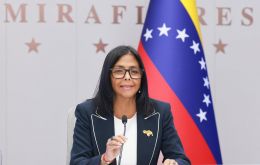
Venezuela's acting president, Delcy Rodríguez, arrived in New York in the early hours of Monday to take part in the 81st session of the UN General Assembly, days ahead of a planned meeting with US President Donald Trump on Tuesday.
-
Saturday, September 19th 2026 - 06:23 UTC
Trump and Delcy Rodríguez to meet in New York, first encounter with a Venezuelan leader in 11 years
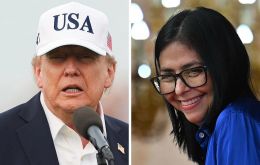
US President Donald Trump will meet on Tuesday with Venezuela's acting president, Delcy Rodríguez, on the sidelines of the UN General Assembly in New York, in what will be the first encounter between a US president and a Venezuelan leader in more than eleven years, since the brief meeting between Barack Obama and Nicolás Maduro at the Summit of the Americas in Panama in 2015.
-
Saturday, September 19th 2026 - 06:00 UTC
Trump announces ban on CNN, MS NOW and Politico at the White House, with no steps to enforce it
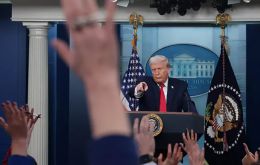
US President Donald Trump announced on Friday that he is barring CNN, MS NOW and Politico from the White House “effective immediately,” though by the end of the day there was no indication his administration had taken any step to implement it and reporters from the three outlets were still working at the presidential complex.
-
Thursday, September 17th 2026 - 15:01 UTC
Trump still has confidence in his Fed’s chairman, despite the rate increase to 4%
President Donald Trump said he has confidence in the recerntly appointed Federal Reserve chair Kevin Warsh and found a way to justify the central bank’s decision to increase the benchmark interest rate to 4%, the first since 2023.
-
Thursday, September 17th 2026 - 08:35 UTC
US removes Venezuela and Bolivia from list of countries failing on drugs
The United States government removed Venezuela and Bolivia from the category of countries that Washington says have failed to demonstrably combat international drug trafficking, while keeping Colombia, Afghanistan and Myanmar on that list. The determination, sent to Congress on Tuesday and released by the State Department on Wednesday, is part of the annual assessment of the 23 countries deemed major drug transit or producing states, five of which had been designated last year as having “failed demonstrably.”
-
Tuesday, September 15th 2026 - 07:39 UTC
Trump rejects calls to regulate AI and targets Anthropic's CEO
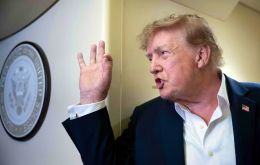
U.S. President Donald Trump on Monday rejected calls from the technology industry to slow the development of artificial intelligence, asserting that his administration holds broad criminal and regulatory powers over those companies.
-
Saturday, September 12th 2026 - 17:25 UTC
Trump says he could 'settle' any conflict over the Falklands, calling it a potential disaster
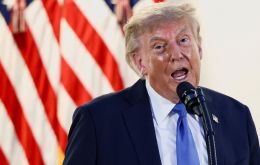
US President Donald Trump said in Dublin on Saturday that he expects to be called in if a new conflict breaks out between the United Kingdom and Argentina over the Falklands, which he described as a “potential disaster,” and said he would probably be able to settle it.