MercoPress. South Atlantic News Agency
Tag: Donald Trump
-
Thursday, July 23rd 2026 - 22:33 UTC
US rebuilds its tariff wall with forced-labor levies on 60 economies
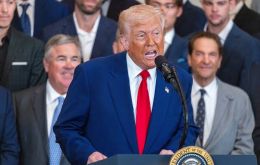
The United States imposed tariffs of between 10% and 12.5% on 60 trading partners, which together account for about 99% of its imports, over what the Office of the US Trade Representative (USTR) described as their failure to adopt and effectively enforce bans on the import of goods produced with forced labor. The measures, announced on Thursday, took effect at 12:01 a.m. on Friday, at the same moment the 10% universal tariff in place since February expired.
-
Thursday, July 23rd 2026 - 01:57 UTC
Foreign Secretary Ed Miliband, no friend of “Trumpism”, White House
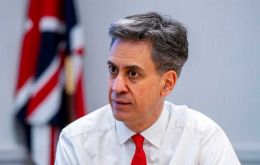
Reports from the United States indicate the White House has raised concerns about UK Premier Andy Burnham’s decision to appoint Ed Miliband as foreign secretary, amid warnings from the Donald Trump administration that he could create tensions in the UK-US relationship, according to reports Tuesday.
-
Wednesday, July 22nd 2026 - 22:26 UTC
Report says Trump is pushing Infantino to lead the UN
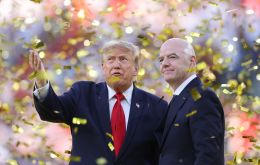
US President Donald Trump is promoting FIFA President Gianni Infantino as a candidate to succeed António Guterres at the head of the United Nations, according to the New York Post, which cited anonymous sources close to the White House. The information has not been officially confirmed by the US government or FIFA, and Infantino himself has not commented publicly.
-
Wednesday, July 22nd 2026 - 07:18 UTC
US readies tariffs on some 60 economies over forced labor, with Argentina among them
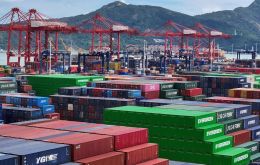
US Trade Representative Jamieson Greer said his government will announce new tariffs on some 60 economies in the coming days for failing to enforce bans on the import of goods produced with forced labor. “The US has laws to prohibit trading goods with forced labor. Other countries, most of them, don't have a law, and those that do really don't enforce it,” he said on Tuesday in an interview with CNBC.
-
Tuesday, July 21st 2026 - 07:16 UTC
PM Andy Burnham’s first conversation was with President Trump, whom he invited to visit Manchester
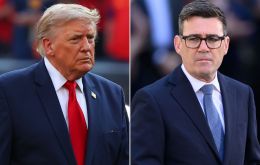
Prime Minister Andy Burnham spoke to the President of the United States, Donald Trump, shortly after taking office Monday afternoon, 20th July 2026. According to 10 Downing Street, the Prime Minister began by congratulating the President on a successful World Cup and agreed that England had an excellent tournament.
-
Sunday, July 19th 2026 - 23:05 UTC
Trump takes center stage at the World Cup final, presenting Spain's trophy and holding it beforehand
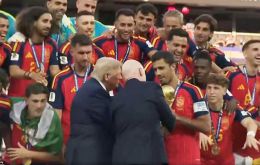
US President Donald Trump was one of the central figures off the pitch at the 2026 World Cup final, co-hosting alongside FIFA President Gianni Infantino the trophy presentation to Spain, champions after beating Argentina 1-0 in extra time at MetLife Stadium in New Jersey. Trump, who watched the match from the VIP box with his wife, Melania, also held the original trophy before kickoff, in images that circulated widely on social media.
-
Sunday, July 19th 2026 - 17:43 UTC
Lula asks Trump to explain 25% tariffs on Brazil, speaks of a “war of truth”

Brazilian President Luiz Inácio Lula da Silva publicly called on his US counterpart, Donald Trump, to explain the reasons behind the 25% tariffs he imposed on most Brazilian products, a measure Brasília attributes to political rather than commercial motives. The levies, announced on July 15 by the Office of the US Trade Representative, will take effect on July 22.
-
Friday, July 17th 2026 - 20:33 UTC
Balogun says he thought it was “a joke” when FIFA suspended his red card after Trump call
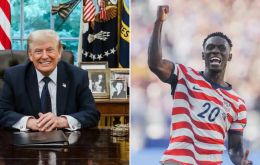
United States forward Folarin Balogun said he thought it was “a joke” when he was told FIFA had suspended the sanction for his red card, allowing him to play in the World Cup round-of-16 match against Belgium. “Two days before the Belgium match they told me I was allowed to play again, and for me it was unreal; at first I thought it was a joke,” the player said during a conversation with basketball star LeBron James at the Fanatics Fest in New York.
-
Friday, July 17th 2026 - 10:00 UTC
Trump accuses China of meddling in 2020 election, though intelligence findings say otherwise
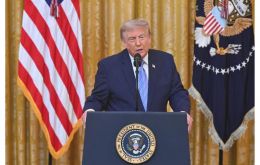
US President Donald Trump accused China of interfering in the 2020 presidential election and of having the complicity of officials who, he said, concealed that information. He did so on Thursday night in a primetime address to the nation from the White House, announcing the declassification of documents that he claimed reveal vulnerabilities in the US electoral system.
-
Tuesday, July 14th 2026 - 07:24 UTC
Trump says US is investigating whether Iran stores drones in Cuba
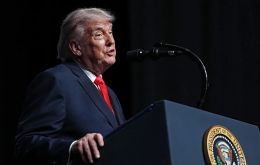
US President Donald Trump said on Monday that his government is investigating whether Iran is storing drones in Cuba and warned that Washington would act if their presence on the island is confirmed, though he framed the matter as a hypothesis that has not been verified.